Biodiversity: the Blog

How can I help you?

Saguaro cactus (Carnegeii gigantea) are rarely seen in the middle of wide open space. Instead, in the Pinnacate lava flows where this photo was taken, plants cluster, growing up under an adult which shelters delicate seedlings.

With all the conflicts in Egypt, Libya, and Wisconsin these last few weeks, I figure it’s time to briefly bid farewell to the little doom cloud floating over me and write about something entirely different:  positive interactions.

The Sonoran Desert is a pretty harsh place. I myself am already cursing my stupidity in setting up a field study that requires me to spend summers in Arizona instead of somewhere pleasant, like Colorado or Montana.

The heat and dryness is not so nice for little plants, or little mammals, like the furry-tailed woodrats or docile and bouncy kangaroo rats. Unfortunately for the Sonoran seedlings, the way rodents deal with their thirst is to eat off the juicy, green stalks. So between the sun, the drought, and the animals, desert plants have things pretty tough.

Okay, none of this has sounded like anti-doom cloud so far. Maybe because it’s 10 pm Friday night and I’m in my underground office, taking a break from work to write this blog.

But this is where nurse plants come in, and they are nice. If you have ever seen a saguaro cactus in its natural habitat, you will notice they are seldom growing out in the open by themselves. No, there usually lies near their majestic base the remains of a smaller shrub that sheltered them from the sun, increased the moisture in the soil, and hid the tiny, soft-spined cactus from the creatures that would devour it.

Some scientists named Brad Butterfield, Julio Betancourt, Ray Turner, and John Briggs recently studied how plants help one another out as nurse plants in Arizona. They found out that this is actually kind of a big deal for how populations grow or shrink here: adult plants shelter juveniles, helping them get established. The more it rains, the more these nurse plants help the little babies.

Of course, the downside is that all these little plants that germinate and establish then compete to the death with one another and their former nurse. But the facilitation – the positive interactions of plants sheltering one another – helps to protect the populations from the extreme variability of the weather and climate.

Want to know more about facilitation? Check out this paper by Jan Bowers and Elizabeth Pierson on how saguaro and other Sonoran Desert superstars get their start, or this more mathy one by R. Diaz-Sierra, M.A. Zavala, and M. Reitkurk.
NPR had a story yesterday about a fish called tomcod that are evolving to better survive the highly polluted environment of the Hudson River in New York. There are a lot of PCBs (stands for poly-chlorinated biphenyl) that end up in the Hudson. These molecules mimic hormones (substances in our bodies you can take pills for, like melatonin or estrogen), but don’t actually perform the roles of hormones. They are therefore called endocrine disruptors (or EDs).

Some of the fish in the population there are better at surviving the EDs than others because of the shapes of their proteins. These proteins are coded for by DNA, so it is called a genotype. Since DNA is what is passed on to offspring, and different forms of specific genes, or  alleles (like blue eyes vs. green eyes), make a difference in how well individuals survive and pass on their genes, we can measure evolution by the changes in how often one or another allele shows up in a population. (Actually, changes in allele frequency can also tell us about just random dumb luck – called drift or draft by evolutionary biologists – or small population effects, Allele frequency changes are cool.)

This story is a happy one for the tomcod – they’re surviving! There are downsides, though. The allele that makes them more resilient to PCBs makes them more sensitive to changes in oxygen or temperature. If you have ever had a pet goldfish, you know that matters to fish. It also means the PCBs can build up in the fish, which get eaten by other, larger fish, which find their way to sushi bars. Unfortunately, PCBs don’t seem to be good for people.

A new paper in the journal Science explains the molecular mechanisms of how these survivor fish do their thing.

This I Believe

Okay, this post isn’t strictly about my research, but it is about the other important step of science – getting the word out about what you found!

Next year, I will be supported in my graduate studies by the BioME fellowship, in which I will be teaching biology in a K-12 classroom. The actual grade is still TBD until June, but will probably be middle school. I volunteered for middle school because the Arizona state curriculum calls for topics that fit my research interests about then, but also because it’s a really important time in life for most people. For me, it was absolute hell, the low point of my entire life. Maybe that’s why I want to be there – I have some idea I can do it all over again, like Billy Madison. Whatever.

Point is, I had to write a short essay on my philosophy and beliefs about teaching last week, and I thought I’d share it here:

This I Believe

I believe that education is like running a marathon or writing a novel: you do it one step at a time, write one word at a time. Considering the whole of a curriculum for an untrained teacher like me can be overwhelming. But I recall a quote by St. Francis of Assisi, of all people: “Start by doing what is necessary, then what is possible, and suddenly you are doing the impossible.” I imagine taking one stride, then another. Soon a whole training run has passed. One word, then another, form a sentence which grows into a chapter. If I start by coming up with one concept, then an activity, soon – I hope – a lesson plan with take shape. Never losing sight of the big picture, tackling the planning day by day will grow to be a year of lessons.

Some days, one step may be just patiently coaching one student to finish an activity, giving her extra time to finish. Some days it may mean flashing the overhead projector around the ceiling or licking a dirty whiteboard eraser just to recapture the attention of sleepy students after lunch.

When I was in gradeschool, each assignment became its own challenge measuring success. I had to learn to read words, then sentences, then whole stories. In math classes, those seemingly interminable multiplication worksheets paid off with the ability to easily calculate tips and discounts in daily life.

While everyone has their own stride, some habits are less useful than others. There may be no right way to run or to learn, but there are unproductive ones. Those lead to dead ends and injury. It is as true for the students as for the teachers. For a struggling kid, every assignment that comes back with a failing grade stabs with the pain of a knee injury in mile 20, whether anyone can see it or not.

All those individual steps may sound intimidating, but I find comfort in them. It means that tripping up on any one step will not define the journey. For example, my Junior High math teacher, Mr. Peterson, stepped into a pothole one day. As he walked us through a story problem in our Geometry text book, he paused to mock the name the authors had chosen: Melvin.

As soon as he returned to the problem, a girl named Melanie raised her hand. “My dad’s name is Melvin,” she said when called on.

Mr. Peterson considered this for a moment.

“Is he a big guy?” he asked.

“Oh yeah,” said the boy next to Melanie, who was her friend. “And mean.”

Our teacher returned to the problem at hand, but before turning us loose with a problem set, he remarked that the name Melvin was growing on him. “I might even name my next kid Melvin,” he said.

“You’ve got fungus growing on you, too, Mr. Pete,” said Melanie’s friend. “But you wouldn’t name your kid that!”

Whatever Melanie’s dad’s name was, Mr. Peterson survived to tell the tale and I would swear he was the best math teacher I ever had.


Give me fever

Last night I suddenly came down with a bad fever. When I called my mom (a pharmacist) today, she told me in no uncertain terms to take Ibuprofen. But that might be bad advice. Why?

Over a decade ago, Randolph Nesse and George Williams published an article in Science interpreting disease in an evolutionary context. It’s a fun and fascinating read about not just the arms race between ourselves and pathogens that attack us, but the value of some symptoms we abhor, like fevers and morning sickness. A rise in body temperature, they argue, can quickly fry microorganisms and even deactivate viruses living inside you. As the famous biologist Theodosius Dobzhanksy once wrote, “nothing in biology makes sense except in the light of evolution.”

Two years before that (1996), Klugor and colleagues had reviewed several studies and also concluded that fever might be beneficial to the host (me) in defeating its pathogens (this #@&! virus). Research in this area continues, with Jane Carey’s literature review just last year on whether treating fevers in hospitals actually helped the patients. She found the results were inconclusive, but that it could actually prolong a patient’s stay.

I should point out that high fevers can be bad for the host! You can denature your own proteins. That’s bad. So if the fever is getting really high, it is probably a good idea to treat it. Was mine high enough to worry? I don’t know; I didn’t take my temperature. Not very scientific, I know. But I’m hoping that by letting the fever run its course and sleeping it off, I have decreased the time that I will be sick.

More bedbugs? Are they here to stay?

Bedbugs (Cimex lectularius)  were in the news in recent months for epidemic outbreaks in across the United States. A brand new study shows WHY they are even harder to kill than ever. Researchers at the Ohio State University sequenced the bedbug transcriptome, which means they isolated all the DNA that was being used by the bugs (there’s lots of “junk” in most genomes that is not transcribed, or used) and figured out the sequence of the nucleotides (the building blocks of the double helix). This has only recently become possible to do as quickly and cheaply as they did – and we’re still probably talking in the tens of thousands of dollars at least!

The researchers found a number of genes that detoxify pesticides being used frequently – much more frequently than a colony of bedbugs isolated since the 1970’s. This means the bedbugs have probably evolved higher pesticide resistance, which is why our usual pesticides aren’t getting rid of them easily anymore. Yikes!

Host-parasite interactions is the fancy ecologist word for what people and bedbugs are doing: they live on sucking human blood, we humans don’t like that, we try to kill or avoid them, and they try to get around our defenses. A LOT of research has been done both on the “arms race” of these systems (for example, we develop new pesticides and they develop new resistance) and to the ecological population dynamics on shorter time scales.

Some pairs of hosts and parasitoids have numbers that go in cycles, like spruce trees and budworms that attack them: the parasitoid feeds up on the hosts, killing them off, until the host population crashes. Since the parasitoids cannot find the hosts as well, their population declines, too. Then the hosts build up and it keeps going. Other pairs of species have surprisingly stable numbers, like the California red scale and a parasitoid introduced to control it. How these interactions function partly depends on the spatial scales of each species. Bedbugs seem to be good at dispersing with people traveling, and people are probably not going to decrease our population densities (move out of the cities) any time soon.

So are they here to stay? Given human ingenuity and our history of pesticide research, I bet we’ll come up with a defense. But sooner or later, the bed bugs will overcome that, too.

Why I hate long walks on the beach

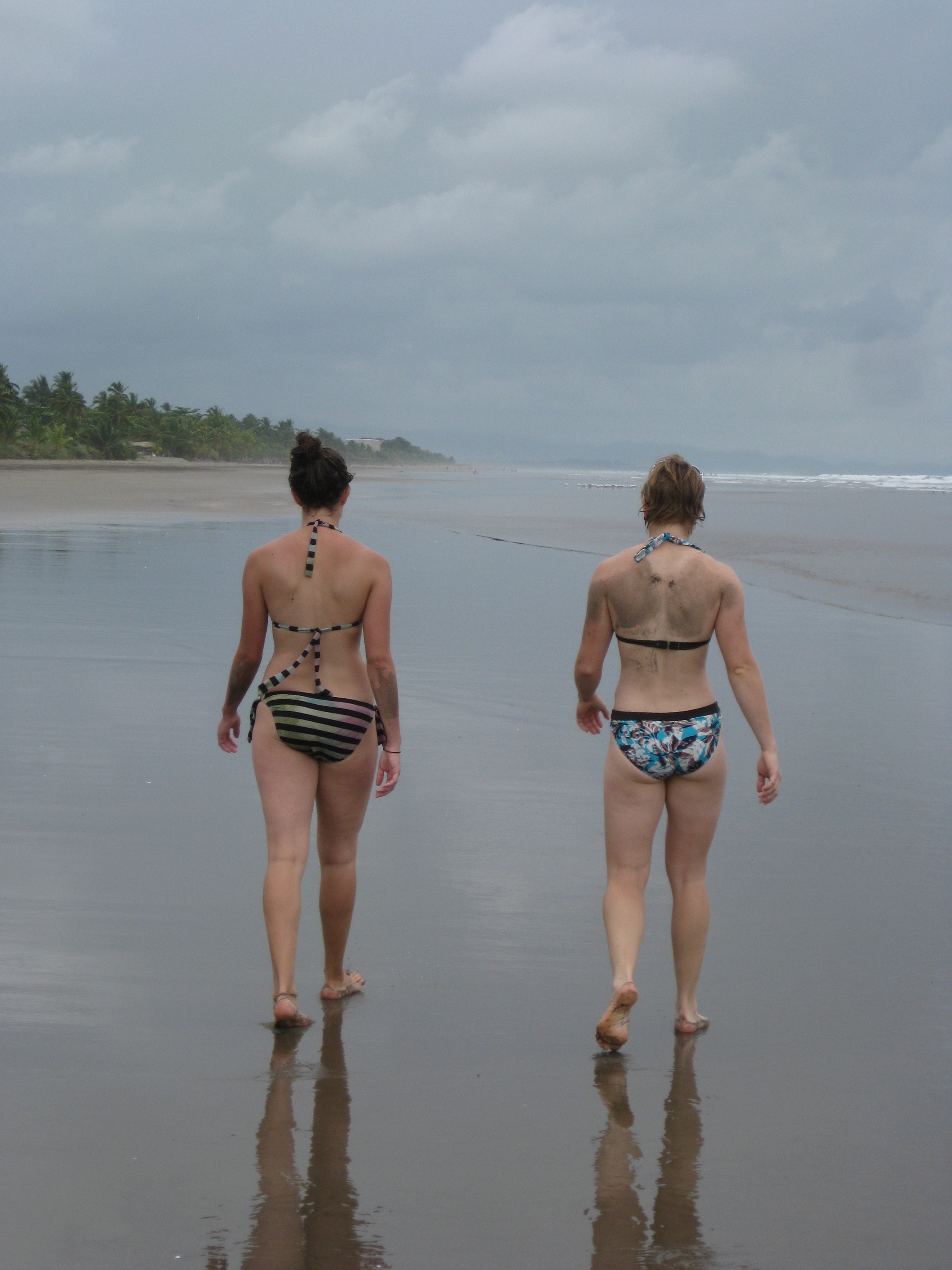
My sister and me on a long walk on the beach. I am clearly miserable.

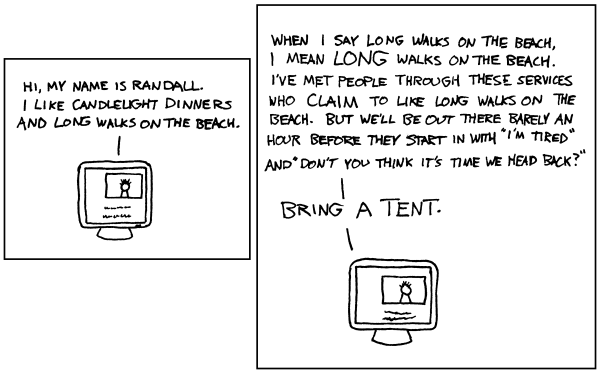
I have a confession to make: I don’t like long walks on the beach. It’s a classic line in a singles’ ad, but I just can’t make myself fit in there.

The problem is that I get bored. So I start looking around for things to entertain myself, and usually wind up with the local wildlife.

While visiting my sister for New Year’s in Panama, where she is a Peace Corps volunteer (more on her community and tropical agriculture later), we spent a few days at a nearby beach on the Pacific ocean.  I saw shorebirds like great white egrets and collared plovers and an unidentified species of sandpiper. I saw fiddler crabs abandoning their sand-rolling feeding as I approached to dash into their sandy burrows. I watched tiny green worms and snails inscribe mysterious and winding pathways as they bid farewell to each wave.

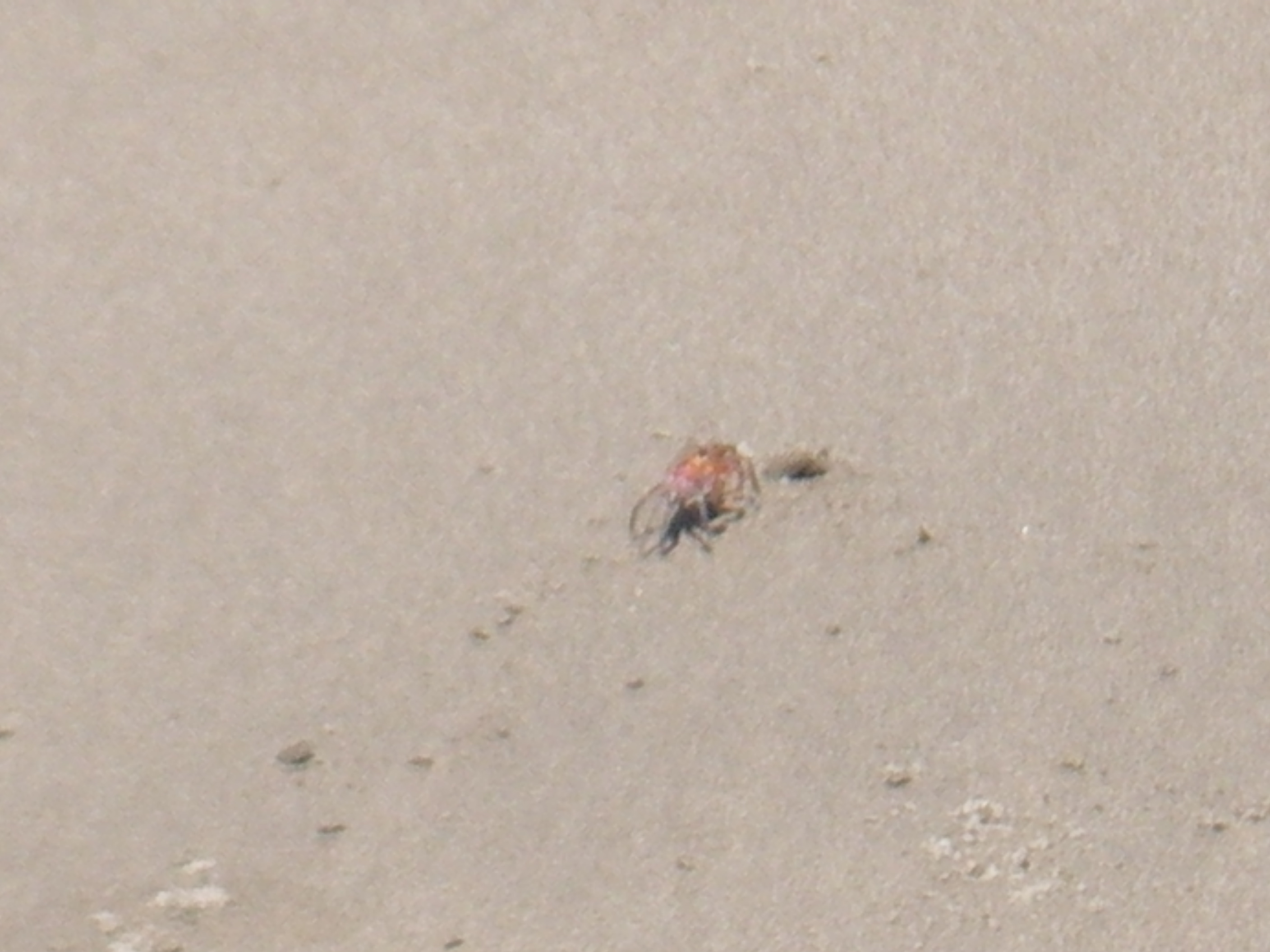
A fiddler crab about to enter its burrow. I know, I know: I need a better zoom on my camera. However, it is waterproof and relatively indestructible, which is better than a fancy zoom.

I could hypothesize that the birds eat the crabs or worms or snails based on their size difference and the behavior of the birds pecking at the sand, but it would take much more observation and experiments to prove it. In fact, a number of important ecological studies have been done on Pacific beaches.

In 1964, Robert Paine did just that: he spent a year observing and experimenting on the food webs on the Olympic Peninsula in Washington. He published an article in American Naturalist (a prestigious scientific, peer-reviewed journal) titled “Food Web Complexity and Species Diversity.” Paine described an experiment where he kept the purple ochre starfish (Pisaster ochraceus) out of an area for nearly a year. While the species of barnacles, tunicates, and shellfish it fed on remained the same in a neighboring plot, where the starfish was excluded things began to change. One of the barnacles, Balanus glandula, took over 60-80% of the space within a few months, leaving little room for less efficient competitors. But it did not stop there. By the next summer, two other barnacles (Mytilus californianus and Mitella polymerus), tiny and fast-growing, were displacing  everything else, even the B. glandula. Sponges and their nudibranch predators, algae, tunicates, and limpets all disappeared as well.

Trails from swimming snails and tiny green worms.

Paine was hardly the first to notice that predators had real effects on their prey’s populations – Aldo Leopold had written decades before of the trophic cascade that resulted when eliminating wolves in Arizona caused deer populations to explode and completely denude their mountainous habitat. Paine’s point was that the entire ecosystem became much less diverse in species and simpler in food webs without that top predator. This was a big deal in ecological thinking: that predation could change the outcome of species’ competition for space!

Of course, now we know that predation goes further than just changing competition: it can have an equal and equally important impact on species diversity. So now I am left wondering which, if any, predators on the Panamanian beach are preserving the diversity I managed to capture in just one, long, boring walk on the beach.

Most Mysterious

My mother posing with a larger sapling we suspect is Eastern white pine
Visiting my parents for the holidays, we went hiking around Bear Meadows in Rothrock State Forest (central Pennsylvania) a few days ago. As we emerged from the aggressively drooping forest of rhododendrons into stands of oak, pine, and other trees, I noticed large patches of what I think are Eastern white pine saplings. They may have been just a couple years old, and grew not in the clearings but under a fully thick canopy of oaks and other angiosperms (your word for the day – click on it to look it up!). I did not spot any other white pines in the immediate vicinity. I have read that there are active human restoration efforts to boost white pines’ numbers in Pennsylvania, but the placement of these saplings did not look human designed. For example, one would be right up next to an existing tree or shrub – clearly the root system of that other plant would have made digging a hole to plant the tree inconvenient.
This made me wonder:
-Which trees did the cones that grew here come from?
-Did those cones end up in a patch here, or are they scattered all throughout the forest? If they are scattered evenly everywhere, why did they only germinate and grow here?
-What combination of light, moisture, topography, and microorganisms in the soil made this a great spot for white pines?
-What eats pine cones and/or seedlings around here?
-Regardless of the environmental factors that make this quarter acre favorable to white pines this year, they are sure to experience competition with the other white pine saplings as they grow larger. Not all of them will survive. This kind of patchiness and lowered fitness of individuals in crowded places is a pattern we can see all over in nature. Even on a short afternoon walk through the woods.

More on space travel

As it’s almost 2011, it seems like a good time to continue considering space colonization. I posted below about a spaceship or colony like Biosphere 2, and how many species could survive indefinitely on it. Instead of more than three hundred species of rainforest tree, I imagine a dozen or fewer species could persist in the rainforest because their population sizes would be too small to avoid inbreeding or survive disasters. There are only so many trees that big you can fit into an area less than the size of a football field. From talking to students who do research in the rainforest (e.g. Ty Taylor currently in Scott Saleska’s lab), it sounds like about 400 is the high end of what you could pack in there, and fewer than that would persist even with good care. And that is assuming they get pollinated and make seeds at all – something people would have to help them out with in the absence of the right insects or wind.

Speaking of insects, you could fit a lot more species into the area and have reasonable population sizes, just because they are so much smaller. There are in fact a lot more insect species in the world than there are plants, too – is that for the same reason? Or are other factors, like the genetic structure and the forces that separate and shape populations at the root of such high insect diversity? Biologists are still studying that question.

So what else does thinking about little Biosphere 2 tell us about the big Biosphere all around us (Earth)? Well, assuming Earth is like an island with no immigration, a colony all alone in space, no new species are showing up and evolution happens verrrry slowly. In the meantime, some of the fast changes people are making, like chopping down the Amazon for soybean farms or cattle ranches, like building shopping malls and suburbs in the deserts, like introducing snakes and rats onto islands that have never seen such things – these fast changes are causing a lot of species to go extinct.

How many? Well, about 1% of the total described species. Considering that more than 99.9% of all species that ever existed are extinct, that’s really not a lot. Other people argue that we have only described a small proportion of the diversity in the Amazon, and are changing that habitat at really astonishing rates, causing hundreds to thousands of extinctions a year that we don’t even record.

Is there any reason to worry about this? Why not keep at least the handful of species we actually want – a few individuals in zoos if necessary? Barbara Kingsolver makes a compelling argument for diversity as an insurance policy against disaster and as the raw and holy creative potential invested in the world we live in. Others have described the process like a giant game of Jenga – all these species depend on one another and pulling out a piece at a time, we may eventually cause the structure we depend on to collapse.

Of course, if you live in a space capsule, you can build machines sufficient to produce oxygen, clean your water, fertilize your plants, and other services we get for free from nature in the Big Biosphere here on Earth. As a friend (thanks Gabriel!) pointed out to me, there are aeroponic crop options if you live in low to no gravity – no messy (or free) ecosystem services to worry about. Unfortunately for those of us busily buying things that destroy diversity here on earth, building our own replacements for those services on a planetary scale might be just too expensive.

Mars? No, this is a beach in the Galapagos. A permanent outpost on Mars might look like Biosphere 2, which we can imagine as an island.

A few weeks ago when NASA announced it had a big discovery (which turned out to be bacteria that can build themselves with arsenic – see below), it reminded us all how cool it would be to colonize space. Maybe we could start small with Mars. As Dirk Schulze-Makuch and Paul Davies suggested in an October article in Journal of Cosmology, we could make it financially feasible by sending people on one-way missions there.

That was kind of the idea behind building Biosphere 2 in the early 1990’s, as a mock-up for a self-sustaining colonial ship to  pace. And as we found out, that’s not so easy. And since University of Arizona agreed to take it over a few years ago, we have found out more about how the big biosphere, the one we live in, works as well.

This inspired the topic of the lecture I gave last weekend out at Biosphere 2. People are still counting how many species have survived the missions, the periods of disuse, Columbia University’s tenure, and the various management regimes throughout that. Ty Taylor, who is a grad student in my department (EEB), censused the plants left in the rainforest. He’ll publish that later, so this is just a teaser – he has cool results.

To get to an island, like in the Galapagos, plants and animals have to fly or float or swim or hitchhike. How would new plants or animals get to an island on Mars?

So how many species could last indefinitely in the different biomes of Biosphere 2? There are a lot fewer of some kinds than were originally introduced there in the 1990’s. Other species, like cockroaches, have moved in since it has been kept unsealed since then. We can imagine it like an island that has been cut off from its continent. Perhaps it used to be a penninsula, connected by a narrow bridge (or in this case, an open door). Then that last bit of rock, buffeted by waves, collapsed. Or in the case of a Biosphere 2 type rocket ship, it was sealed up and blasted off.

Two very famous ecologists, E. O. Wilson and Robert MacArthur, wrote about the Island Theory of Biogeography. This idea is that within a group of organisms – for example, trees or grasses or mammals – the larger the area, the more species will live there. It’s kind of an obvious point, right? You can have more types of rainforest size trees in 100 acres than you could in a quarter acre. On an island, new species show up periodically. They fly there or float there on logs. If there are enough of them surviving to make babies and their babies can make babies, a new population takes hold there. Because they all come from just a few individuals and the island habitat might be different from the environment where they evolved, eventually they look different than their ancestors. This is called adaptive radiation.

Lonsesome George is the last Galapagos tortoise from his island. He now lives a cushy life at the Charles Darwin Research Center on San Cristobal, where he meets a lot of lovely lady tortoises, but he doesn't seem to want to make babies with any of them.

But these new populations can go extinct, too. If there are only a couple of individuals to start the population, their offspring have no choice but to mate with cousins or siblings – yuck! Their offspring are inbred and do not survive as well. Or maybe the island is hit by a tsunami or a really cold winter and a whole population dies.

The Island Theory of Biogeography is the idea that larger islands can support more individuals, and so can support more species because their rate of arrival is higher than their rate of extinction. Islands that are closer to continents also have more species than islands the same size that are further away, simply because they get more new arrivals, regardless of their extinction rate. Robert Ricklefs and Eldredge Bermingham recently published a review of this idea.

So… an island the size of two and half football fields is pretty small for many Amazon trees to survive – and even smaller when you consider the rainforest is only part of that. Heck, it’s pretty small for human-sized animals to persist. And if you’re on Mars, there are pretty few new colonizations going on.

Would you go if offered the chance? What if you could take your family? What would you want to know before you did?

I’ll post next about how many species there are back on the mainland (Earth) and what this tells us about biodiversity here.

See You Saturday

How many species have been described by humans? (Hint: a quick Google search will get you some results, make sure you find the most legit!) Do we think we are anywhere close to describing them all? How could we tell?

How many species could survive inside Biosphere 2 indefinitely? What determines the number of species that can persist in a given environment?

Should we worry about the rate of extinctions? Can we build some Biosphere 3’s and 4’s in response to climate change and be okay?

I’ll be giving a talk at Biosphere 2 10:30 Saturday addressing these very questions. If you’ve been putting off that visit you always meant to take, this might be a good weekend.