Biodiversity: the Blog

What bike crashes and tarantulas have in common

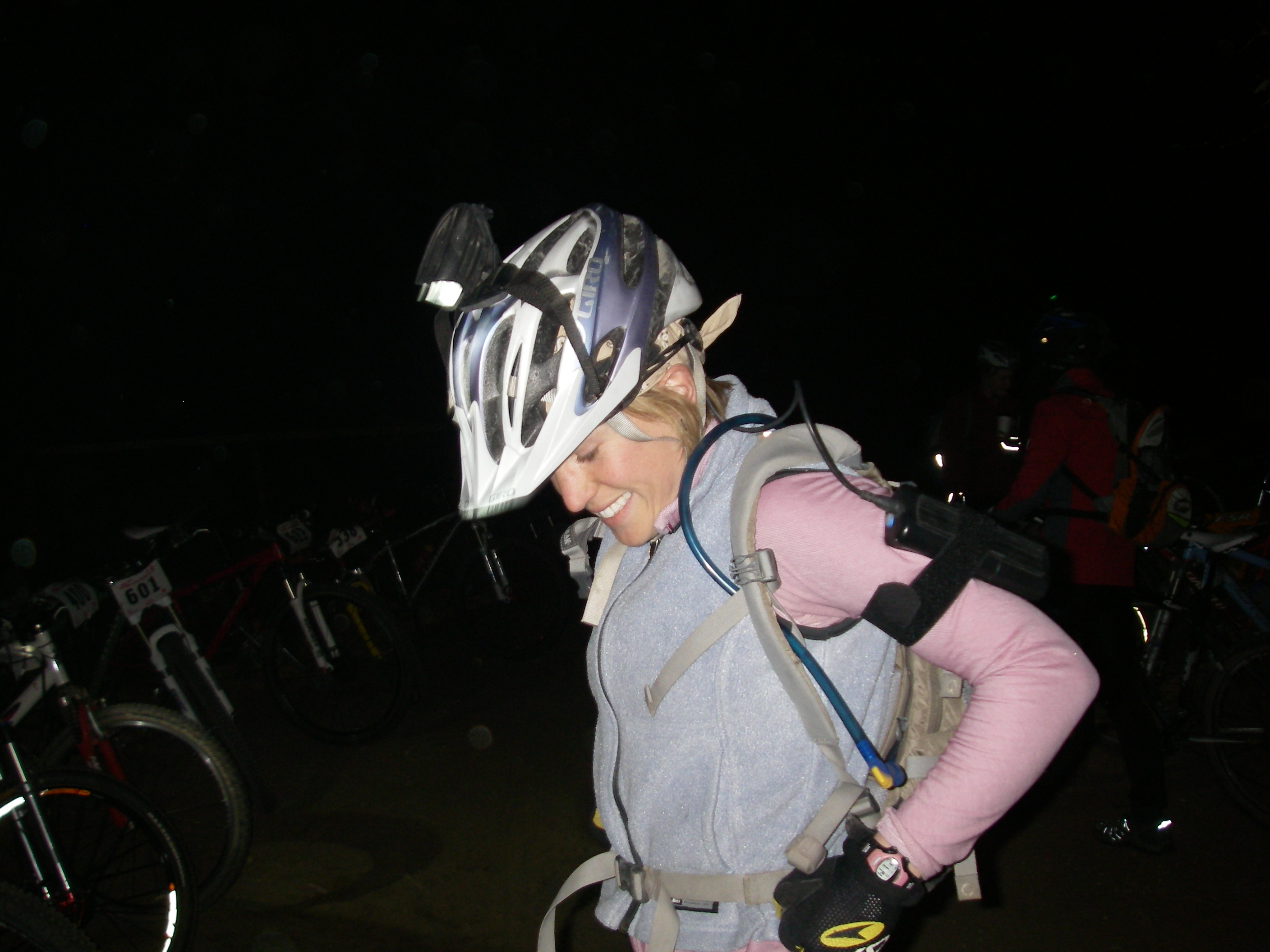
Here I am prepping for a night lap in a 24 hour race in February with my great big headlight. It's important to be a responsible mountain biker: stay on trails, don't ride them if they're wet and you will destroy them, brake for wildlife. Biking can have a negative impact on the environment, though nowhere near the impact motorized vehicles have off-road.

I recently went out into the desert after dark and bashed myself against the rocks for a few hours. By this I mean I went on a mountain bike ride. I had a good light; the problem really lay in my not having ridden on trails for six months and being off balance. I failed to hit any saguaro or other types of cactus, so I considered the night a major win.

Over the course of the ride, my riding companions and I stopped several times. Once was to observe from a safe distance the Mojave rattlesnake coiled at the side of the trail. Another stop or two were to observe male tarantulas crossing our path. I assume they were male because the males crawl out from their holes in force during late summer to wander in search of a mate. The third and longest break was to fix a broken bike chain. As I watched the others struggle with the chain tool that was produced, I tried and failed to discern what they were doing with it. Much like the tarantula with a nice deep hole and plenty of prey, if my chain were to break when I was out alone, having a chain tool would be insufficient to succeed in life. Just as he must find one more thing – a mate – in order to pass on his genes, were I to find myself with a broken chain and a tool to fix it, I would still need to hunt down someone who knew how to use the tool.

Okay, so that’s a bad analogy. But at least give me this: both of us are stranded in the Arizona desert with little to no water, and if we stay stranded alone for too long it can be bad for what biologists call “fitness” (and everyone else calls “the chance to have babies”). And both of us need more than one scarce resource to get de-stranded. In fact, if you break it down, we both need many resources over the course of our lives to survive and pass on our genes.

Pierson and Turner (1998) showed saguaro cactus populations grown in spurts when conditions are good. "Good" for a saguaro mean rain, temperatures above freezing, plenty of seeds landing under other plants ("nurse plants"). You can think of conditions being "not bad," meaning no freezing or drought, but that implies some kind of maximum that might not be realistic.

Tarantulas, people, and other animals all need shelter, need water, need energy and need nutrients. The iconic saguaro cacti I rode past last night need water and need nutrients, and when they are little baby cacti, they need shelter, too, from another plant (a nurse plant). Basically, plants and animals almost always compete for more than one resource. Elizabeth Pierson and Ray Turner found in a 1998 paper in the journal Ecology that saguaro populations have massive numbers of seedlings surviving in wet years without bad freezes. Some ecologists, like David Tilman, have looked at coexistence of several species as results of their limiting factors (Tilman 1990 in Oikos), where limiting factors might be water, or nurse plants. It’s sort of analogous to cooking: you have enough of everything except flour to make a full batch of cookies. So you have to limit yourself to a half batch.

However, the number of environmental factors (like temperature or humidity) that an animal or plant experiences, and the importance of each one, can make one daunting laundry list. That is why I prefer the approach Peter Chesson (as in his Annual Review of Ecology and Systematics article in 2000) takes in describing the “environmental response” of a plant or animal without specifying the environment necessarily. His models deal with the way growth rate changes based on the environment with some probability of a “favorable” year, whatever that may be, coming up so often, like your odds on a slot machine.

In the meantime, I think I will learn to repair a chain. Fun as slot machines may be, I’d rather have greater certainty in my ability to return from a bike ride than the gamble I can find that other individual out in the desert who can help me.
How to take candy and favors from your family and coworkers

Ask your favorite family member who is bad at math if they will take the following bet. (As a word to the wise, I would play with pennies, or M&Ms, or my personal favorite: chocolate covered espresso beans. Just make it something small just in case they look up Jensen’s Inequality and get mad. Or in case you lose, because there is some chance you will. The odds are in your favor in the long term, though, so if you do, find yourself another sucker. )

Here is what you say:

“I will pay you in chocolate covered espresso beans to roll a die, as long as you pay me based on your winnings. Since I know you like candy, let’s make it the square of the number. The average number rolled should be 3.5, and that squared is 12.25. Since you are my _____ (boss, little sister, etc.) and I want to be generous, and besides, we don’t want to quarter candies, I’ll pay you 13 beans for each roll. You just have to give me the square of what you roll. So if you roll a 2, you pay me 4 candies out of the 13. Do we have a deal?”

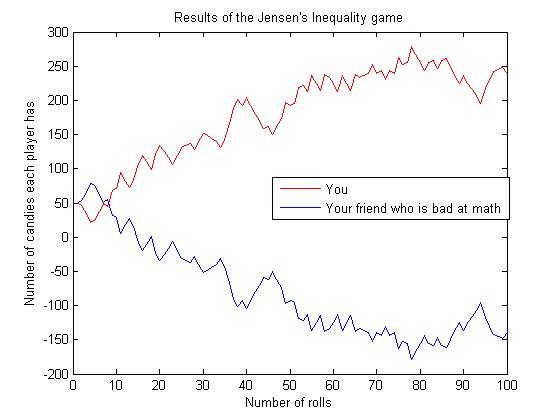
Try to get them to roll at least 10 times if you can. The more the better, because the long term odds are in your favor. Below I’ve graphed the outcome of one person playing another. Each starts out with 50 chocolate covered espresso beans. Red is the House (you) and blue is your favorite coworker who is bad at math. See how many candies you could win if you let your friend have 100 rolls of the dice?

The trick here is that you’re paying the square of the average roll (13ish), but the average of the squared rolls is higher! It is just over 15. Basically, you get so many more beans when you roll high that it more than makes up for all the lower rolls where you are playing your friend. This game illustrates, as I allude to above, a form of Jensen’s Inequality. What is unequal? The square of the averages is not equal to the average of the squares.

What if we are measuring something other than rolling dice?  The insects I wrote about in the last post essentially play this game against the environment. Imagine little bugs picking one of the ephemeral bedrock pools Galen studies, and laying its eggs there. Many of them are small, and dry up and the eggs bake. Sorry, bugs. This round you pay me more than I pay you.

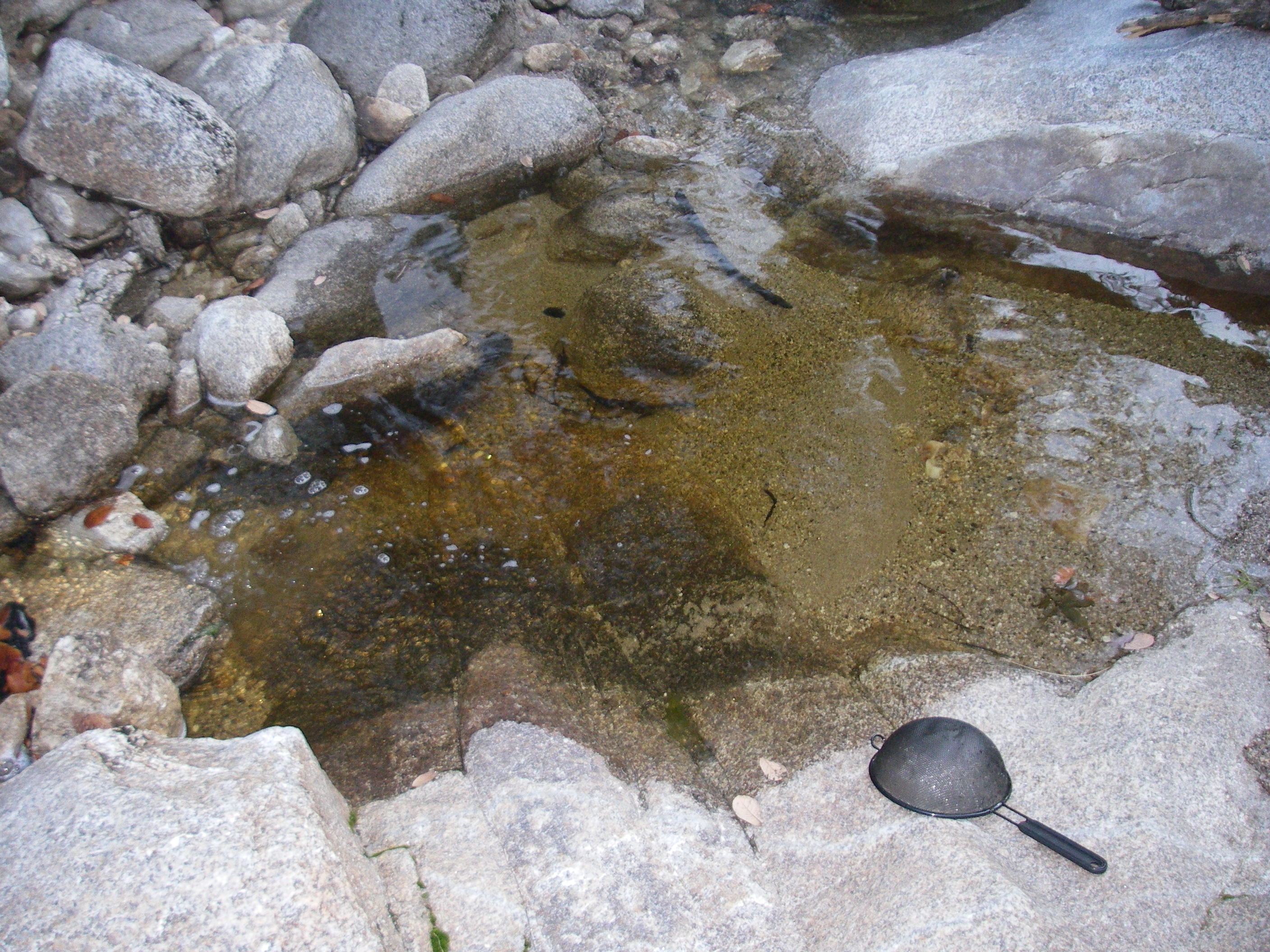
The kind of bedrock pool insects might lay their eggs in
The kind of plant that might wait underground for moisture to grow and reproduce

But…. When they do survive, and they hit a pool with few competitors and few predators and all of their hundreds or thousands or hundreds of thousands of offspring grow up and move out into their own pool and lay their own eggs, they win big. Kind of like rolling a six. This was well described in Peter Chesson and Robert Warner’s 1981 paper in the journal American Naturalist. This works for plants, too. Little seedlings wait in the baking Arizona earth as part of a seed bank, waiting for a winter thunderhead to explode above them, moisten the soil, and sound the starting gun for them to bust out of their seed covers and grow and reproduce like crazy. I’m not saying this happens for every species. Just that it can, and has been demonstrated for some, like in Anna Sears and Peter Chesson’s 2007 paper in Ecology.

The environmental variation is not the whole story. Bugs (and plants) play this kind of game against one another, too, essentially each one rolling their own die, paying the other. That gets more complicated.

Now go win yourself some chocolate covered espresso beans. With the resulting caffeine buzz, write a comment about how many people fell for it.

[Note: huge thanks to Simon for feedback on the game design!!]

That’s it

What if your life and your children depended on living in water, but every so often the pool you were living in dried up? Maybe it was no more than a puddle, and, though part of a flowing stream after every good rain, between storms just disappeared – sometimes? Let’s say you’re an insect, and you have wings to fly off in search of other water, but your offspring won’t for a month or two. Why would you ever lay your eggs somewhere so risky?

In my last post, I wrote about how the landscape we live in, even a city block, is full of good patches and bad. What makes a spot “good” or “bad” to a dandelion or a dragonfly depends on their individual needs: a dragonfly needs water and plants to land on and other insects to eat, while a dandelion needs soil and light and of course some water, too. But the number of other conspecifics (other dragonflies or dandelions) they have to compete with can also make a patch better or worse.

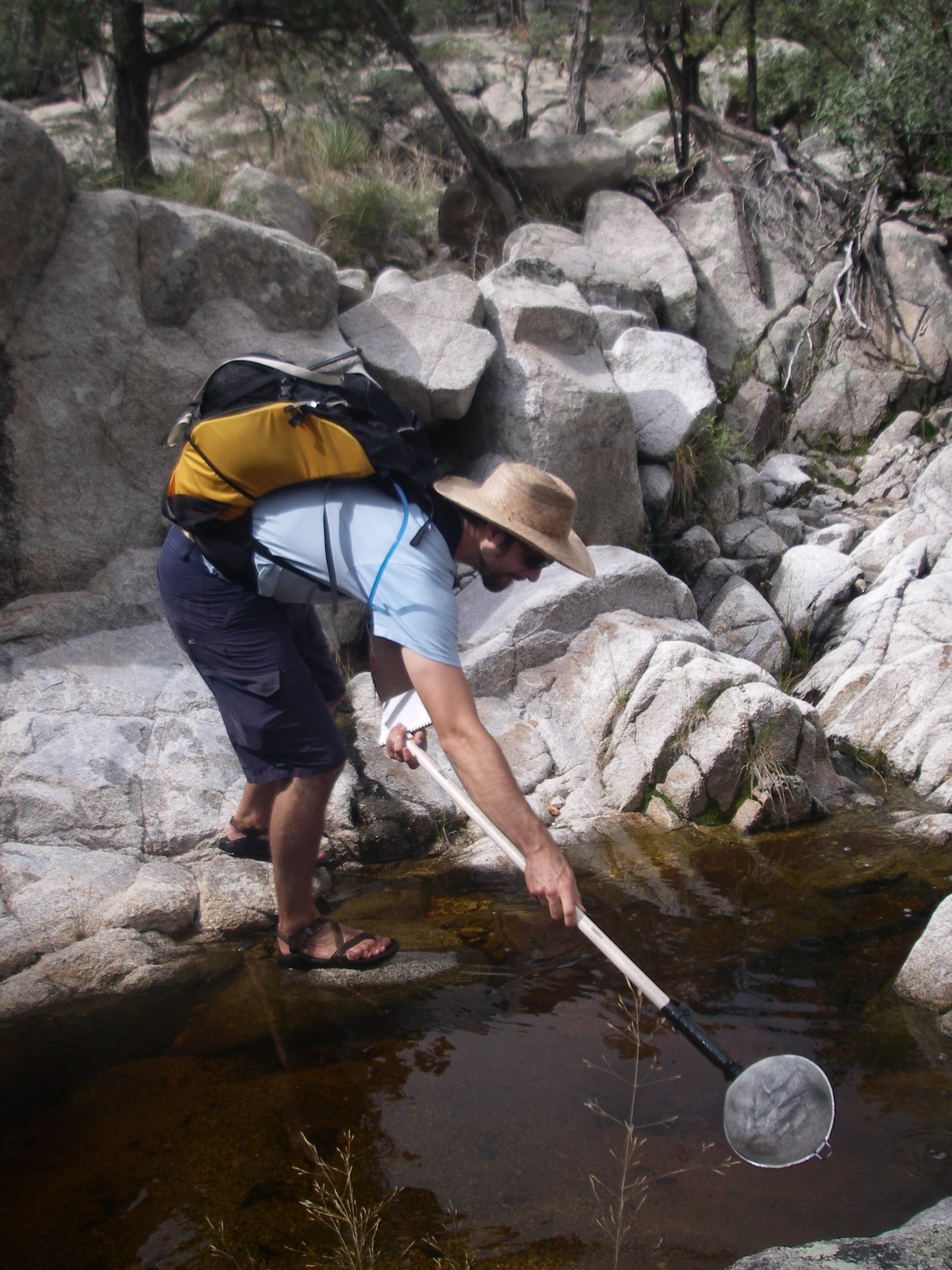
Galen catches something in one of his larger pools.

Besides wanting to understand life, the universe, and everything, I want to be a biologist because I like being outside. So I was excited to help another student in my lab with field work last week. Galen studies stream ecology on Mount Lemmon, the tallest mountain overlooking Tucson in the Santa Catalina range to the north. Specifically, he studies the response to environment and competition in several kinds of aquatic insects. That sounds like a mouthful, so I’ll just summarize that he counts backswimmers and water striders up and down these mountain creeks.

I am planning to study these communities of aquatic insects, too, because they are crazy cool. First of all, they have short life spans compared to a PhD timescale (a few weeks to a few years), and are really small, and live in small little pools, so it’s easy-ish to study their population dynamics. Well, easier than studying lions and hyenas on the African savanna anyway, since I can just box these guys up in a kiddie pool or aquarium and watch to see what happens.

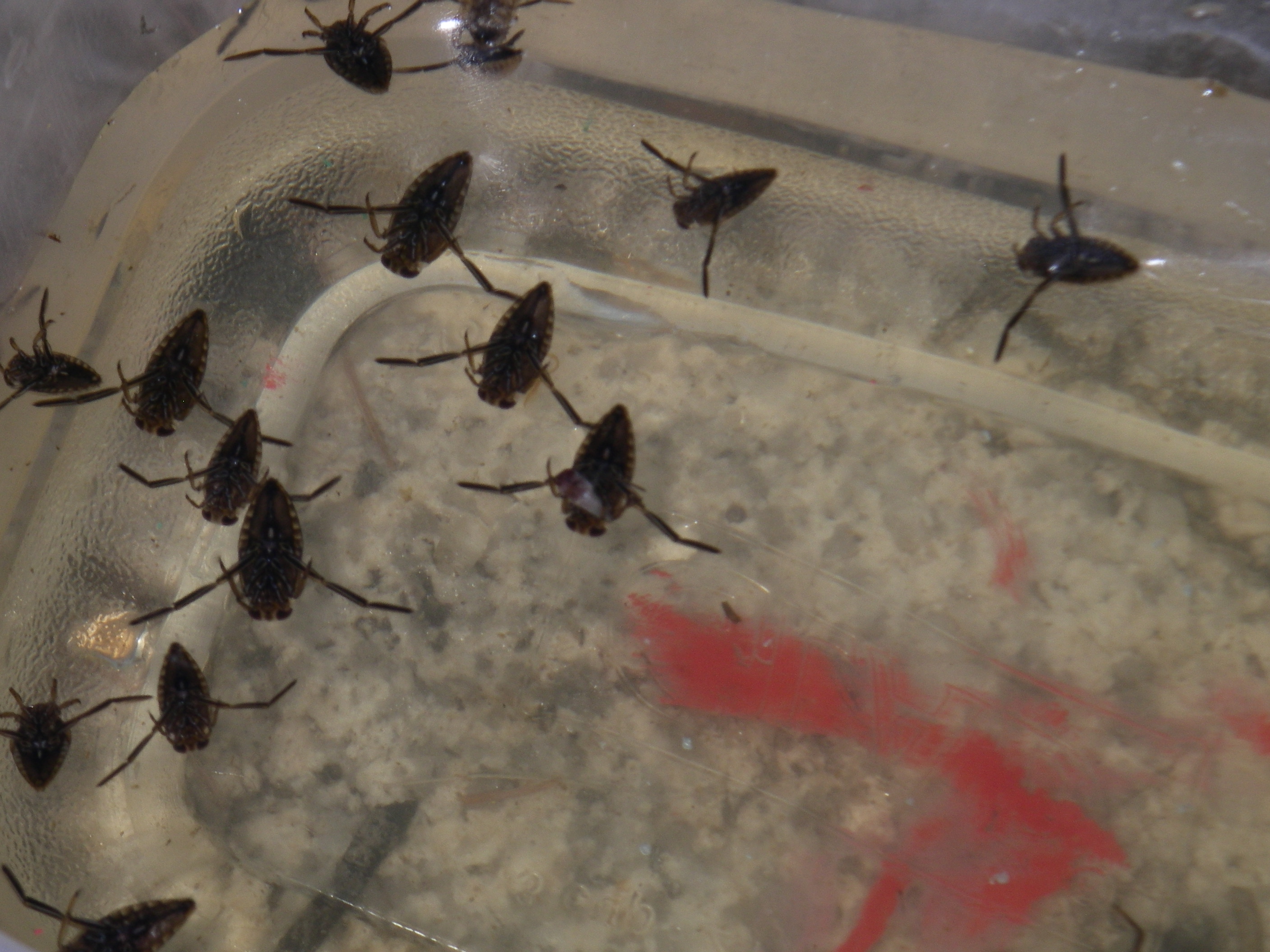
Backswimmers in Tupperware
Backswimmers (Notonectidae, 1-3 different species pictured here) waiting to be identified and counted
The round things clinging to the rocks below the pine needles are the males of the giant water bugs (Abedus herberti), who carry a raft of eggs on their backs until they hatch. The proud new daddies refrain from eating for about a week, then even their own young are fair game as prey for these voracious predators!

But if you get down on your hands and knees, these guys are no less spectacular than crocodiles and elephants. You ever have backswimmers invade your pool? Did they bite you? They haven’t gotten me yet (I scoop them up in a net and let Galen do the handling), but I hear the notonectids (science-y name for backswimmers) pack a punch that’s not as teeny tiny as they look. Then there are the “toebiters,” also known as giant water bugs, like Abedus herberti (that last year’s Biosphere 2 fellow Chris Goforth studies and blogs about here). Brilliantly colored sunburst beetles (Thermonectus marmoratus) bustle around the rocky beds of these glorified puddles. What is their business? What are they eating? Above them, water striders (Gerridae) skim the surface.

Underwater photo of sunburst diving beetle (Thermonectus mamoratus)
Two water striders (Gerridae) that have been marked white and blue to indicate the pool they were captured in. Just below and to the left of the bottom one, you can make out a backswimmer lurking beneath the surface - the striders better watch out!

Beyond the alien-like life forms fighting their daily battles in the pools, liquefying and sucking the guts out of one another, these streams perfectly illustrate the variability I wrote about last time. While after a good rain, water cascades over the Gneiss bedrock like designer waterfalls, most of the time it seems these “streams” dry up into a series of puddles. Some are the size of a hot tub, while others are hardly larger than a pot you would boil spaghetti in. Some are shaded by trees, others bake in direct sunlight, surrounded by bare rock radiating heat back. (Those are absolutely unbearable to count bugs in on a hot summer day, even at the higher elevation.) Some are full of fallen trees, grass, or algae, and others are nearly empty.

But these pools also change from week to week, from year to year. Last year, Galen picked a bunch to monitor, counting the insect inhabitants regularly. He tried to pick some that he thought were permanent, and some that were ephemeral, or dried up entirely rather frequently. (Note for geeks: he did this by dividing all the pools into these categories of permanence and elevation, then randomly selecting a percentage of each of them using a computer random number generator I think. That’s called a block design. It’s very important to prevent researcher bias in experimental design by doing things like flipping coins or using random numbers. Human beings are inherently nonrandom, however random, say, your parents may seem sometimes.)

This year, however, the pools are behaving totally differently. Pools that were always dry last year now boast water after weeks without rain. Ecologists call this spatio-temporal variability, and it can help promote coexistence, just like the spatial variability I wrote about in the last post, although as you can imagine, it gets more complicated when you consider that fourth dimension (time). Spatio-temporal variability and its effects on community structure is what my adviser specializes in, and it’s the title of the class I am taking from him this fall.

So why risk the variability when you could opt for a more consistently safe environment? Maybe it’s a case of high risk bringing high reward. A small pool may dry up, but if it lasts, your offspring may have it all to themselves, low competition, low predation. For species with buffered population growth (a relatively long adult lifespan, or a seed bank, or something else that keeps them around), a good year can help more than a bad year hurts. That’s one condition for the storage effect my lab studies. Hopefully Galen can enlighten us in the next couple years about what’s really going on with these pools.

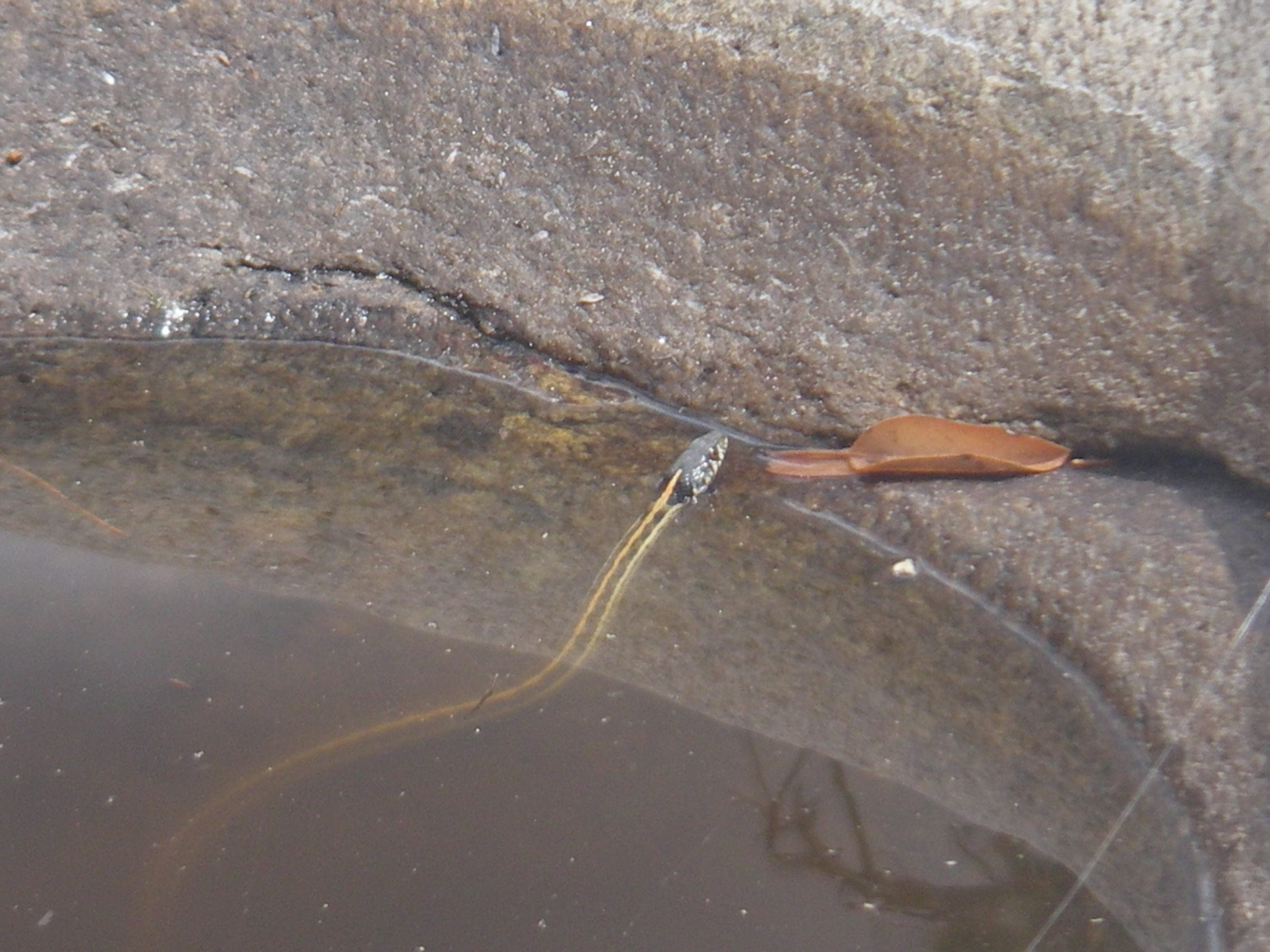
A small garter snake chills out in a bedrock pool on Mount Lemmon.

Garden Envy

I have mad garden envy of my friends who can garden. My friend Jonathan puts a lot of work into his, from hauling in pick-ups full of eye-watering not-quite-ready compost to determinedly watering the blank spot where his pipe vine used to be before his vacation until it re-sprouts. A former housemate, Emma, harvests greens and strawberries and radishes from a plot in a community garden (and blogs about it!).

By contrast, my yard is a haven for whatever can survive the brutal Arizona heat and the adorable trampling of my housemate’s dogs. I have yet to figure out how bribe myself to work out there. The tentative promise of plump cherry tomatoes I ate from our backyard a kid just doesn’t do it. That’s what grocery stores are for, right?

The fruits of my labor, or lack thereof, in my Tucson yard.

My point is that different houses offer very different growing conditions. A watermelon seed falling in Jonathan’s little Eden may live to grow and produce fruit. I can spit all the seeds I want into my backyard, secure in the knowledge that they won’t stand a chance.

Seeds can arrive not only through loving planting and tender care, but also via birds pooping, the wind blowing, or children playing. Ecologists call this process seed dispersal, as the seeds disperse themselves throughout your neighborhood (or the radius of the hardware store where you bought the packet).

Here is another ecologist-y phrase to describe the collection of well-watered manicured gardens and the dandelion-spotted lots you see as you bike around a city: spatial variation. Means that in some yards roses grow better than dandelions (in Tucson it’s probably only if some human is maintaining their water supply), but in other yards the dandelions win.

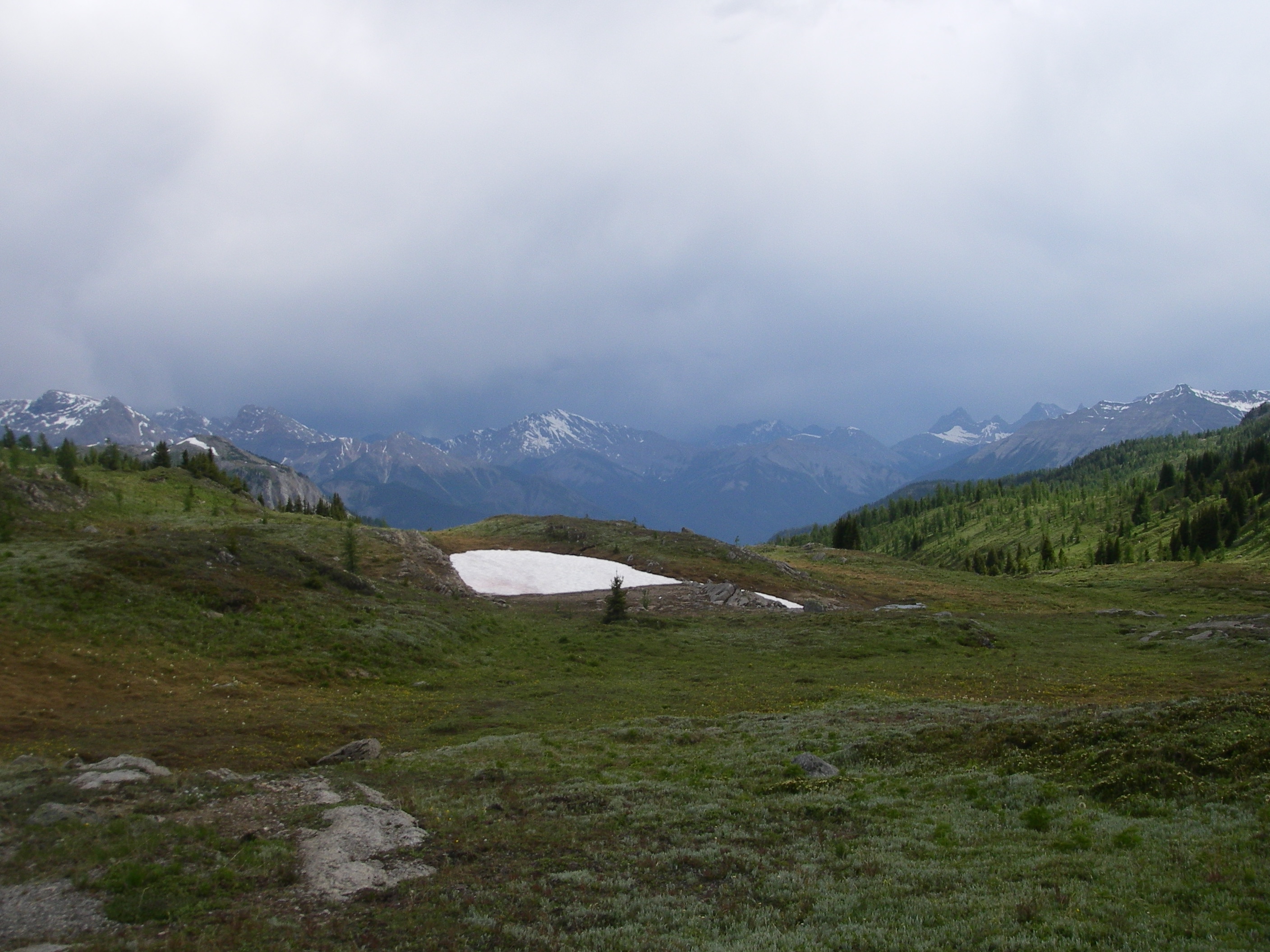
Spatial variation can promote biodiversity. You can see more species along a street with a range of landscaping preferences or conditions than you might in a neighborhood where everyone has picture-perfect Bermuda grass coating every inch of space. It is a common phenomenon in nature, too, one I observed in the Rocky Mountains on a recent vacation to Banff. Different trees and plants dominate the dry, windswept ridges than do the pockets in alpine meadows that remain swampy from melted snow. We can see with our own eyes that species have their own specific responses to environmental conditions.

Hiking in Banff National Park, Alberta, Canada, I observed spatial variation in environmental conditions and levels of competition.
Snow pockets provide wet conditions, favoring species who compete well with plenty of moisture.

But if that seems too obvious, environmental conditions are only part of what determines which species can coexist. The other major part is competition. As gardeners who start their delicate basil plants indoors know, if you sprinkle several seeds into each tiny pot, you’re almost sure to get at least one sprouting (that’s called bet hedging, and plants do it, too). But very likely, you will have a number of seedlings poking out their first shoots and leaves in every pot, as Emma’s April 21st photos show. As they grow larger, not all of them can survive. There is just not enough room, never mind nutrients, light, moisture, or other things plants need.

This process ecologists (and gardeners) call thinning. If the gardener does not pinch off the smaller plants early, they will die out eventually, but only after a long and grueling battle with its siblings, sapping the energy of the survivors, reducing its eventual output. This is competition, a familiar word from sports and family life, but much closer in meaning ecologically to the way we use it to talk about economics. Remember Adam Smith and his “invisible hand?”

Just as a University neighborhood (or gloomy sky like Seattle’s) may provide fertile grounds for coffee shops, yet a plethora of espresso joints ensures stiff competition and low profits, so do plants that find the choicest habitat have to battle contenders for space, for water, for light, for nitrogen, for pollinators, and the list goes on and on. (Check out Emma’s March 1 photo of a field of daffodils in Washington for an image of competition!) Environment and competition are obviously related and can determine local coexistence (and larger regional biodiversity). But how? Should a “good” environment be more diverse or less diverse than “poor” habitat?

In introductory biology classes, we received this answer a maddening amount of the time: it depends. But that just leads to more questions, the most obvious being: it depends on what?!

That’s where biology starts to get fun, but you’ll have to excuse me for a bit. The monsoon has started here in Tucson (raining in small patches, providing more spatial variation!), and I have a garden to go imagine. Stay tuned.

Why are there so many species and what are we going to do about it?

There are an extraordinary number of life forms on the face of the earth. I mean, just staggering. Somewhere in the neighborhood of 2 million species have been described, depending on how species designations change as we get new information. That’s a hard number to wrap our heads around.  Most of us have probably never seen 2 million somethings at one time (not counting bacteria and other stuff not visible to the naked eye).

All those species have no business being alive and well! Didn’t Darwin’s theory of evolution suggest that when species compete, one of them wins and the other, well… tough luck? In Princeton biologists Rosemary and Peter Grant’s Galapagos study made famous in Jonathan Weiner’s Pullitzer winning The Beak of the Finch, people actually watched species converge and differentiate due to resource competition. So does that mean that each of these two million species is part of a neat little food chain, with each having their very own food, their very own kind of home, the predators that are only hunting them?

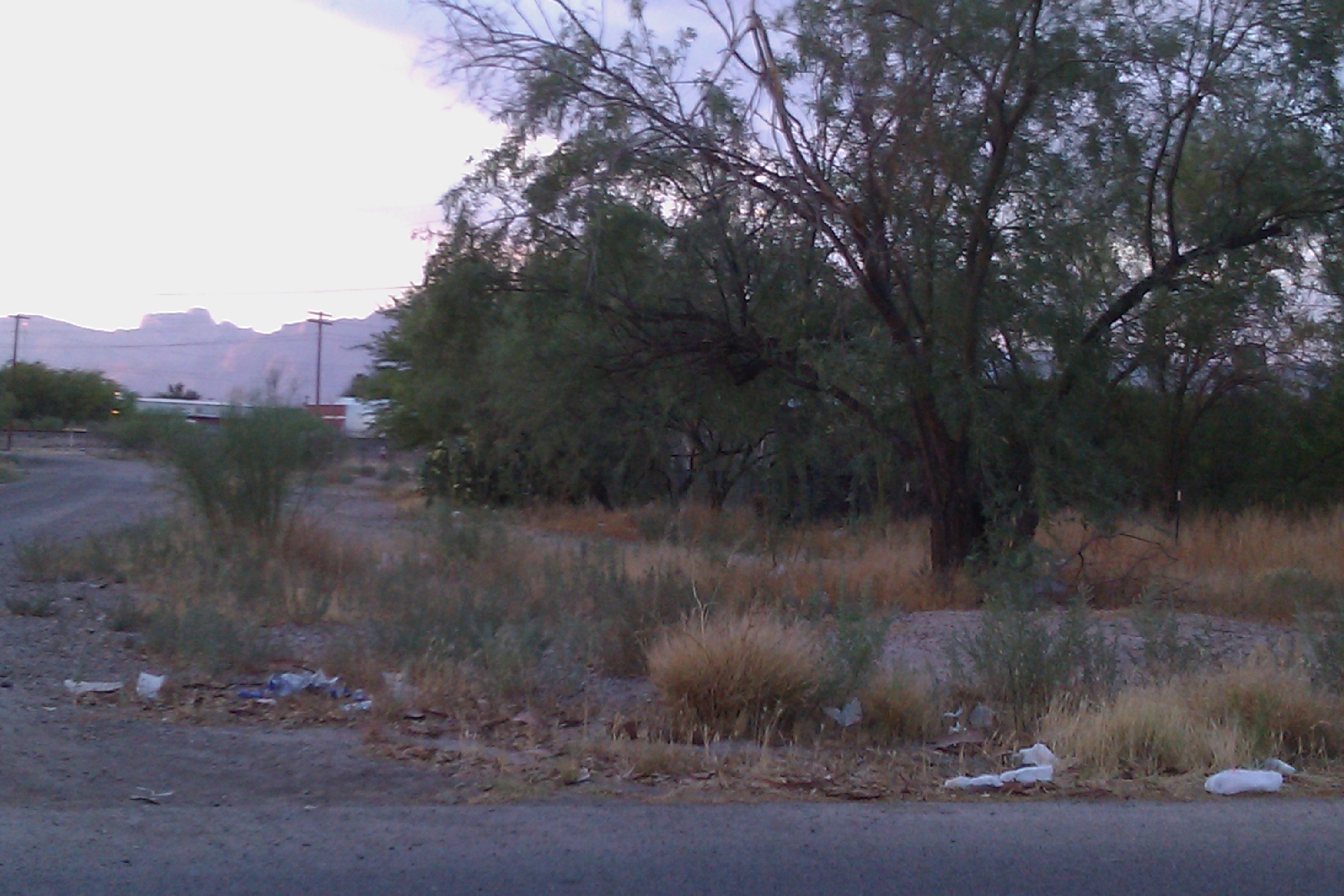
Corner in Barrio Anita

Walk outside and look around. Along my street in Tucson, Arizona, there are plenty of empty lots, populated by weeds despite the brutally hot summers here – not many plants, and not many species, but certainly more than one. Rarely do I see a monoculture occur naturally. If you live near the Pennsylvania temperate forests, take a hike in the game lands and look at all the different trees and shrubs. Up in the Rocky Mountains, the fields of summer wildflowers are multicolored because of all the different species. The same holds true in Californian tidal pools, and in rainforests from Portland to Panama.

It seems that a neat little picture of who lives where and eats what will not suffice to explain the world around us. Biodiversity is somehow maintained while species compete ferociously. A species’ ecological niche is not a tidy little box, but overlaps generously and unevenly with its competitors.

How is this biodiversity was maintained? Why are those weeds coexisting in the empty lot next door? Or are they? Any why aren’t any petunias coexisting with them? I hope studying mechanisms of local coexistence will help us understand its loss and what that means.

Species are vanishing faster than humans have ever experienced, and we are contributing to that. (Throughout the fossil record, but well before we were around, there have been 5 really big extinctions, of which the well known dinosaur extinction was one. We may be approaching a sixth.) Well-studied birds and mammals have been disappearing at roughly a species a year, and those are just the ones we know about. Thousands of square miles of Amazon rainforest is cleared every year, which, in such a lush and diverse ecosystem may be spelling extinction weekly for localized plants or beetles. It’s like we are playing a giant game of Jenga. We remove structural supports of this great towering network of ecosystems one by one, hoping it won’t collapse.  Of course, if we keep going and keep going, eventually we would collapse, but are we really going to get to that point? Scientists are trying to answer that question: how much diversity is enough?

That’s why I’m studying coexistence mechanisms in Peter Chesson’slab at the University of Arizona for my PhD. Members of our lab study the storage effect, relative nonlinear responses to competition, covariance of environment and competition, nonlinear competitive responses, and other fun mechanisms in variable environment ecological models.

Still trying to figure out what that mouthful means? So am I.