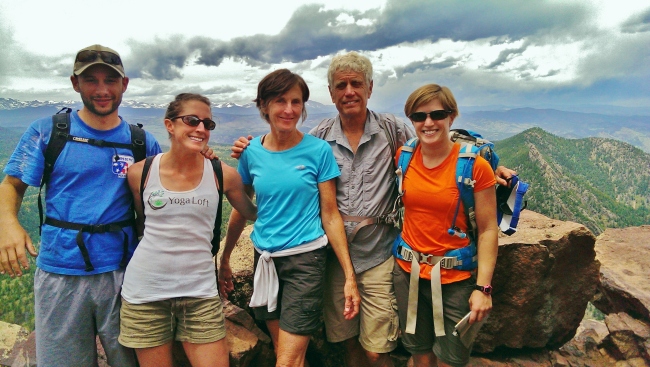
That question was posed this last weekend by a woman from Chicago as we hiked through the conifer forests high above Boulder, Colorado. I had traveled to the Rocky Mountains for the weekend to meet up with my parents, my sister, and her boyfriend, to enjoy the longest day of the year from a high vantage point. As often happens in the mountains, we made a new friend on the trail.
It’s a good question, though. What is hiking in Arizona like? A month ago, I was serving as the teaching assistant for a field ecology course for the University of Arizona. We explored some of the reasons why the geology, flora, and fauna of the Sonoran Desert is so diverse and dramatic. That diversity means hiking in Arizona can be like many different things.
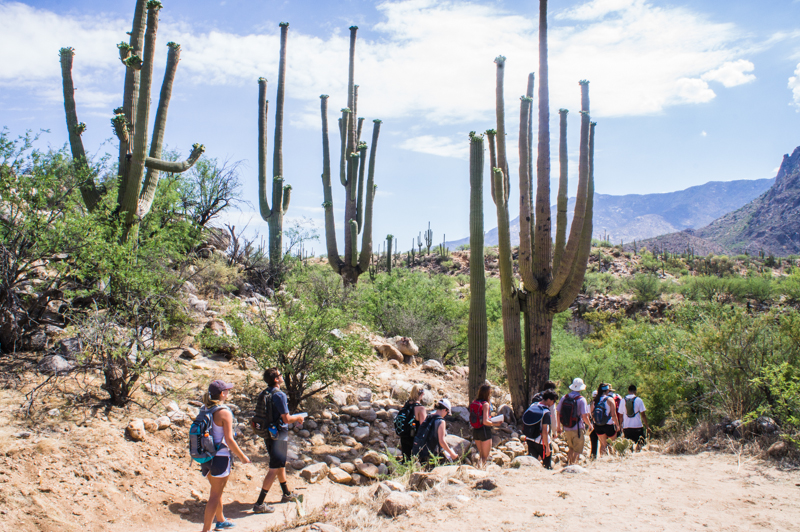
The classic image of Tucson or Phoenix is that of the giant saguaro cactus (Carnegiei gigantea) and bare ground. It is true that hiking around Tucson involves a lot of dry washes, loose rock, thorny and spiky plants, and venomous animals. This time of year, it is beastly hot even near sunrise and sunset, with little relief.
But southern Arizona is dotted with mountain ranges between the wide basins of desert. The change in elevation creates distinctive changes in the temperature and moisture conditions, and support isolated islands of distinct biological communities. Travel only a little higher in elevation, say, to the foothills of the Santa Rita, Patagonia, or Dragoon Mountains, and you will find a grassy savannah like view dotted with trees. Some students were so close to expecting a lion or elephant to emerge from behind the tall grass that their Facebook photos convinced friends back home they had taken an African safari.
Travel higher into the mountains, and they become steeper. The mesquites (Prosopis spp.) are replaced by oaks (Quercus spp.), which turn over into pines (Pinus spp) and eventually even quaking aspens (Populus tremuloides). These elevations, slopes, and forests feel not so different from hiking in Colorado. The gathering thunderclouds on the solstice even felt like the monsoon we are waiting for in Tucson.
Many Tucsonans have noticed this on their annual trek up Mount Lemmon to see real life snow on the one or two days the clouds dump up there each winter. (I hear it used to be more frequent, but not in my five year experience.) But why are the mountains here, and why do the plants and animals change with elevation?
The short answer is that long, long ago, tectonic plates collided, created stretching forces in the Earth’s crust that led to volcanoes popping up throughout the region (perhaps more on the geologic story in a future post). During the Ice Age, the plant life of the region probably looked like the the tops of our mountains do today (perhaps more of this coming, too) – except with woolly mammoths and other megafauna trampling them (and watch for more of this)! As the climate warmed, those species either could not survive in the hotter, drier environment, or were excluded from the area by species that found an advantage in hotter, drier conditions that migrated north from tropical regions (more of this definitely coming in a future post). The process of adiabatic cooling creates colder but also moister conditions at the tops of these mountains (more on this later).
Hiking in Arizona is like, well, like hiking in Mexico. Like hiking Canada. Like hiking in Europe, or in Africa. Why it is like hiking in so many different places inspires questions about geology, chemistry, physics, molecular biology, ecology, and other scientific disciplines.
As we head deeper into the most miserable of the Sonoran Desert’s five seasons, lend me your eyeballs (and your ears) and let me renew your interest in this unique region.
For the past 3 weeks, I served as a graduate teaching assistant for University of Arizona’s field course on the Sonoran Desert. At the same time, I was drafting and revising a manuscript with collaborators for a special journal issue on species interactions in the region. It has been a fantastic time to step back from my narrower research questions to consider the broader context of the environment in which interactions occur.
Let me say first of all that the five seasons of the Sonoran Desert include summer monsoons, autumn, winter, spring, and the arid foresummer. Guess which one we are experiencing now in Tucson!
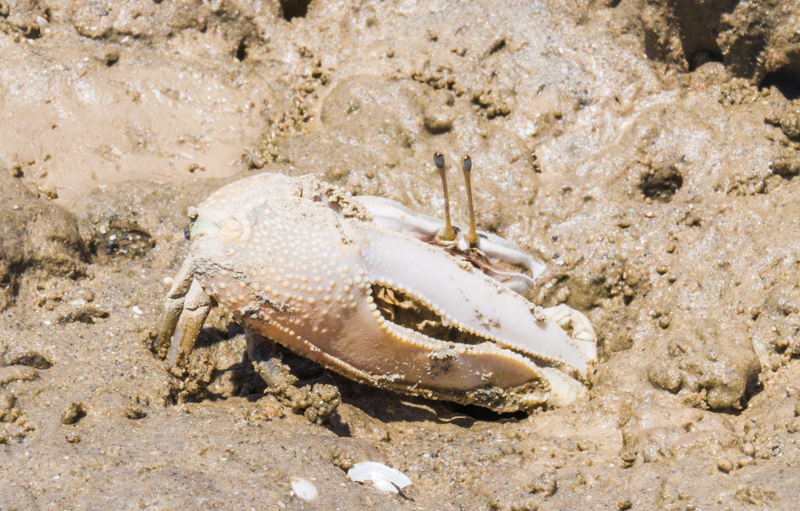
The key to much of the moisture and diversity in this subtropical, semi-arid region is the Gulf of California (also known as the Sea of Cortez). It is home to a unique endemic porpoise which that may soon be extinct, a strong fishing culture that is slowly learning to fish more sustainably, inspiring researchers and educators at CEDO Intercultural, and a literary and ecological legacy from the trip that John Steinbeck and his friend Ed Ricketts took in the 1940’s. It is also the home to several species of fiddler crabs, which provide endless entertainment and substantial numbers ready volunteers for research projects on their behavior, morphology, and density.
Inspired by the “True Facts” videos posted by zefrank1 on YouTube that make animal diversity approachable and entertaining, we put together a tribute to those videos based on my shaky, low quality footage of fiddler crabs in the estuary:
Additional note: Stay tuned for Biosphere 2‘s renovations emphasizing the regional importance of the desert sea!
Recently, I decided I needed to know how many seeds a paloverde tree drops during the period from May-June when it produces copious (and delicious) pods. However, virtually anything that eats in the Sonoran Desert seems to eat these paloverde seeds. So I need to design a seed trap that allows seeds to fall into it, but does not allow animals to eat the seeds before I return.
I first thought five gallon buckets would be pretty resistant to javelinas and pocket mice, but quickly realized the Harris’s antelope squirrel has no problem boinging in and out of them. My next try was to extend the bucket with a squirrel baffle type cone. This had the added benefit of increased diameter of seed collection, but the decided detriment of acting like a sail on gusty days. Even with all the heavy rocks I could find piled in the bottom, the prototype blew over ten minutes after I set it up.
However, I was rewarded for leaving my camera out with my first ever video of a bobcat! He or she wandered by late in the afternoon, and returned a few days later at dusk. Check it out:
PS Thanks Prohaskas for letting me try out my seed traps behind your house!
The UA Science: Sky School, a residential science program in multidisciplinary science, is housed at the summit of Tucson’s nearest Sky Island, in an old military base converted to an astronomical observatory. One of the buildings on site, the old enlisted barracks (it was only men up there back then), is condemned and boarded up. No one to my knowledge has been inside in a decade. It is very, very dark if you walk past it on a moonless night to set out a wildlife camera. (I sing to myself if I’m alone.)
Ten days ago, I was up at Sky School with a group of middle schoolers, and walking past the enlisted barracks in the night, we saw a light on in a downstairs window!
I don’t know if some electrical system went haywire, someone had broken in, or the ghosts were out in full force in anticipation of the full moon (this was two days before the lunar eclipse). One week later, I passed by in the dark, and the light was off. Spooky.
Lots of things happen outside while we sleep. Some of them we will never know about. Some of them we lack the olfactory or other senses to detect. But if you could see in infrared like a snake, or echolocation like a bat, or even hear like a fox, here is what you would have seen in a clearing between the telescopes at the summit of Mt. Lemmon last Friday night:
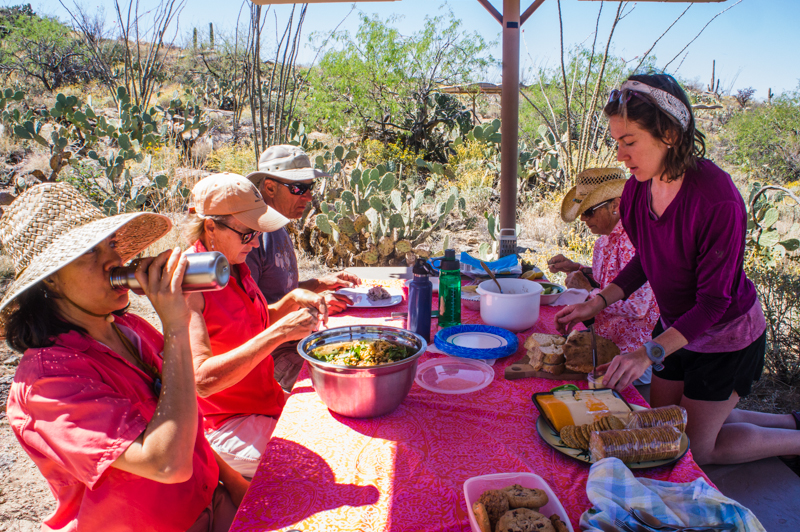
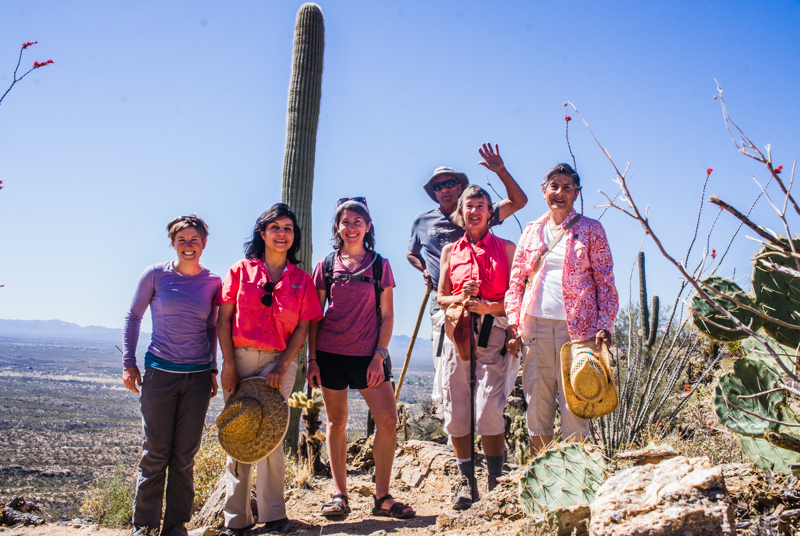
This morning, I took a hike on the Tanque Verde trail with four other alumnae of Scripps College out at Saguaro National Park East, in the Rincon Mountains. As usual with Scrippsies, we had a beautiful location, great conversation, and of course plenty of fantastic food.
Quite the picnic!Some ocotillos have lost their leaves (these are red), but all of them are blooming.Nice view up on the ridge.
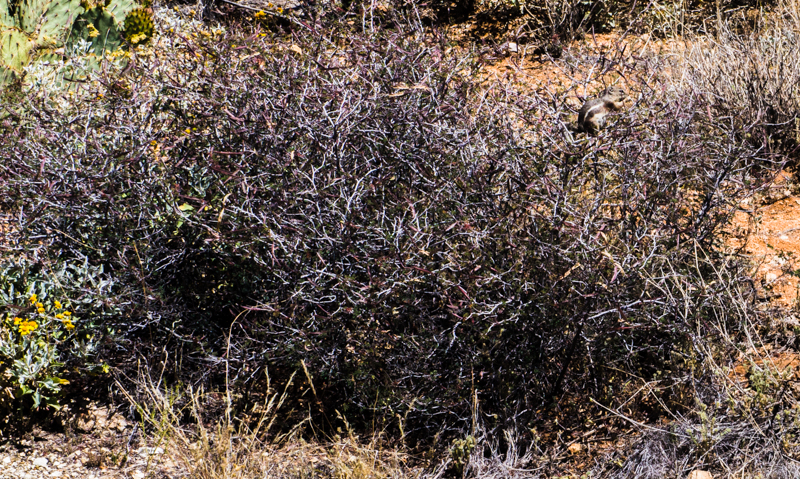
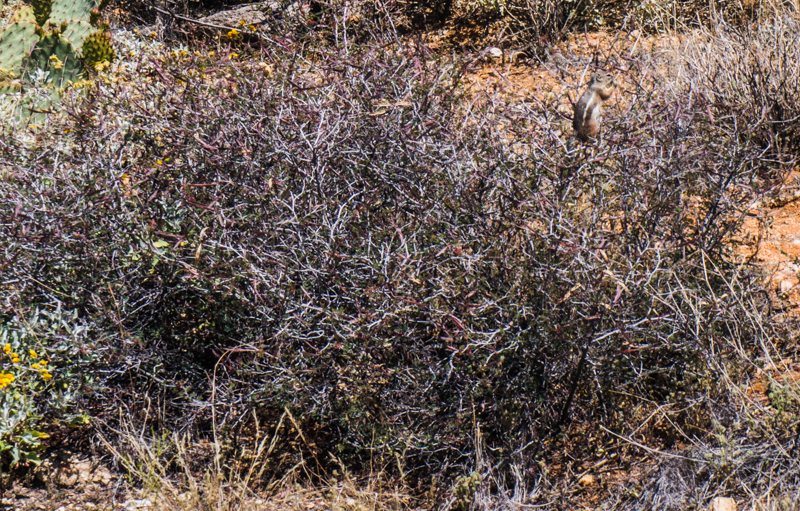
But while we ate, I noticed the vicious killer I posted video of just this week stalking around the outskirts of our ramada: Harris’s antelope squirrel (Ammospermophilus harrisii). Today she (or he) was far more interested in perching several feet above the ground (so much for being a ground squirrel) to nibble on the seed pods of the shrubby leguminous fairyduster (Calliandra eriophylla).
I have no doubt that as soon as we left, our crumbs supplemented the fairyduster appetizers. It occurs to me that paloverde and mesquite seeds and seed pods are also edible to humans – does anyone know if fairyduster seeds are? A quick Google search turned up reports of other members of the Calliandra genus having toxic seeds, but I don’t know about this one.
Visitors to southern Arizona sometimes compare the landscape to Africa, with saguaros substituted for elephants. It may not surprise them to learn that some of the grass in the foreground of this photo was actually introduced from Africa.
A video I captured in Saguaro National Park of a vicious hunter eating its prey alive reminded me of Africa for a different reason:
Celeste Patterson, a field assistant last summer, has been analyzing videos from motion-detecting cameras in Saguaro National Park East we took last September to determine differences in animal richness between mountain ranges and whether it is affected by grass invasions. She pointed out these videos yesterday.
We have tentatively identified the hunter as Harris’s antelope squirrel (Ammospermophilus harrisii), and the insect larva has not been identified. These antelope squirrels were noisy and prominent during the monsoon season, chirping continuously from exposed, rocky outcroppings. We have plenty of videos of them eating the sterilized millet seeds with which we baited cameras, and I was interested to read in Hoffmeister’s Mammals of Arizona text that although they eat primarily fruit and vegetation, with plenty of insects and meat when they can steal it from baited traps, one was even recorded to have killed and partially eaten a pocket mouse (one of the dancing kind) when they were left in a cage together!
To learn more about how small mammals interact with grass, you can attend a talk I’m giving April 8 at 12:30pm in BioSciences West 208 on the UA Campus. (You’ll also get to hear from Kea Skate about the evolution of division of labor!)
To learn more about the differences in animals between Saguaro National Park East (Rincon Mountains) and West (Tucson Mountains), check out Celeste’s poster at the EEB Undergraduate Poster Session from 1-3pm on April 16, on the north side of BioSciences West.
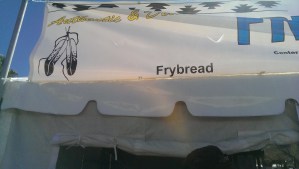
The Tucson Festival of Books is hands down one the best things about Tucson, and it just got better. The two day event on the grassy mall of the University of Arizona campus every March draws illustrious authors and publishers from around the country, as well as local and lesser known writers, and features an extensive hands on science education component. But the food has disappointed me in years past. While Tucson favorites, like Beyond Bread, Tucson Tamale Company, and Brushfire BBQ made appearances, I was always – ALWAYS – distraught not to find the one fair food I had missed most back when I lived in DC: frybread. I’m pretty convinced there was no frybread the last four years because I looked hard. But today at long last:
MMMMMMMMMMMMM
Unfortunately, the wait was 25 minutes and I was supposed to be volunteering at the Mount Lemmon SkyCenter table, promoting the public observing and UA Science SkySchool opportunities. Fortunately, some great friends (Erik and Moira) waited for me and brought me a treat!
I was especially inspired to see new books being produced because just yesterday I had the opportunity to handle some first editions of historic books that were around 400 years old. The UA/NASA Space Grant invited its interns and graduate fellows on a tour of the library’s rare books in Special Collections, led by Assistant Professor of Astronomy Yancy Shirley. Unbeknownst to most of us, apparently, the University of Arizona has first edition copies of about a dozen of the most important books in the history of astronomy – the Copernicuses, and the Keplers, and the Newtons- remember all of them from your Eurpoean History or History of Science or maybe just your Physics or Calculus class? The ones that fundamentally changed the way we viewed the universe and ours place in it?
Old books with delicate pages
Part of the draw was the importance of these books in the history of science, religion, and society. Part of it was the celebrity factor. So what did Galileo Galilei’s handwriting look like? I was able to run my bare fingers over ink on a page said to have been marked by the man himself. Apparently the first edition printing of The Starry Messenger had a typo! So he rounded up all the copies and hand corrected them – much more difficult to do in the age of the internet. It’s kind of a big typo – can you tell in the photos below?
Like most texts at the time, it was written in Latin.Gallileo Galilei allegedly hand fixed a typo in the first edition of Starry Messenger (1610)
Although his major empirical observations and discoveries were published in Latin texts like this one, Galileo is perhaps equally well known for having explored broader ideas of how the universe operated in a series of thought experiments, as narrated by three characters in a play. He published these not just in Latin, but in Italian so that it was less restricted to the elite – or at least, the elitest of the elite. Remember, in the early 1600’s books were less plentiful and more expensive than today (no Amazon drones to deliver them, either). And literacy rates were lower. So you still had to be fairly elite to read this at all. But still, as someone who thinks about how to connect more people who are not professional scientists to cutting edge discoveries, I am kind of impressed that Galileo wrote this as a play, and that he went to pains to disseminate it to the broader society. He certainly started a conversation (even if, as you may recall, that conversation resulted in his house arrest and excommunication that was only reversed in 1992). I can’t help thinking of modern day Science City sections of the Tucson Festival of Books or Neil deGrasse Tyosn’s resurrection of Carl Sagan’s Cosmos series as the modern day equivalent to Galileo’s Dialogues.
The text is full of what looks like footnotes from the author, commenting on what the characters are saying.The characters in Dialogues
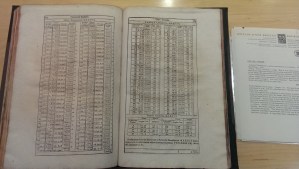
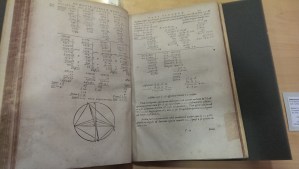
Other books of interest included the Rudolphine Tables, a long term data set begun by Tycho Brahe and eventually published by his student, Johannes Kepler, who realized the implication of their discrepancies in observed orbital positions of planets: namely, that orbits were elliptical instead of perfect circles.
Beautiful imprint in the front of the Tables.After the beautiful imprint came some dense data tables.
Why were they called the Rudolphine Tables specifically? Why not the Planetary Tables or something more descriptive? In honor of the funder of the observatory, of course! Much like the SkyCenter has the Schulman Telescope and Tumamoc Hill started its legacy of long term ecological research as the Carnegei Desert Laboratory. With decreasing public dollars available for research (budget cuts to National Science Foundation, for example), private investors are once again looming as more important investors in research, which is sparking debate about appropriate funding mechanisms and influence in the direction of research fields. It would be worth looking into the history of private funding, from these observatories in Rennaissance Europe to the Bell Labs, Carnegei, and other industrial development of basic research in the United States in the beginning of the 20th century, to better inform these debates about whether this is a funding model science can safely return to, or whether serious flaws drove the original flight to public infrastructure more than the consolidation and nationalism after WWII. But I digress.
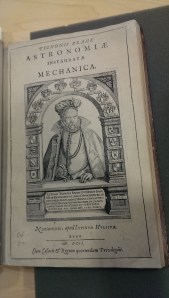
Brahe, of course, published work even before his protege stole the stage. In a very pompous and very unreadable (to me) text in Special Collections, Brahe himself is pictured, looking like he very much enjoys his dinner and enjoys ruffles:
Tycho Brahe
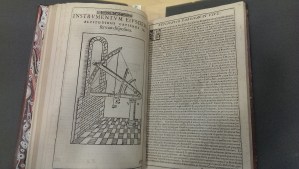
And more puzzlingly, at the end of the text appears a full page ode of some sort. Brahe’s name is at the top, and his funder at the bottom. I wonder whether it is a poem from Brahe dedicated to his sponsors, or vice versa? Is it a form or formalized expression of cooperation, or is this a more lyrical and whimsical expression of the wonder of the universe Brahe felt, that he jotted down between observations, and shared with the reader in order to connect on an artistic as well as technical level?
Instrument used by Brahe and Kepler to generate angular observations of planetary positions at the scale of an arc-minute. Look familiar? I have made mini (and less reliable) versions with a simple compass (or protractor) and a piece of string…Is this artistic poetry, or thanking a funder?
I think it was also Kepler’s book (the one on the eliptical orbits, published after the Tables) in which I photographed the long division taking up pages and pages. This seemed not atypical of books in this era – unthinkable today, except for a textbook on long division:
Then there was Newton, who you could see drawing curves and exploring ideas with geometry that would later become more unified and more elegantly reproved, as it evolved into what we know as Calculus:
And jumping back to the beginning, before Newton, before Galileo, before Kepler and Brahe, was Copernicus. He waited until he died to publish his conclusion that the earth traveled around the sun, and not vice versa: a revolutionary idea.
Today at the Festival of Books, the SkyCenter sported telescopes allowing attendees to look at the sun safely. It looks so small in the sky that some kids were surprised at the diagrams I handed them at the nearby table, which shows just how tiny we are compared to the sun. But they were not surprised the earth goes around the sun, or that the sun was like other stars in the night sky, just closer. An 8 year old girl asked me whether Pluto had blown up, and that was why it was no longer a planet. I did my best to explain the real reason, that it was still there but we now knew about so many other objects larger than Pluto with similar orbits that we had to either declassify it as a planet, or add about 30 more planets to the list. I tried to imagine what Galileo’s conversations with a strange 8 year old in a public square would have sounded like, and failed.
You can see the books pictured above for yourself in the Special Collections reading room during business hours. Just bring a photo ID and wash your hands.
And go to the Tucson Festival of Books! Help support the academic and informed society culture that produced these discoveries and these giants of innovation, and immortalized them in, well, books.
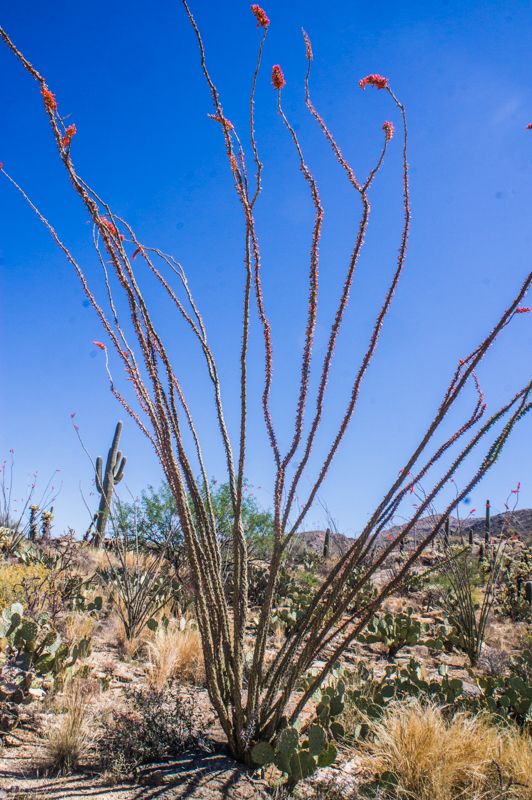
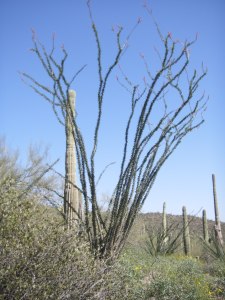
The plants in Sonora were familiar, but a little wrong – like a dream where everything is just backwards. We were driving across the Plains of Sonora region of the Sonoran Desert, while I spend most of my time in the Sonoran Uplands region. For example, visitors to Tucson from more temperate regions of the US are often blown away by the spectacularly strange looking plants. A favorite of mine is the ocotillo, Fouquieria splendens, that waves tentacles skyward like a very lost giant kelp:
“What is that?” I remember thinking when I first visited Arizona.
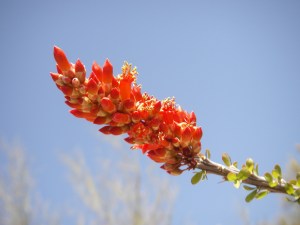
The shrub (not a cactus, despite its evil looking thorns!) produces leaves only after rains, and in the springtime sports a brilliant red inflorescence like a gas flare in the night:
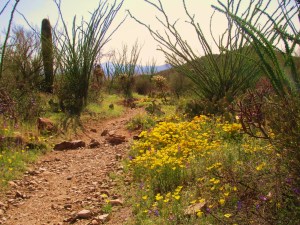
Ocotillos lurk in among the wildflowers in spring of 2010.
The red flowers are edible. Many of them have a bitter taste to me if the sweet drop of nectar has already been provided to a pollinator:
Also adds a nice flavor to water bottles when added.
I remember how eagerly I stared at the ocotillos the first year I was in Tucson. Now I look mostly to see if they have leaves, if they have flowers. But arriving in Sonora, I found the ocotillos had more than that – they had trunks and branches!
What is that?!
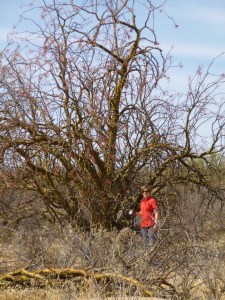
Just kidding, these were not ocotillos at all, but a different species: the Mexican ocotillo tree, or Fouquieria macdougalii. Their flowers were distinct, and even more enchanting, but I was so busy photographing them I forgot to taste.
They LOOK tasty
Guess I’ll have to go back soon. Gracias para una visita muy buena.
Plants may have all kinds of behavior – or maybe they do not, depending on your definition of behavior.
In his documentary, The Private Life of Plants, David Attenborough demonstrates the way they do at least respond to cues from their environment. This we all know: that some windowsill plants will tend to grow toward the light. I learned recently that the majestic saguaro cacti, like barrel cacti and others, grow distinctly differently on their south and north sides, as so in transplanting one, care should be taken to orient it the same way as originally planted.
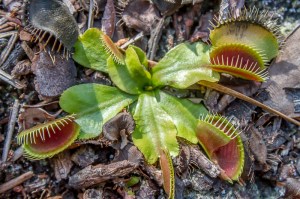
My point is that plants move and respond to their environment. Sometimes quickly, like the veuns fly trap, which I was able to watch in its native range near Wilmington, North Carolina, at the end of December. Stroking a stick along the hairs of open traps, as seen below, caused them to quickly glide shut, as is the one at the bottom of the frame.
Winter senescence in a Venus fly trap. Photo credit: Neill Prohaska
But sometimes plants move more slowly – important competitive and survival behaviors may take place as they grow, but on timescales too slow for us animals to register them. This is where time lapse cameras like Attenborough’s come in. I decided to take a stab at plant behavior in my backyard.
Last November, my housemate moved a big planter behind the house, and started a garden. I placed a relatively robust wildlife camera in the planter to capture the movement and growth of her lettuce, beets, and radishes. The bright reflection off soil during the day meant I had to time my photos only for infrared detection at night, giving the scenes a spooky air. But then something important happened:
The weekend of El Tour de Tucson, a 100 mile bike race around the perimeter of our city, it rained. Not a nice gentle cooling rain for a few hours or even a whole night, the kind that makes me run outside and dance in the puddles because it rains so infrequently here. This was a downpour. And it was cold. Like living in Portland, or Seattle, or anywhere but Tucson, really. This mattered to me (and 9,000 other cyclists signed up for the race) because we almost never ride in the rain – if it’s raining in Tucson, you usually just wait and ride tomorrow instead because it will be sunny and dry. [Note – this applies only to casual cyclists, otherwise known as sane or relatively normal people. Real cyclists are not deterred by snow or hurricanes.] It was also the first time it had rained – really rained – for the race, which has been going on for decades.
So this storm dumped an unusual amount of water. What’s the big deal for the garden, or the plants and animals in general? There are two main takeaways from this for ecologists and population dynamics analyses:
(1) Infrequent events require long time scales to ensure a capture. If I were a plant ecologist studying winter annuals, and I only had time in my PhD to collect 3 years of data and was trying to extrapolate the growth trajectories of a population over the next 50 years, how would I know to include a storm of this magnitude if I never observed one? Only sampling 3 years from any of the last 30 years would rarely turn up a rainstorm like this. I assumed my nice rugged weatherproof camera would be safe getting rained on in the outdoors for a few months. Based on my experience in the last four years in Tucson, I did not expect the garden to turn into a swimming pool, which was not safe for my camera.
(2) But if you happen to capture one in a short window, it will really mess with your estimates of how a system usually behaves. This was only my second time riding El Tour de Tucson, so now I have one memory of a beautiful ride, and one memory of a truly horrific near-hypothermic sufferfest. Weighted equally in terms of frequency in my experience. If my 3 year window included this event, I might naively conclude this system was pretty highly variable – that an event like this might happen every couple of years.
This was an issue I explored in my undergraduate thesis (with Diane Thomson at Scripps College), but that still continues to be an interesting problem today.
Posting a picture online got me an ID from someone with expertise in minutes, while the snake was still in view! ‘Course, it also garnered some smart alec comments (Moira!)….
I was standing next to an experimental plot high on a ridge in the Rincon Mountains last summer when I looked up and saw the snake. It was winding its way through the vegetation, approaching closer and closer – only feet away! It was about four different colors. Its head was long and narrow, not triangular like a rattlesnake.
My field team and I watched as it snaked its way around us, apparently unconcerned. I pulled out my phone to look it up on Snakes of Arizona, but too many color options confused me. So I took a picture and uploaded it to Facebook, an hour’s hike off trail out into my study site in the National Park. Within minutes, the phone buzzed in my pocket. A graduate student with expertise in herpetology had already commented on my photo with the species name! I could now Google that snake to learn about it while watching it actively hunt in the wild, as long as I stood relatively quietly and did not startle it away. Imagine if it had been a rare or endangered species – or a dangerous one!”
As the earth reaches this point in its revolution around the sun, members of our species, at least in many urban areas around the globe, reflect on the new advances in technology and the way in which they change (or don’t change) our lives. We hear stories about Most Viewed trends on YouTube (spoiler alert: not science and nature!).
I share the snake story above to illustrate how our connectedness and more importantly the mobility of our devices changes my experience as a naturalist in the field. I can instantly have access to the experience and information of other people, even in (relatively) remote locations.
On the other hand, this connectedness in some ways underscores how much has not changed about field work, or academia in general. Some identifications are difficult or even unknown: if I post a photo of the summer germinating seedlings I am studying, I am unlikely to get back a quick ID. I have to make that seedling guide myself. But for something well known like the snake, what really helped me was having a network of experts that I could turn to. If I were still waiting tables instead of studying biology, a snake spotted on a casual hike would be much less easily identified. The public resource I could quickly find for snake identification with a Google search required some additional knowledge to take advantage of it.
But the internet does provide a platform to get help from experts outside my network – it may take a little more time and effort, but not nearly so much as the in person call of a century ago. After questioning everyone I knew who studied pocket mice about an odd dancing behavior I had repeatedly recorded in the field and finding no explanation, I compiled the clips to funny music, and posted it online. I was thrilled to receive responses via this blog, Facebook, Twitter, and email that provided a consensus opinion from experts I had never met in person.
When I read the following email about the reach my blog had had this year, I was blown away:
“The WordPress.com stats helper monkeys prepared a 2013 annual report for this blog. Here’s an excerpt: A San Francisco cable car holds 60 people. This blog was viewed about 3,600 times in 2013. If it were a cable car, it would take about 60 trips to carry that many people. Click here to see the complete report.”
Though science and nature videos may not match views of cats or video games on YouTube, and watching nature unfold on a screen is far less impactful than really being outside yourself, that is still far more people than I would likely be able to tell what I learn through more traditional mediums – and I undoubtedly am able to learn far more from others this way, too!















 Biologist. Explorer. Storyteller.