Basking in the glow of media interest and looking forward to future growth.
The program I have been helping to build for the past year and a half has received some good press in the past month, from school district and department newsletters to the University’s news service, to our local public media affiliate!
I find it easy to talk about the UA Sky School with the media because it is important and powerful. That power comes from reality and rigor. This is not nature camp or space camp. The instructors are prepared with knowledge about unique opportunities to emphasize important scientific standards and the resources to investigate them, but our activities are not simulated and our lessons are not canned. Students on the four day stays especially interact with actual scientists, using actual mountains and plants and telescopes, to do actual original research. The potential to have an epic experience in scientific discovery or outdoor adventure is tangible.
The impending end of the calendar year is a season of reflection and envisioning what the future will hold. In an era of decreasing interest in science, an era of increasing time spent in front of screens, increasing urban populations, here’s to envisioning a future network of such university affiliated outdoor science schools across the country – even across the world – that provide this chance for students to get real and get inspired. And seeing the interest in the UA Science Sky School gives me hope we can make that vision real.
UA Science Sky School Fellows, all graduate students, prepare to lead high school programs by sharing knowledge from our different areas of expertise.
This is no Nutcracker. After sundown, the pocket mice of Saguaro National Park are working it like a strip joint. Check it out (second one has my narration):
A brief summary also appear’s on Felicity Muth’s blog (Not Bad Science) over at http://www.ScientificAmerican.com. What started as bored amusement at this energetically costly behavior turned to curiosity as I realized how often I was seeing it. Idle curiosity turned into fascination as I realized how few mammologists had even seen the dance before.
But beyond the novelty and the entertainment factor, does this behavior matter at all to the ecology of the species? Does it affect their population dynamics?
Maybe.
1. What if this is anti-snake flagging behavior? (Cool video.) I have already posted about the ways in which an energetically costly anti-predator behavior can affect the energy flows in an food chain, and the densities of both the predators and their prey. So if this is tail flagging aimed at a snake, it could decrease the population growth rate of the mice.
2. What if mice are marking territories? I actually had more trouble than I expected finding general theoretical conclusions on the effects of territoriality on population dynamics, but please feel free to correct me if you know of some (or have research of your own I overlooked!). A trivial answer is that dividing space into territories is a form of intraspecific density dependence – that means the species is limiting its own population growth. But does that limit growth differently than pure resource competition? What about in a spatially variable environment? Maybe I can contribute something through my own research here eventually.
My camera setup
3. And of course, what if this is sexual behavior? Male mice have been reported to do a butt wiggle before mounting a female (Bret Pasch, personal communication), so these could be males smelling a potential mate and getting excited. If they are wasting energy dancing too early in anticipation of mating before even locating the female, that could decrease their eventual longevity or mating success, I suppose. That might not even matter to population dynamics if there are plenty of males to get out there and mate, though. Especially if dancing is a minimal cost relative to the total effort of running around through the desert searching for females.
Finally, how can I start testing these hypotheses? Proving the presence of an off-camera snake that is triggering flagging behavior might be hard, but a good first step would be to put a mouse and a snake together and video the encounter to compare with what I have. To detect urine spray for territoriality, I have tried placing filter paper around the camera to inspect with a black light in search of urine droplets. No dancing over my filter paper, yet, sadly. Additionally, if I want to find out whether only males do the dance, I could capture and mark mice in a study area before re-deploying the cameras.
Help me out by posting your own ideas about why the mice are shaking their booties, how to test the ideas, and what the important implications are!
[Update 1: I did not speed up or slow down any of the videos. All I did was select the parts of clips where they are “dancing.” Nothing else is changed from raw footage.]
[Update 2: Noelle Bitner, a doctoral student (candidate?) in Dr. Michael Nachman’s lab at Berkeley, reports she has two female pocket mice who “dance.” So much for the male-specific sexuality hypotheses? Also, Vicky Chan, a graduate student in Optical Sciences, reports her captive pocket mouse (unknown gender) often dances after caching seeds. Support for scent marking?]
In promoting his new book, author Simon Singh put together a short “quiz” of math jokes for The Guardian. I was initially tickled to see an ecological type problem in the very first question:
“1.Why did 5 eat 6?
Because 1, 2, 3
Because 7, 8, 9
Because 5 predates 6″
There is a well-known joke that goes more like, “Why was 6 afraid of 7?” The answer to that is quite obviously, “Because 7, 8, 9!” Such predator avoidance behaviors as 6 being afraid of 7 and perhaps fleeing from it are ubiquitous in animals, as anyone knows who sees sparrows flutter away at your approach in the parking lot. There is a growing body of mathematical theory demonstrating the effect that these avoidance behaviors can have on the actual population dynamics of the prey species, led by scientists such as Peter Abrams and John Orrock. These results are readily demonstrated in experiments: Oswald Schmitz and his colleagues have demonstrated how grasshoppers reduce their feeding and thus slow their population growth rates by avoiding nutritious leaves where spiders may lurk – and the reduced grasshopper population growth rate occurs even when they glue spider mouth parts shut! The effect of fear on the prey species can even transform entire biological communities and their ecosystems.
Well, 7 eating 9 is a great reason for 6 to be afraid of 7, especially if 6 looks anything like 9 (and it sure does to me). But that’s not a good reason for 5 to eat 6. What on earth do we learn about 5 from this other interaction? (Well, it’s prime, like 7, I suppose, so maybe they have similar predaceous traits.) Predators that are coexisting in a community (of integers less than 10?) are quite likely to partition prey in some way as a trade-off that prevents one from excluding another.
But, as Abrams and other theoretical and empirical studies point out, adopting behavior to avoid one predator may make a prey item easier to capture by a predator hunting by a different mode. So if 6 is afraid of 7, it may crowd closer to 5, who, predating it in an ordered number line, can also then prey (or predate) the 6.
Imagine my indignation, then, when I clicked on the end of the quiz to see my answers, only to discover this subtlety completely overlooked by Singh. He had set the answer to this unusually phrased variant of the classic to the well known answer, which frankly, in this scenario, made far less sense.
So since 5 does predate 6, that is a far better reason for 5 to then eat 6, than because some other number like 7 ate the far off 9. I rest my case, sir!
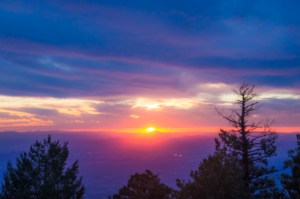
High in the Sky Islands, sunsets are epic and forest fires and freezes more common than on the basin floor in Tucson.
Freezing and frequent fires are both more prevalent in the Sky Islands than in Tucson. Sky Islands are the forest capped mountain ranges dotting the low lying desert sea of the southwestern United States and northern Mexico. Over the last two days, I helped to investigate which would contribute more to weathering: the fires or the freezes?
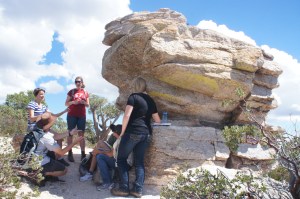
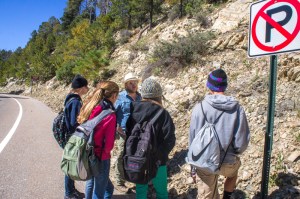
This project was the work of five Environmental Science students at Tanque Verde High School who spent their fall break attending the new University of Arizona Sky School, a residential science school located at the summit of Tucson’s most accessible Sky Island: Mount Lemmon. It was co-advised by myself (a doctoral candidate in Ecology and Evolutionary Biology) and Phil Stokes (a doctoral candidate in Geosciences). Needless to say, this project built substantially on Phil’s expertise, and I learned a lot.
For example, I learned that weathering is the process of rocks breaking down, while erosion is the transportation of those particles. I learned that having five students lean around a fire and watch intensely through their safety goggles as a crack in a rock widens visibly a millimeter feels like success.
We collected 3 types of rock to test the effects of freezing and fire: schist, quartzite, and granite.
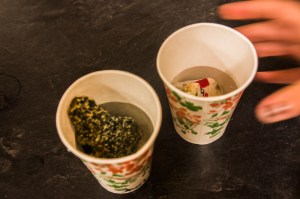
To test the severity of weathering by freezing and by fire, we collected 3 types of rock, and subjected them to 4 treatments. The rock types were schist, quartzite, and granite. The treatments were repeated short freezing cycles, repeated short fire cycles, a long freeze, and a long burn. Rocks were soaked in warm water before treatments, and between freeze or burn cycles.
As the members of Team Tough Schist presented in the Second Sky School Symposium, ice and fire work differently on weathering rock. A very general explanation they provided was that water seeps into existing cracks, then expands when frozen, widening them. Fire, however, heats the many minerals in the rock, busting them apart and creating new cracks. This additional surface area opened by fire allows more weathering.
Armed with this understanding of weathering mechanisms, and the evidence of more cracks in the roasted rocks than the frozen rocks, Team Tough Schist also concluded that schist is not so tough. Anyone who has picked up the papery flakes laced with mica may have also observed this. And when those papery layers curl up when expanding due to heat, they stay crinkled like a book that once wetted, never lies perfectly flat. As you might also imagine, repeated freeze-thaw cycles wedge cracks wider and wider more than one long freeze. But one long and intense fire may expand and crack a rock more than repeated short fires.
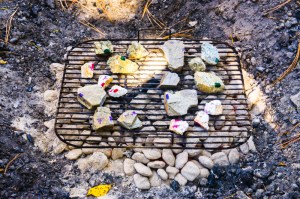
Rocks were grilled on charcoal to simulate forest fires, and placed in the freezer to simulate winter.
Although overall fire was determined by Tough Schist to be a more severe weathering agent, freezing occurs every year all over the tops of Sky Islands, and fires near any given rock are less frequent, even under historical more frequent fire regimes. So they left their audience with further questions: Which weathering agent, ice or fire, should be contributing more to weathering processes on Mount Lemmon overall?
On a final note, I was obviously disappointed none of the students were fans of George R.R. Martin, given their choice of research question.
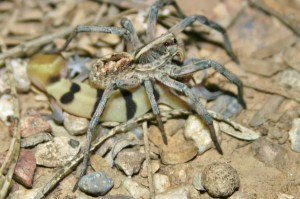
Dr. Brittany Barker, a post doctoral researcher at the University of Arizona, recently photographed another example of an invertebrate tackling and eating a vertebrate, this one from Sabino Canyon in the Santa Catalina mountains:
She writes:
“The spider apparently attacked the baby gecko – they appear to be sit and wait predators. Gecko was still partially alive – I could see his/her eyelids moving – but not moving. The stuff I see here in Tucson is crazy!”
Interestingly, sit-and-wait predators that ambush their prey tend to have larger effects on prey behavior, according to experiments with spiders and grasshoppers that appeared in the journal Ecology. Prey are much more cautious and avoid areas from which predators might ambush them. I know I avoid large rocky outcroppings where a mountain lion could be lying in wait when I hike alone at dusk. This avoidance behavior, though, can change the way they forage on the landscape either by where they forage or how much they eat, and that has effects on their resources in turn. Cool to think about, right? I wonder if geckos are instinctively avoiding places that look like spider ambush points, and if so, did this one just get unlucky? Or is it something they have to learn, and this individual was too young and naive?
[Update: Brittany writes that after some research, she believes the spider is a funnel-web wolf spider in the genus Sosippus. Can you find evidence to confirm that or to determine what species it is?]
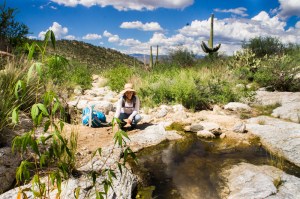
Predation pool, a tinaja in the Rincon Mountains. Julia posing next to the deer leg.
How horrible would it be to have your insides sucked out by a giant insect? Last Saturday I watched a dramatic reversal of what I usually think of as the food chain.
I was hiking down a bedrock wash in the Rincon Mountains, east of Tucson. Julia, who has been working with me at my field sites, was right behind me.
“There’s a snake!” she called out as I launched myself over a tinaja, or small pool of water that had formed in the rock over the course of several large monsoon storms.
Concerned it might be venomous, I stopped.
“Where?”
“In the water,” she answered, squatting down by the pool. “Hey, it’s eating a bug!”
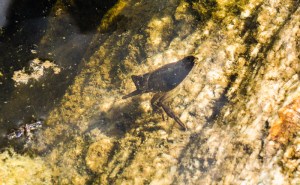
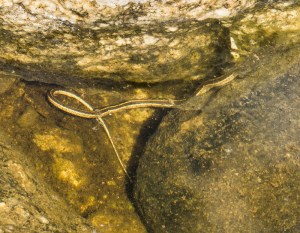
I bent over the pool, too, and saw a writhing, twisting, gymnastic battle being waged below the surface. The garter snake (genus Thamnophis) was about 10cm long, or the size of a pencil. It was locked in combat with a water bug (genus Lethocerus) that was about 3cm long and half that wide. (Both were probably juveniles, as garter snakes can grow to be over a meter long as adults, and the bug lacked the wings of the adult stage.)
“No,” I said. “The bug is eating the snake.”
The bug’s jaws were attached to the throat of the snake, which wriggled and knotted and looped itself, trying to throw off the predator. Of course at that point I dropped my pack and snatched up my camera.
I’ll let you watch how that ended up on my raw footage:
It was pretty horrifying to watch, really. I was empathizing with the snake, being a vertebrate and all. If I remember correctly, the belostomatid mouthpart pierces prey, releases digestive enzymes, then sucks up their dissolved innards through a straw. What a way to go.
The other fourth (?) instar Lethocerus individual was still perched at the surface, rear end in the air to breathe, ready to pounce on whatever fell next into the tinaja.
But why did I have to be horrified? Why could I not be rooting for the bug, who clearly was suffering from competition in that little pool? I never panned the camera over to it, but another identical Lethocerus was sitting just 30cm away, just waiting for something else to fall in to the pool. I bet the bug that got the snake had just been poised on a hair trigger, thinking, “the next one’s mine, the next one’s mine!” It was probably starving. After leaping without even looking, I wonder if it got that look in its little compound eyes that I get when I start rock climbing on a route that is way too technical for me: that look of “Oh well, all I can do is hang on, now!” And its big risk paid off with a Thanksgiving feast – did it feel a rush of relief, or satisfaction? That may be a neuroscience or even philosophical debate for another post.
I have to admit also to being fascinated at the strategies of size-class vulnerability to predators (little snakes are vulnerable to bugs, but I bet bigger snakes even eat those toebiters), the differing predation strategies of the snake that cruises around hunting and the insects that lurk in the shallows and pounce, and the avoidance behavior of the snake that I probably disrupted by leaping over the tinaja and scaring it into the water without due caution.
Oh yeah – to add a macabre touch at the end of the video, as I packed up my camera, I lifted my backpack and realized in my haste I had dropped it on a deer leg, fur and hoof still intact. We had found the predators’ pool. (Hope the water bug didn’t take the deer down, too!)
The victorious water bug hauled its prey deeper and away from its conspecific competitor to feed.
My crappy cell phone photo of Crotolus molossus in the Rincon Mountains a few weeks ago.
I dream relatively often of being bit by a snake. Probably because 3-5 days a week, I am tromping off trail through Saguaro National Park to my research sites, and I try to stay hyper alert to the threat of venomous booby traps. I have been buzzed off my intended path by rattlesnakes several times a summer, both last year and this year. A few encounters, however, have involved a snake lying stretched out on a road or wash that peacefully watched me approach, notice it, and move around. Then there was the one my boyfriend stepped on as he jumped down a pile of volcanic rocks in the dark, which rattled angrily after the encounter, but was fortunately too busy falling off the opposite side of the rock as him to strike.
Have you heard the rumor that rattlesnakes are less and less likely to rattle? The hypothesis goes that because humans (or in some versions, human introduced livestock) are likely to kill rattlesnakes they discover, those that avoid rattling have a survival advantage. Whether the decreased propensity to rattle is a genetic defect in the tail muscles or a behavioral predisposition to silence, selection favoring that morph is increasing its frequency.
I had asked herpetologists at the Arizona-Sonora Desert Museum last summer about this hypothesis, and been told there was little or no evidence for it. I received a similar answer from herpetology students at University of Arizona.
So imagine my surprise to hear NPR feature herpetologists discussing anecdotal evidence (personal observations in an unstructured setup) supporting this hypothesis in South Dakota this week. A quick search on Google Scholar and Web of Science turned up no papers by them or anyone else providing solid evidence of such a trend. A broader web search only yielded a site categorizing that as a disputed urban legend.
When you think about this, it is a difficult hypothesis to test. Quantifying the strength of selection for rattling ability and behavior across a landscape would be difficult, at best. A herpetologist could perhaps find as many rattlesnakes as possible, and quantify the proportion inclined to rattle. But beyond the question of whether they could conduct a search that is unbiased by rattling propensity (which would make those snakes easier to detect), we have no reliable long term datasets against which to compare this metric to tell if the proportion of rattling rattlers has changed over time. A massive survey of land managers regarding the number of snakes they kill every year, and how those snakes were found, could provide a metric of risk to the snakes in those areas related to rattling. But quantifying the presumed benefits of rattling with regard to the rest of the world besides humans would be an important metric to include in determining whether rattling has a net benefit or cost to survival, and that would be harder to measure.
Based on my small encounter rate, last summer, only 1 of 4 snakes rattled at me. This summer, however, 4 of the 6 snakes encountered have sounded a warning (excluding the one my boyfriend stepped on, which I’m not sure whether or not to count or not). So in my limited experience, snakes are rattling MORE frequently.
Herpetologists, do you know anyone who is testing this? Or have better ideas of how to test it? Also, feel free to tell me why it is not even a useful question for moving the field forward, and not particularly worthwhile to investigate.
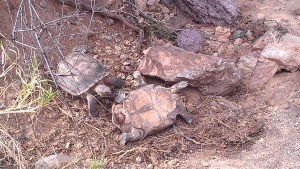
The victor standing over his vanquished foe (Gopherus agassizii). Apologies for poor cell phone camera quality of the photo.
I was walking down a wash in Chaos Canyon, west of Tucson, this morning, when I came across two tortoises evidently in the throes of a pitched battle.
One was already on his back. (That means he was losing.) He waved his legs, and struggled to roll. His breathing was audible and labored, liquid oozed from his backside, and occasionally squelchy farting sounds did as well. Losing precious moisture through urination even can be damning to these slow-metabolizing and slow-moving desert dwellers. I mentioned they were in a wash, but it has only rained twice there all summer (I have a rain gauge up the canyon). Being on one’s back for any length of time when you generally rely on gravity pulling your lungs open away from your shell is also a problem.
The other tortoise loomed over him, regularly bobbing his head aggressively, biting the downed animal’s feet, and lying on him to hold him down whenever he gained any momentum to rock back up.
I wondered if I should intervene. I don’t like to see animals suffering, and obviously the guy on his back was in a bad way, breathing and hydration wise. But this was an ongoing conflict the other tortoise seemed determined to end. (A very slow conflict, mind you. It was like watching baseball.) For all I knew, the guy on the ground deserved it. So I walked away with only video, leaving the tortoises to duke it out.
Further apologies for quality of crappy cell phone camera quality of the encounter. I recommend turning up the volume.
If you would like to to learn more about Gopherus agassizii, check out the Desert Museum or ask Taylor Edwards.
I’m analyzing videos of mice eating. It’s often as boring as it sounds, leading my office mates to give me weird looks as I giggle madly, because I’m listening to Dane Cook or Read It and Weep while I go through hours of footage from infrared game cameras placed in the foothills, trained on small trays of seeds (sterilized millet, thanks for asking).
There are a lot of videos of wind blowing the grass around. Some of foxes (see last post).
A lot of videos provide useful data, but are kind of crappy images like this one:
Then, out of the blue, I spy something unusual, and sit up straight in my chair. Mid-giggle. I take my feet off my desk. I know I can’t tell these sly little pocket mice apart, because they lack distinguishing markings.
(By the way, my research group spent substantial time and effort earlier this summer trying to build a bait station that dotted mice with sharpie or hair dye or something when they ate the seeds. We wanted a herd of itty bitty jaguars to keep track of. Nothing has worked well yet. If you have any ideas, please let me know!!!!)
Back to the unusual bit. Because I can’t tell these mice apart, I can’t tell how many eat from my bait station over the course of a night. It could be one mouse that defends its territory. Or many with overlapping home ranges.
Here, in this unusual video, was a clue!
Another Chaetodipus spp. lurks in the background while the normally alert diner nibbles on delicious millet.
I write something dramatic in my spreadsheet, probably in all caps under the “Notes” column for this video. I write something along the lines of “OMG ANOTHER MOUSE LURKING.” It’s a technical scientific term, lurking.
I lean forward in my chair and click on the next video.
Nothing. It’s just wind in the grass. I’m not going to waste your ten seconds with that video, not when mine are already spent.
But I keep watching. And seven minutes later (in 10 second increments every few minutes, mind you)……
My academic adviser reminded me of something today that I have frequently noticed. A side project or half-baked pilot project can really take over and become a successful program.
In that spirit, although I have rarely had the energy to post on this blog with my field season in full swing, 4:30am mornings and all, I have taken some neat detours this summer. I’ll share a few side sightings here.
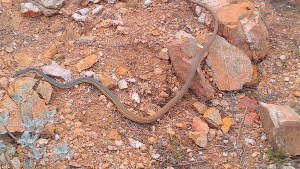
Although my daily hike is usually in search of seedlings, I manage to see owls and foxes, deer and tortoises. Sometimes these encounters are painful, like the bite from a Pogonomyrmex (harvester) ant that made my whole body flush red and hot for an hour (and scared the heck out of me, miles from the car or nearest medical treatment) or the bees that have twice climbed into my shirt to sting my stomach as I try to extricate them. Others were more gratifying, such as watching a beautifully tri-colored four foot snake cruising around near my feet, posting a photo to Facebook on the spot, and having an ID within minutes. (Thanks, Shea!)
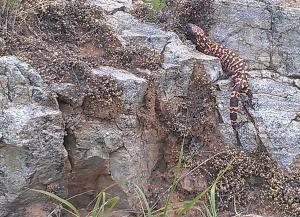
Just this morning, my fellow field adventurers and I saw a gila monster and a rattlesnake within about ten minutes of each other in the Rincon Mountains. Just a few days ago I started analyzing our video study from the Tucson Mountains, and came across some fox footage. Enjoy!
Update Aug. 21: Here’s that fox video that was missing yesterday due to technical difficulties:
I set off this rattlesnake when I walked too close to the shrub.This Sonoran whip snake (Masticophis bislineatus) was just snaking around near us.Gila monster!


 Biologist. Explorer. Storyteller.