Tap dancing tamales

Last week, I encountered a mystery that was best solved with a tamale. (I wish I could say that every day.)

One of my research projects this summer involves using game cameras to capture candid videos of small rodents eating seed bait using infrared flash. I had placed a ten of them in the field for nearly a week, and while the seed bait was gone, no videos recorded the culprits.  Well, we did have two videos of a ground squirrel one afternoon. But that left a lot seeds unaccounted for. And I did have a lot of video of wind blowing branches around, so the cameras were clearly functioning.

The seeds in question were large enough that I was skeptical of ants being responsible for their theft. And there was one more key piece of the puzzle: despite the fact that most of the small granivorous (seed eating) mammals in this area are nocturnal, I had no night time videos.

I had previously captured regular videos of wood rats, deer mice, and pocket mice in these environments eating such seed bait. What was the difference this time?

I realized it might have to do with the orientation of the cameras. While the distance to the bait was the same as before, I had secured the cameras above the bait to record downward, having read about a study from Australia in which downward orientation improved the reliability of triggering, increased the researchers’ ability to identify animals, and also provided more rigorously defined study areas and rates of animal movement.

However, these rocks are much hotter than body temperature, and take a long time to cool down.  Heat absorbed by dark volcanic rock throughout the course of a hot, arid foresummer day is familiar to me and to my field assistants. On some of our epic experimental set-up days, we laugh about how by 11am we stop sitting on rocks because they burn our backsides through our pants, by 1pm we can no long pick up small rocks to use as tools, and by 3pm they burn our feet through the soles of our shoes.

These game cameras are built generally with spotting deer at forty feet, not mice at three feet. Some of the issues with this off-label use are cheaply remedied by, for example, placing masking tape over the panel of LED flash to reduce the blow-out of close objects. It seemed likely to me that the heat-sensing motion trigger used by the camera after dark cannot “see” the rodents moving against such a hot background.

A series of tests were in order to confirm this hypothesis, but we needed some rodent stand-ins. Being Tucson, I had a dozen frozen tamales in the freezer, which seemed about the right size.

We commenced a series of trials of triggering the game camera using a microwaved tamale moving across the field of view, varying the tamale temperature and distance from the camera. These tests were conducted at first in the darkened back closet of the secret underground laboratory in the corner of the sub-basement of Biological Sciences West. I later repeated some trials with the tamale dancing before the camera in varying orientations that night in the field.

I am still looking for a journal in which to publish these groundbreaking results. In the meantime, for your entertainment, I give you a sample of my tap dancing tamales recorded in infrared.

Wildlife safaris of Arizona

It’s June 1, and a panther stares down at me from my National Wildlife Federation 2013 calendar on my desk. One of my field sites is on the south slope of Panther Peak, but I have yet to see my own mountain lion out there – although a friend accompanying me last week did point out that the fur-filled scat along the trail was far too large for a wildcat, and it tapers on the end in a distinctly feline way.

I think about the panthers at my field site like a Chuck Norris joke:

“How do you see a mountain lion?” Answer: You don’t. The lion sees you.

Indeed, the site is ringed by rocky outcroppings perfect for dens and ambushes by the cats. I’m sure they see me bent over my plots, nose to the ground. Which is why I try not to spend too much time out there alone, although I am far more concerned about heat and people as dangers than I am wildlife like panthers and snakes.

FunSagAtTHill
A dead saguaro at one of my field sites, Tumamoc Hill, overlooking central Tucson

Speaking of which, field work has started in earnest for me for the summer. Highs are creeping up over 100 degrees Fahrenheit as of today! During this hot and dry month preceding the start of the monsoon season, many animals are either just becoming active (like desert tortoises and ants and monsoon field biologists) or are hunkered down, awaiting cooler weather (like my housemate’s husky mix and the rest of Tucson).

Some  folks from Tucson Audubon, however, had a really great field day recently. You can read about that here. It’s definitely worth checking out, if only for the video of a badger waddling away!

Something missing

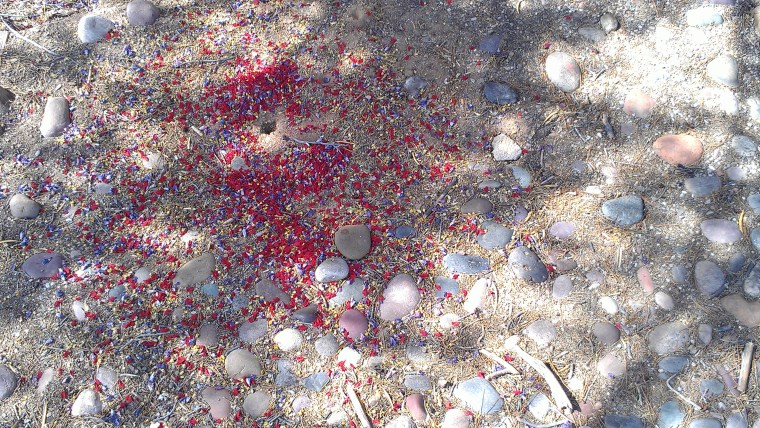
I have ants in my front yard. They are some kind of leafcutter, I suppose. They decorate their hole with whatever flowers are blooming. The ants are mostly active in the late evening, so every morning when I walk outside, there is a new and transient work of art to greet me. Recently the flowers available have been red and purple. The ants compose a new combination of these every morning.

AntArt

But there is something missing, a color that last year dominated my front yard for a month: the bright, sunny yellow of paloverde flowers that last year I blogged about being the Tucson version of the Cherry Blossom Festival. They are not just missing from my front yard, but from Tucson and the Tucson Mountains in general.

I have taken special note of the lack of paloverde flowers because I am interested in paloverde germination and survival. Last spring and summer seemed fantastic for these unique trees. As several winter storms came through, providing a spring bloom, I thought the trees must have made out even better. Do they not have deeper roots than tiny annual wildflowers? And are they not primarily inactive growth-wise all winter?

Yet as Doug Siegel from Pima County pointed out to me recently, the rains were late and they were torrential and few. One rain gauge, he said, received four inches of rain in one hour. Four inches! In one hour?! Nearly all of that would have run off, and Doug observed the sediment stripped away from the earth, confirming that to be the case. Little water soaked in to the ground, percolating deep enough to be absorbed by thirsty green giants.

And so those giants stand awkwardly about, green and brown and naked of blooms, jealously watching pink froth blossom on the  ironwoods nearby. And the ants work with the palette available to them this year.

Strange and wonderful things

It’s been a while since I posted on this blog. Not because strange and wonderful things have not been occurring in the world of biodiversity and conservation, but because too many strange and wonderful things have been happening.

In fact, my last post at the very beginning of February. Later that month, I began a five week exam called Comprehensive Exams. Passing this exam resulted in me now being a doctor candidate (as opposed to student), a distinction I failed to appreciate until I began grad school myself. Allow me to try to explain.

Comprehensive exams are a common feature of most PhD programs, although just about everyone does them differently. Not only does every subject and every school organize their exams differently, but within a department, different academic committees advising different graduate students may organize their exams differently. Usually they are composed of a written portion and an oral portion. The written portion for some departments is a one-time, closed book, exam-type exam. Like an MCAT or SAT, but harder and more specialized. Or something. That’s not how mine went.

Every week, I was given a question with 3-5 parts, and asked to write a 5-10 page single spaced response, open book. This was repeated for three weeks with a day or two to recover in between.

So I have some fun new ideas from reading scientific studies and ideas to blog about. These have been fermenting for a few months now.

A few weeks after these written exams, came the oral exam. This is a procedure that primarily consists of the student being examined anxiously pacing the hallways of some academic and trying to stave off a nervous breakdown, while the four faculty members that make up her Committee chill out in a conference room to discuss life, the universe, and everything. Or at least that can be how it feels when the committee sends a student out of the room to discuss evaluation and the next line of questioning. One Chemistry student passed me pacing in the hallways a few times, and, smelling the fear in the sweat that dripped off me, finally asked if I was taking my orals.

In between pacing the hallways of the Chemistry Department, I did have some very interesting conversations with my Committee. More fun ideas that have been fermenting since then will surely appear on this blog soon.

Between writing the exam responses and studying general biology to prepare for my oral exam, I felt justified in skipping the blog. If I had failed, and felt I should have better prepared, I did not want to blame this project.

Immediately after the exams, I left to go backpacking to blow off some steam. Then I went rock climbing. And repeated the sequence. The blog remained neglected, collecting dust in this obscure corner of the internet.

In between these fun trips, I managed to help put together a new residential science education program for high school students in the nearby mountains. More on that coming soon, too. And began putting together my summer research.

So the long and short of this blogging hiatus is that while I still am not an expert (yet!), I am one teeny tiny but enormous step closer. I am coming across more and more strange and wonderful things all the time, helped by the new UA Science: Sky School, my exams, and ongoing research I am exposed to.

And strangely, and wonderfully, I’m ready to start sharing that again on this site. 🙂

Fun examples of diverse adaptations

Some fellow grad students in the Ecology and Evolutionary Biology Department here at University of Arizona recently shared this link with me on Facebook:

http://wtfevolution.tumblr.com

The site posts fantastic close ups of exotic animals (mostly) that look like something Dr. Seuss or Salvador Dali would draw. I love these examples of the diversity of life.

My own silly nature photo to add to the conversation is one I took yesterday in Chaos Canyon, at UA’s Desert Station research site in the Tucson Mountains. The saguaros, which puff out like plump Tweedle Dee and Tweedle Dums during the summer, have contracted into wrinkly, shriveled posts, despite the recent winter rainfall (nearly an inch only five days ago!). Perhaps it was too cold for them to take advantage of the water? All that remains of their monsoon water stashes are small bulges in their midsections, like snakes after a snack of baby packrat.

SONY DSC

Back to the basics: what we don’t know we don’t know

Basic research can look ridiculous at times...
Basic research can look ridiculous…

Why do we conduct fundamental biological research? Why do researchers devote miserable hours in dark basements to what a fellow graduate student describes as rather unglamorous data crunching and document editing? Why participate in a Ph.D. program and career that even the successful survivors describe as traumatic and soul crushing? Why should a cash-strapped government invest in genotyping grizzly bears or getting monkeys high on cocaine?

I recently wrote a statement aimed at my representatives in Congress on the importance of such research. I cited drug development, wild land firefighting, tourism, and other applications that rely on discoveries regarding the fundamental nature of the biological systems we seek to manipulate. I invoked the percentage of GDP other countries are spending on scientific research, the economic impact of good jobs and skilled workers that has led Tucson to brand itself as a Science City.

These are the metrics and tools a harried official or her or his staff might provide a skeptical constituent to defend a press release or vote. But arguments relying on applications of discovery kind of miss the point. The point is not discovery, but the search itself.

The point is often to better understand the world around us: how it works and why. The mysterious “life force” that many cultures have speculated philosophically about is relevant to our very sense of self, and to making decisions on the morality of what constitutes life. I could branch off here into discussing the way answers to these questions can be applied to decide when to continue life support, or to support the human need for spiritual fulfillment by providing perspective on what it means to be alive. It is so easy to get sucked in to relating results back to life in justifying the time, money, and angst required for fundamental biological research.

Biologists trying to explain the importance of fundamental research without relying on direct benefits of discoveries can sound as cheesy or flippant as rock climbers trying to explain our adventures. The sense of curiosity and the desire to meet  the challenge issued by the remaining unknown is similar. Until we explore a little further, we don’t know what we don’t know.

As Carl Sagan put it in Cosmos, “Somewhere, something incredible is waiting to be known.”

And really, that is the point of fundamental research. All those benefits I cited are just a bonus.

Ridiculous it may seem, but basic research can transform your perspective.

Ch-ch-ch-changes

Monday set a record low temperature in Tucson for this date: 17 degrees Fahrenheit at the airport. And this just after we learn that most of us younger than 28 have never been alive for a month that was globally colder-than-average! (I say most because this consistent streak of hotter-than-average months started in April 1985, so my first two months were pre-heat wave.) What are we to make of it? What does it mean for future biodiversity?

My housemate's adorable puppy was fascinated with the ice on our run this morning! She is only about eight months old, so this is her first winter, and maybe the coldest she has ever been.
My housemate’s adorable puppy was fascinated with the ice on our run this morning! She is only about eight months old, so this is her first winter, and maybe the coldest she has ever been.

First, we have to unpack variability in time and space versus trends over larger temporal and spatial scales. Variability is pretty important for maintaining biodiversity. This is obvious if you look at large scale variability: Tucson may have had a low of 17 degrees, but  Greer, Arizona, near Sunrise Ski Resort is expected to have a low of 0 degrees Fahrenheit tonight. Pine trees grow thick between the chairlifts there, as opposed to our saguaro forests in Tucson.

On a finer scale, if you garden, you may know that some of your plants prefer one side of your house or another, to get sun or shade or different soil. In time, you might know that some years are colder or drier than others. This affects what wildflowers come up.

And you know that even within a season,  some days you need your puffy jacket and some days just a sweater. Some days are powder at the ski resorts, some days are sunny.

So it may be no surprise that temperatures averaging out over the globe or even continent may be warmer-than-usual, while individual valleys, in which cold air sinks in an inversion, might experience colder-than-average months. And that the cold days within a season come on different dates, so because Tucson often freezes for only a few days every winter, it had never done so on January 14 specifically.

But what does this mean for biodiversity? And how might that diversity be affected if we have a general trend of warming, or a general trend of increased variability? Dr. Peter Adler and his colleagues gave this question a thought back in 2006. First, they summarize a key reason environmental variability (in this case, how the environment changes in time) can help to stabilize biological communities:

” ‘Storage effect’ theory derives the conditions under which climate variability will have stabilizing or destabilizing effects on species coexistence (10). The temporal storage effect… requires that three conditions be met. To satisfy condition 1, species must have long lifespans to buffer their populations against unfavorable years. For condition 2, species must differ in their response to climate variation. These species specific responses to climate cause each species to experience relatively more intraspecific competition during its favorable years and more interspecific competition during its unfavorable years. Condition 3 requires that the effect of competition on each species must be more severe in years favorable for that species than in unfavorable years. When condition 2 is present, intraspecific competition will be more severe than interspecific competition. As a result, climate variability gives species an advantage when they become rare—the signature of stabilizing coexistence mechanisms. The size of this advantage when a species is rare (i.e., the strength of the storage effect) can be quantified by comparing species’ average low-density growth rates in variable vs. constant environments, in the presence of competitors (11, 12).”

(As a side note, I would be very grateful if you would leave a comment oh how clear that explanation of the storage effect is! Our lab constantly struggles with how to clearly explain the concept.)

The authors then present some evidence that interannual climatic variability is important to maintaining the diversity of grasses in a Kansas prairie. As a second side note, I’m not convinced their Figure 2 really demonstrates a condition for the storage effect. Please leave a comment whether you think it does, and why it might not! Don’t be fooled into thinking they correlated strictly individual grass blade growth rates with density, though – there is a statistical model fitted to a spatial data set used to generate these plots, as described in the Methods section at the very end.

So how might a diversity maintenance mechanism like the storage effect change with an increased greenhouse effect?  That depends largely on how the species in the community respond to the increase in temperature, or new species invading, or increase in variability. It also depends on how all the other species they interact with respond to those changes. One thing we know: it’s complicated.

Just this afternoon, Dr. David Inouye gave a talk to University of Arizona’s Ecology and Evolutionary Biology Department on the variability of interacting populations of alpine wildflowers. He also mentioned the many observations on mammals and insects that have changed their phenology (seasonal timing) or the altitude at which they are found. These rich data sets may provide fertile ground for further understanding how variability will change with the increased greenhouse effect, and how that may affect biodiversity.

Mountains and microbes and Mars!

Why does Biosphere 2 not sport an alpine environment, or a polar environment? That would be a lot of fun. I mean, if you’re going for rainforest, ocean, desert, savanna… what’s the next epic, exotic ecosystem to include? Mountains, clearly.

(For those of you not fortunate enough to have visited the large, glass structure outside Tucson, it’s a combination space fantasy and tree fort for scientists. Originally constructed as a venture to practice colonizing Mars, it now houses a host of interesting and interdisciplinary science research projects. I have never been bored there. They have pretty cool faculty and outreach fellows, as well.)

Well, if the researchers there don’t have simulated high alpine environments in which to grow mountain microbes, they have to send mountaineers out to collect samples. One of my favorite new finds online is Adventurers and Scientists for Conservation. This organization partners accomplished mountaineers like Lonnie Dupre with Biosphere 2 researchers like Dr. Dragos George Zaharescu to collect those samples.

This project sounds like the classic search for new knowledge and new places as captured by Apsley Cherry-Garrard’s chronicle of his adventures in Antarctica a hundred years ago:

“And I tell you, if you have the desire for knowledge and the power to give it physical expression, go out and explore.”

I can only aspire to inspire as many explorers of science and the earth and space as have Cherry-Garrard and Dupre.

Biodiversity? There’s an app for that, too.

Marketplace has a story today about cell phone apps that can help everyday people become citizen scientists. They highlight one really popular app called Project Budburst that allows people everywhere to contribute to databases tracking the phenology, or seasonal timing, of plant activity. 

Several other apps out there can help adventurers, parents, or bored socialites interpret and collect data on the natural world. I purchased iBird Pro, which is an interactive bird guide featuring not just drawings and photos of species, along with their ranges and habitats, but even plays their calls! That has been a lot of fun to use to identify the hawks that hang out near my office. 

One other app, EpiCollect, is a more general platform that allows researchers to develop their own projects for others to submit data to. How cool is that? The developers describe uses from the ecological diversity of suburban neighborhoods to epidemiological observations for disease control. 

Have some biodiversity questions you’re wondering about? Let’s design a protocol and get our friends, students, anyone with a smartphone collecting data for us! 

Quiz: What does The Green Rim refer to?

Answer: it depends. I had the great fortune to encounter two different, but spectacular, green rims in the last week.

If you are an astronomer, you might look for the green rim on the trailing (upper) side of the sun as it sets. It helps to be at high altitude on a clear day with a good set of binoculars. This green rim, which can be seen as a green flash reflected across the ocean as the sun sets over water, is a result of the way our atmosphere scatters light of different wavelengths. Scattering of light is also why the sky appears blue on earth. Shadows on Mars are red because their atmosphere scatters light differently.

Blue shadows in pink at sunset from the way our atmosphere scatters different wavelengths

After at least three tries at observing sunset with binoculars from the top of Mount Lemmon, last night I finally saw the green crescent that lasted for the final seconds as the sun sank below the horizon! I was at the Mount Lemmon Sky Center with a number of Tucson area science teachers and MLSC Director Alan Strauss. It was a fantastic night to observe the sky, animals’ tracks in the snow, and to explore future collaborations to bring more K-12 students up the mountain to observe these same things.

SONY DSC

Tucson area teachers get a look at Vega during the day on the Jamieson telescope. I hope their students soon can, too!

Speaking of snow, I believe that was the attraction that packed the highway to the top of Mount Lemmon yesterday. Mount Lemmon, one of an archipelago of Sky Islands, provides a taste of weather rarely experienced in the Sonoran Desert. Sky Islands are mountain peaks sporting environments, plants, and animals more expected in the Rocky Mountains or Canada than Mexico. The Madrean Archipelago of Sky Islands, a collection of mountain ranges whose diverse landscape provide a network of interconnected habitats for montane species, stretches from the Sierra Madres in the south to the Mogollon Rim in the north.

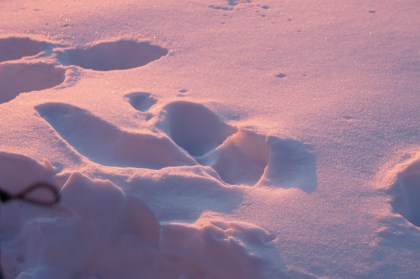
Everyone in Tucson seems to want to play in the snow! Tracking animals is much easier in snow, especially at certain times of day.

The Mogollon Rim creates a very different kind of Green Rim. This line across eastern central Arizona is the edge where the Colorado Plateau falls off into the Sonoran Desert. One week ago, I drove east and north on Highway 77 through the towns Show Low and Pinetop to ski in a foot of new powder at Sunrise Ski Resort. As we climbed in elevation, bare ground shrank as shrubs and grass cover increased. Saguaro cactus and agave were replaced with pinion pine and juniper trees, and, ascending into the mountains, taller, more majestic conifer forests.

As we ascended the Mogollon Rim toward the Colorado Plateau, the landscape became greener and whiter and colder!

The variable environments provided  by the Mogollon Rim, the Colorado Plateau and Sonoran Desert, and the archipelago of Sky Islands, increases the biodiversity of this spectacular region.

Cool perspective of the people benefiting from Starizona's generous donation of eyepieces for use on the Jamieson telescope at  the Mount Lemmon Sky Center.
Cool perspective of the people benefiting from Starizona’s generous donation of eyepieces for use on the Jamieson telescope at the Mount Lemmon Sky Center.