You ever wonder what animals are doing when you’re not around? I did. Especially what they thought of some little structures I’m using for my field experiments this summer. So I set up some Bushnell TrohpyCams by a few structures to see who came by and what they wanted. There are some peanut butter coated oats near the cages as bait. There were also track pads, which some folks at Saguaro National Park were awesome enough to lend me….. but monsoon season is unpredictable, and a cloudburst wiped all the chalk off my tracking plates before I could get to them. Here are a couple of fun ones.
I love that at the end of the second one, the desert cottontail rolls in the dirt, much like my roommate’s cat.
I am back in Tucson, after 3 weeks of the field course I have been posting about.
CEDO’s visitor center in Rocky Point houses researchers, outreach staff, visiting groups like ourselves crashing on a wood deck, and events like their environmental contest that drew hundreds of people just yesterday.
More photos and stories to come, but for now, we can say I’m already missing waking up to the sound of waves on the deck of the Intercultural Center for the Study of Deserts and Oceans (CEDO). There, we helped revive a recently neglected long-term data set on the composition of tide pools, danced in the mud until shrimp started crawling up our legs, and snorkeled with thousands of playful sea lions.
Counting snails at first light in a hula-hoop sized area along four parallel lines leading into the surf.
After one week on the run from Biosphere 2 to a camp in the Santa Ritas, the field course has been holed up in a hideout on Mount Lemmon for the past week. Tonight, I have internets (and a shower!). Saturday, we flee onward toward Mexico. Here are a few of the highlights so far.
Post saguaro census at Saguaro National Park East. Note the lack of saguaros in our plot.
The mammals we encountered, or How I Earned the Nickname “Hantapants”: Deermice occur in this region, and have been known to carry the dreaded hantavirus. After I handled an adorable little disease vector too timidly, allowing him to escape, he disappeared.
“Where is he?” I asked the group. “Be careful not to step on him!”
“He’s up your pants!” someone told me.
Instead of carefully feeling along my leg and trapping the little bugger, I unfortunately jumped up with a shriek, and started shaking my leg. Not my proudest moment. Fortunately, the mouse survived uninjured, and so did I (so far).
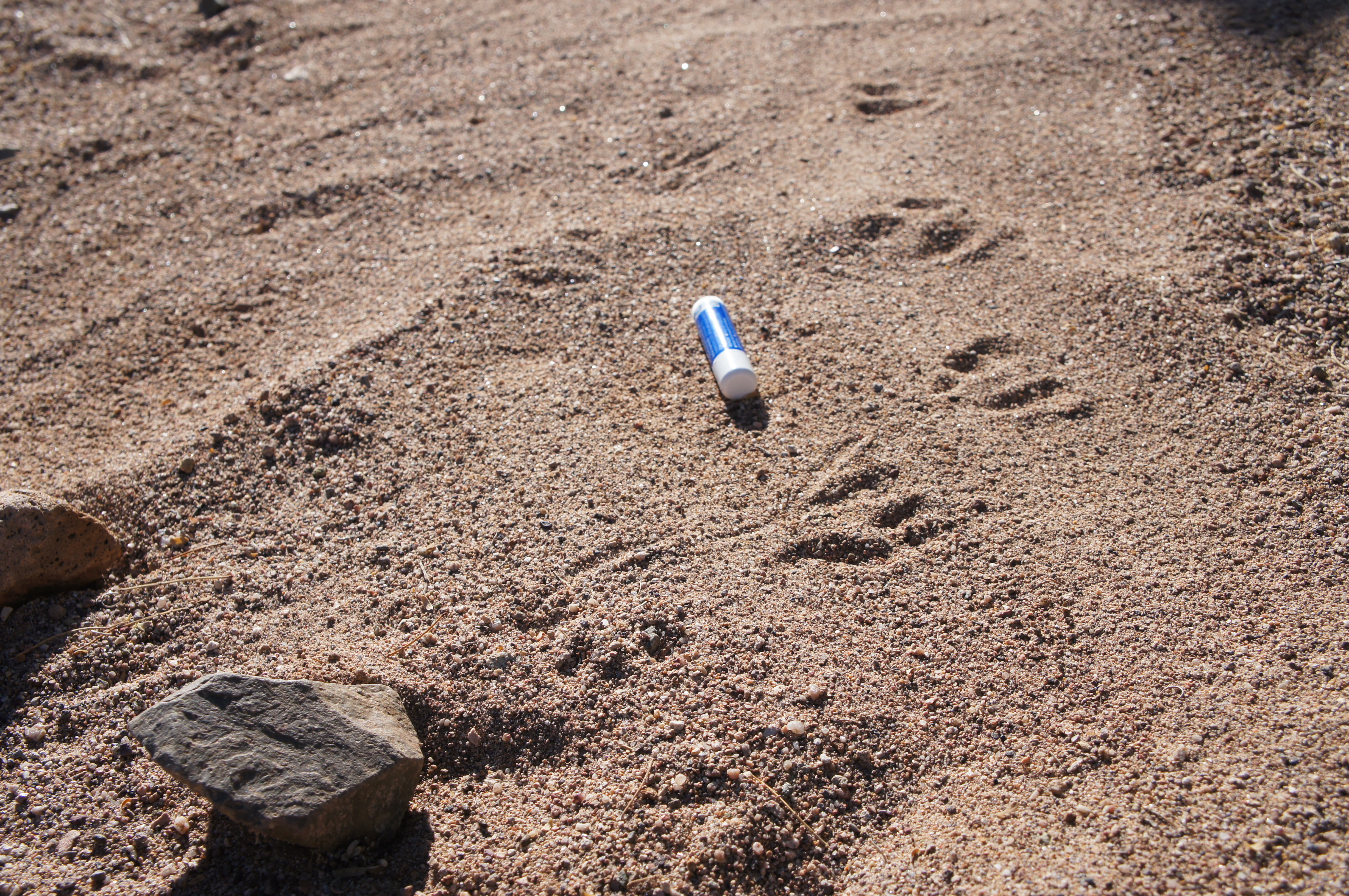
Kangaroo rat (Merriam’s? or Ord’s? Haven’t conclusively ID’d the species) tracks in the early morning light, with chapstick for scale.
In other mammal news, we’ve also found packrats and pocket mice and kangaroo rats. One student, who we’ll call Phil, even managed to surprise a mountain lion on Mt. Lemmon by falling down a hill to where it was chilling. Both Phil and the lion were pretty startled, but survived the encounter. The rest of us were jealous, and disappointed he didn’t get a photo.
Food: Every day.
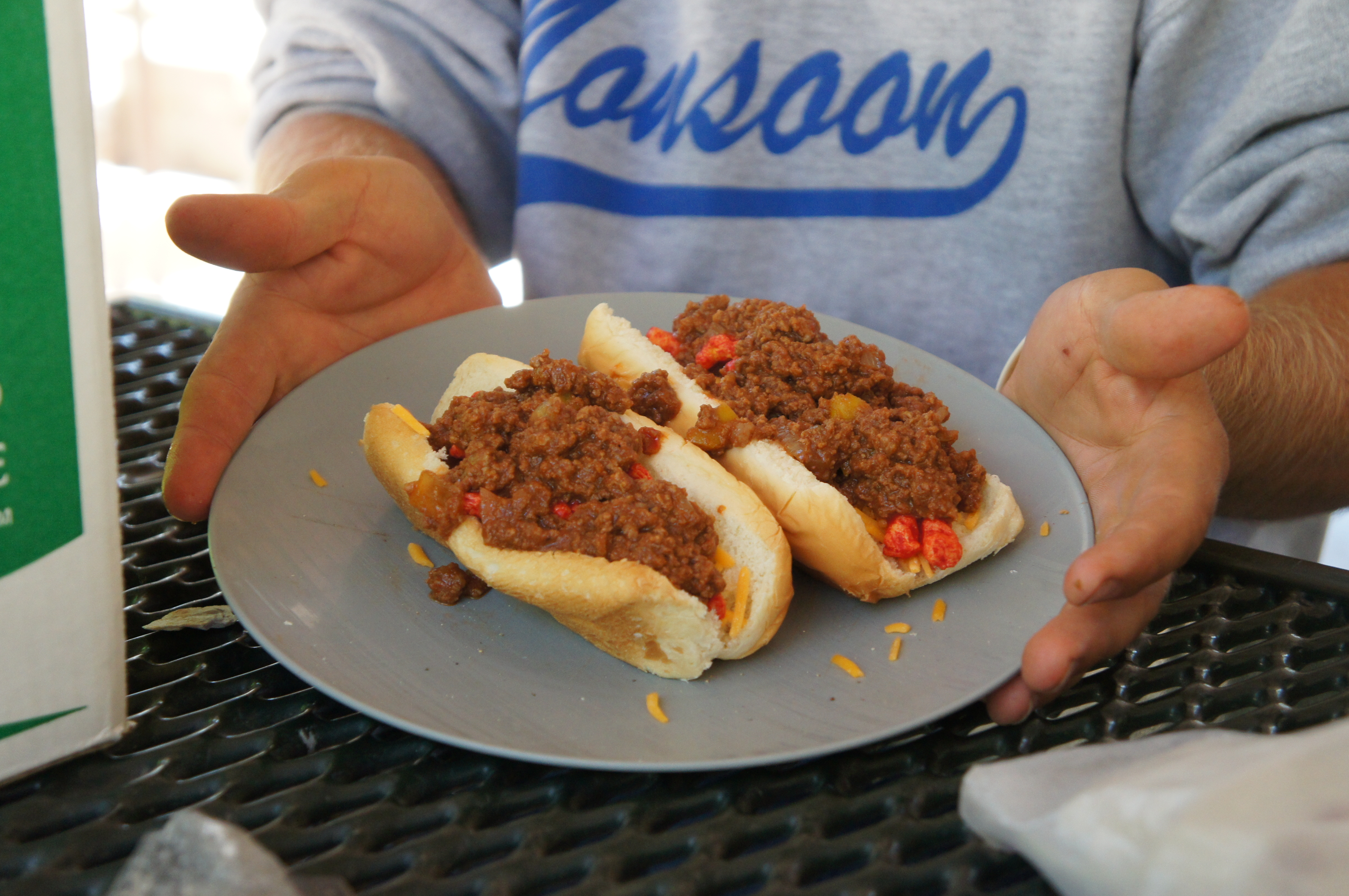
I’ve learned that 14 people’s worth of food for 5 days is really hard to estimate, but that having a little too much is preferable to a little too little. I’ve also learned that you will be heckled no less if there’s extra than if you’re short, and that sloppy joes taste okay for lunch the next day. One student, let’s call him Trenton, transformed the ingredients to make hot-cheeto-sloppy-joe-dogs.
The only way to eat leftover sloppy joe, clearly.
Besides the plethora of sloppy joe fillings, we have acquired an overabundance of s’mores ingredients. Perhaps this is the reason the cookies involved with birding (expained below) generated so little competition within the group.
Will it be fooled into thinking Kevin is a canid (dog or coyote) and squirt blood into his mouth? No.
The course instructor, who we’ll call Kevin, is in fact NOT eating this horned lizard. They are probably not good to eat, since they are one of the few vertebrates that can deal with ants’ formic acid, and survive on a diet of mostly ants. We did learn at Raven’s Way (our stopover in the Santa Rita mountain range) from Vincent Pinto that some other common small lizards can be a good food source in a survival situation, in addition to the invasive crayfish we caught and ate (pictured below). We also grazed Texas mulberry and ocotillo flowers and goosefoot out in the field. This was a more human and useful side of our ecology and natural history experience.
Mmmm, delicious invasive species that we waded through a creek to collect.
Other herps: mostly the first week
“Herps” being short for “herpetofauna,” (think “herpetology,” or study of reptiles) not “herpes.” Did you know the push-ups lizards do are a display of their brilliant chest color to intimidate other males away from their territory? The gila monster was the only venomous reptile we have caught so far (do NOT try that at home – Kevin’s a professional).
Wild? Yes. Venomous? No. Gopher snake? Yes. Male? Yes. Want to know how I know that? Definitely not.
Water and elevation: the first and second Tuesdays.
The instructor of the field course has implemented an experiential learning technique I suspect to be unintentional, but effective, to emphasize the importance of water resources in this environment. He tells us we’re going on a relatively short early-morning hike, or that re-fills will be possible. Then he either changes his mind about the length of the hike, or takes off with our water jugs, leaving us on empty. I think the importance of shade and water resources for Sonoran Desert ecology is pretty intuitive by now.
Birds: Tuesday-Wednesday
The last time I tried to go owling, I wound up seeing more mountain lions than owls. This time, I mostly saw sleepy college students. The last two students to come in did claim to have heard a great horned owl, but it was awfully windy. Owls are probably less active in windy conditions, or at least respond less readily to the calls of birders. But I did learn how to whistle for a saw-whet and a flammulated owl from Jennie Duberstein, of Sonoran Joint Venture, who joined our field course for an evening and morning to go birding with us.
Mexican jays eating peanuts from the “feeder.”
They will weigh several before choosing their favorite to take first.
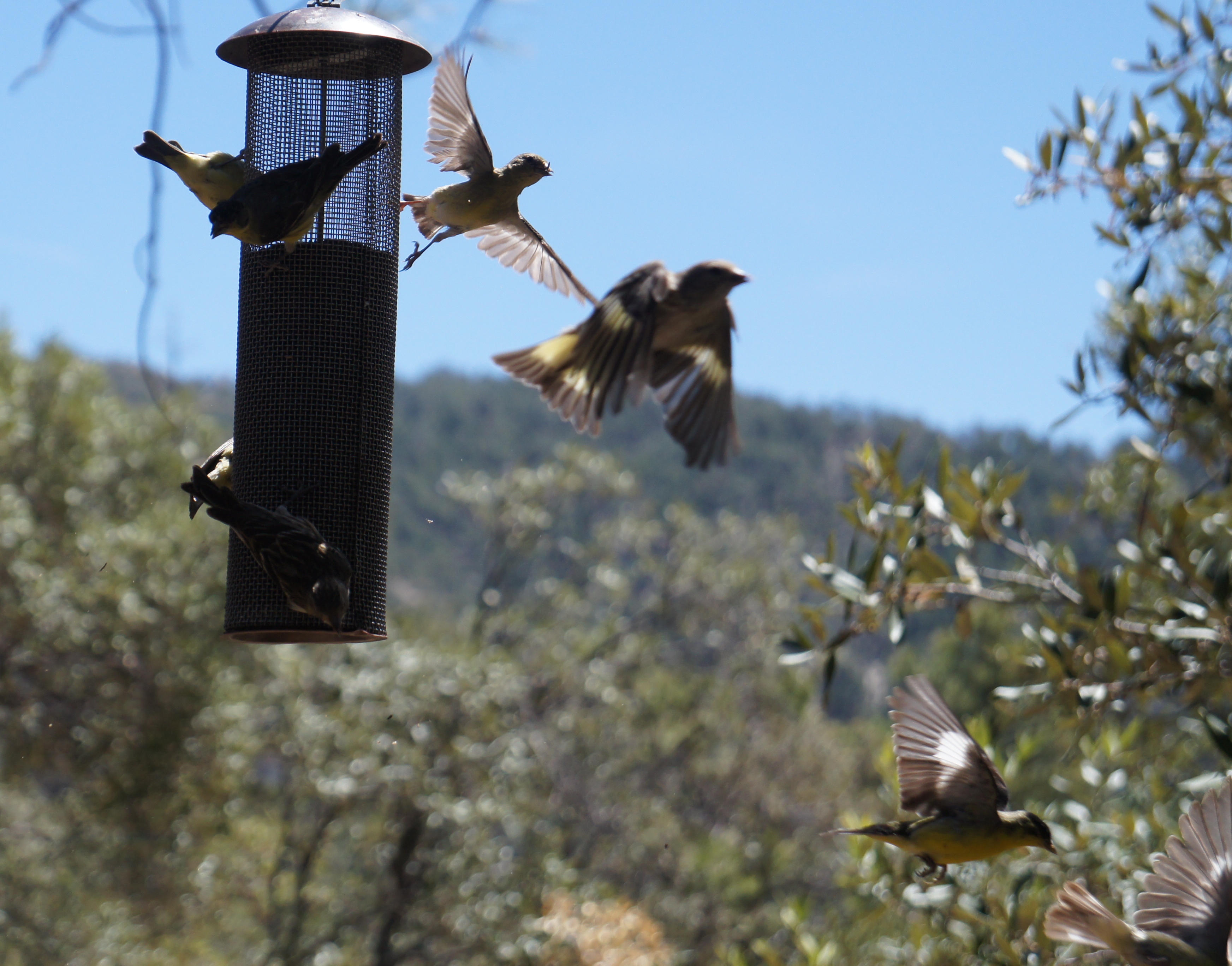
The lesser goldfinches and pine siskins are far less picky, and less territorial than the hummingbirds, but they scare easy, especially when a hawk circles over head.
Fortunately, we had a chance to look for other birds, too. At a lovely Desert Museum docent’s cabin, I compared the behavior of hummingbirds (Anna’s, broad tailed, and magnificent) at sugar-laced feeders, where the females chased the males away, to the behavior at the sugar-laced mammal-feeder (a cookie jar), where our little field course tribe shared resources much more amicably. Over the last 24 hours on Mount Lemmon, we also watched Mexican jays weigh peanuts to decide which were likely the
tastiest, and heard Stella’s jays, verdins, vireos, and black-headed grosbeaks sing. We watched blue-green gnatcatchers darting from their posts, a house wren harassing a drilling acorn woodpecker, and the Arizona woodpecker, tawnier and endemic to the area.
Geology: sometimes actually useful
The substrate and topology of a landscape have a lot to do with the biomass and the type of organisms found there. Kind of an obvious point, but seriously, I’ve been wanting to know the deeper backstory of the mountain ranges. I can tell you briefly where this nice gneiss comes from, and how you can tell the direction of the stretching that formed it. Ask me sometime 😉
Heavenly bodies:
Yeah, after a week without showers in the Sonoran Desert region (even based on a sky island), all our bodies smell not so heavenly. Especially with 14 of us in one van whose air conditioning is, well, Sonoran Desert-ish? On a recent stop through Tucson to eat lunch after censusing saguaros at a national park, a student we’ll call Nine Toes (see previous post about needing some wilderness medicine skills) mentioned how nice and flowery our waitress smelled, and we mentioned how creepy it might seem for him to walk around sniffing waitresses. But we secretly all knew what he meant.
Let’s all stare at the sun.
The other kind of heavenly bodies:
May 20’s solar eclipse was 85% visible from the Tucson area! We were just beginning our stay on Mt. Lemmon, so we found a nice viewpoint and observed the moon’s progress using solar viewing glasses generously provided by the Mt. Lemmon Sky Center. It was a really cool sight. Don’t miss the transit of Venus coming up in June! I highly recommend these glasses if you can get a hold of any (Arizona’s astronomy department was selling them for $5 a piece as a fundraiser).
Field courses were what quite possibly made me decide I should be a biologist. Something about
…hiking around the Salt Lake City foothills as a high school student to sample diversity at local geographic maxima,
…or watching the sun rise over the Mojave Desert while checking mammal traps in college,
….or dubbing our mud-sliding density-at-breast-height tree sampling in the Ecuadorian Amazon “Indiana Jones biology” that captured my interest and imagination. So I am pretty stoked to be the teaching assistant for this course right now:
Of course, it means that I’m essentially out of town for three weeks right before my field experiment for the summer kicks off. Today was the second day of the course, and we’re already utilizing all the combined medical and mechanical skills of the group. On to day 3!
That’s what my roommate, Lila, said after climbing up the big pine our backyard with ropes and a harness and ascenders. I felt the same way the first time I climbed up 20 or 30 feet using just prussik knots.
Have you ever wondered exactly how activists, scientists, and anyone else crazy enough to climb that high get up to the rainforest canopy or redwood trees? These aren’t your backyard branch-scrambling venture. The first branches might be scores of feet above the ground, and the trunk too wide to reach around. One of my friends in grad school is about to embark on some research doing just that – and fortunately a few other grad students have some experience in this department and volunteered to show her the ropes, as it were. Even more fortunately (for me), I have a rather large tree by Tucson standards in my backyard, so I got to tag along and do some climbing too. While climbing with ascenders is not too different than prussiks (just a lot smoother and faster), I especially enjoyed learning techniques to free-climb the rope and the Munter hitch for emergency rappels without a rappel device (like an ATC or GriGri).
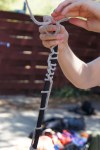
Securing one end of the rope low on the trunk.
There are many ways to climb a tree! My other roommate, PJ, made this ladder Marielle is demonstrating from the scavenged boards of a dumped frat couch and a retired climbing rope.
Ty shows us off his free-climbing
Marielle models the use of ascenders and grigris
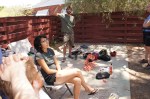
The peanut gallery
Loren gets the hang of the equipment right away
How do you get a rope over a high branch? Here, Loren prepares to fling a lead-filled throw bag. Apparently in the Amazon they take out a crossbow. I’m kind of jealous, but I understand why we shouldn’t use that in a densely populated neighborhood
Turns out aiming that throw bag is tough! Ty finally gets a good toss.
Getting the throw bag over a branch is only half the battle – next you have to get it back down. Ty demonstrates the whipping motion require to loose a weighted rope from rough bark and allow the bag to drop back to earth.
Knots to tie the throw back and a light cord to the actual static rope we’ll be climbing in order to situate it on the right branch
I had noticed over the past couple of months that often a line of flower petals and leaf fragments would extend from one side of the yard across the driveway. Only a little line of them, though. It seemed like a very mysterious pattern for wind to arrange them in.
By now, you’ve probably beat me to the conclusion that should have been obvious to someone studying biology: ants!
They are only active around dusk, busying themselves as the pavement cools, then tucking themselves away later, often leaving a trail of detritus in their wake along the otherwise invisible superhighway, but only about 3 meters or more from their nest. I have this image in my head of the word going out along the line, “Time to go home! You have three minutes to get there!” and those ants that are far away dropping their colorful burdens and booking it. Or maybe it gets too hot or too cold to continue foraging, and those closest to the nest continue dragging themselves forward, goal in sight, but those further away give up on their final contribution for the evening to concentrate solely on dragging themselves in, shivering (not really) or heat exhausted (probably not at night, but anyway…).
My roommates had understood what was going on far before me, and have even provided some commentary.
“Look, they’ve been decorating!” PJ told me the other night. And so they had. The green little mountain had turned yellow from palo verde blooms, and then red from another flowering shrub a few days later.
Last night, I went on a jog up Tumamoc Hill at sunset to get a look at where the buffelgrass invasions were. (Tangent: I’m pretty convinced that sunsets get more beautiful as it gets hotter. I have no idea whether there are any heat- or humidity-related processes that actually change the visual effect, or whether the relief from burning radiation is just greater, later in the evening, during the warm months.) Ss I stepped through the gate onto the road that winds its way to the top, I was most certainly not alone. An antlike superhighway of people extended to the top of the hill, there and back, passing one another. We were not encouraged to carry large vegetative structures off the hill with us as ants would, but I did notice some palo verde had set seed up there, and was temped to try germinating them back at the lab…
The only tame and trained ringtail (Bassariscus astutus) in the world?!
It was only because the lab bench got gotten dusty that the tiny, five-toed pawprints showed up at all, giving him (her?) away. My labmate brought in a cat-sized trap, but we never caught anything. It must have been aringtail (Bassariscus astutus).
It seemed exotic to me that a creature I associate with backwoods canyons was camping out in our building on a busy university campus in the center of town! But the Desert Museum handler of this ringtail I photographed at the Earth Day event at Biosphere 2 assured me it was not uncommon. Much like the Foxface character in The Hunger Games, these clever critters (look at that scientific name: means smart little fox!) hide out in attics around Tucson, perhaps stealing little bits of food, but never so much you might know it’s gone – or perhaps foraging on more pesky creatures also lurking around your place.
This one, safely in a harness, flowed through the trainer’s hands, much like I have seen pet ferrets do. She (I think) seemed awfully alert for that time of the day, but then again, there were an awful lot of people around. I wonder if she was smelling wild cousins – after all, I imagine Biosphere 2 could support a whole crew!
Yesterday was the final day of Washington, DC’s, Cherry Blossom Festival. I would have been sad to miss the hordes seeking serenity from the pink cloud surrounding the Reflecting Pool, but we have our own show going on here in Tucson.
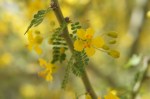
Just outside my front picture window is a sunburst of a palo verde (Cercidium microphyllum). You can see in my photo of the hummingbird nest that the entire trunk and bark is green – and yes, that is for photosynthesizing! Leaves lose too much water here, which might be why this tree that minimizes their area (“micro” and “phyllum” meaning little leaves!) has been so successful. But how does that tough bark-y structure breath, if not by the same stomata that lose water in the leaves? I don’t know the answer to that, and a quick Google Search doesn’t either.
Exploring the cherry blossoms in 2008…
…along with the hordes
That is far more water or monument than the palo verdes have here in Tucson.
So many flowers!
Tiny little leaves
The view of my house with some palo verde in the way (see that nice climbing tree in the backyard? By the way, both my roommates are leaving for grad school…)
It’s easier to see the greenish surface of the tree – and the little hummingbird in her nest! – without all those gorgeous flowers to distract you.
Despite the similarity in these trees’ structures and seasonal showy blooms, cherries and palo verdes have almost nothing in common. Palo verde (meaning “green stick,” this tree leaves nothing hidden) is in the pea family, Fabaceae, order Fabales, while the cherry tree common on the National Mall(Prunus x Yedoensis, or the Yoshido cherry hybrid) is in the rose family, Rosaceae, order Rosales. You have to get all the way back to their class, Angiosperms, which means they are both flowering plants, before they have some lineage in common. Given that the vast majority of plants on earth are in that class, they really don’t have much to talk about.
So would I take the liquid sunshine of the palo verde over the delicate blush of the cherries? Well, we may not have an entire festival for the flowering trees (allergies, anyone?), but we do have the Taco Festival here in Tucson today. Eat that, DC.
I looked around at the faces nodding at me. Germinar did seem to be how one said “to germinate” in Spanish – another fortunate cognate.
Okay, here's a picture of a seedling. El ha germinado.
I was at the Next Generation conference, and very happy to be discussing my research plans with other scientists great like Daniel Morales and Blanca Romero studying plant, microbial, and animal dynamics with the same nasty invasive grass I am interested in, known often as zacate buffel or pasto buffel.
Ecology is probably easier for me to discuss in Spanish than what I did last weekend, really. I know some of the vocabulary, much of the rest I can guess, and there is less slang and fewer funky subjunctive tenses. Wait, did I say ecology, with all its complex systems and policy implications leading to opinions? Sigh, never mind.
Fortunately, most of these folks also spoke English (better than my Spanish), and I muddled through sufficiently to get some really exciting new results and suggested methods for germinating Sonoran perennial seeds from them!
The tunnel leading to Biosphere 2's lungs. Those massive structures kept the glass from blowing out as the sun heated the enormous greenhouse daily during the two missions when it was sealed up. For Earth Day, Biosphere 2 was letting people wander through without a structured tour, and I found myself lurking alone in this transition point.
I’ve had an incredibly inspiring and tiring week, attending the Next Generation of Sonoran Desert Researchers conference, rolling with Sonoran Desert Discovery to Earth Day events at the Desert Museum and Biosphere 2, seeing the undergraduate research I was a part of at the Ecology and Evolutionary Biology poster session… it’s enough to get me pumped up for a summer of fieldwork even as the temperatures hit 100 degrees already! I’m going to have to spread all this information and infatuation out over a few weeks. The plan is to update on Tuesdays, Thursdays, and Saturdays over the next couple of months, so that on days when XKCD isn’t fresh for you to procrastinate with, you can waste time looking at something in the Sonoran Desert instead. It might even be enough to make you wish you were sticking the summer out to see all the action of the monsoons too… or it might just make you glad I’m willing to do so and that you can get a window in on it from somewhere sane like Colorado or Pennsylvania or Brazil.
















 Biologist. Explorer. Storyteller.