Pushing the frontiers of human knowledge through scientific discovery is a lot of hard work, but being curious and using real life observations to answer your questions doesn’t have to be.
Ever hear a claim of how conditioner will increase the thickness of your hair and think, “Yeah, right,” but be unable to test it out? If only you had a microscope you could use to measure the thickness of your hairs before and after using that conditioner….
Which is why it’s great that some public libraries let patrons check out microscopes like a book for up to a week! The Louisville Public Library just bought two new scopes for families to check out.
During their monthly maker-space expo, which was science-themed for September, I had the opportunity to introduce visiting families to using the microscopes to look at some of my favorite Antarctic microscopic animals to spy on: tardigrades!
Tardigrades are microscopic animals that are famous for their ability to withstand drying out, freezing, and the vacuum of space. They are also kind of adorable, with common names like “water bear” and “moss piglet.” When placed on a glass or smooth plastic slide to be observed with a microscope, they appear to run in place, going nowhere fast.
I was scrolling through droplets of water and cyanobacteria, searching for a tardigrade to show visitors, when a kid showed some particular interest in the microscopes. I coached him through making his own slide with a water dropper and slide cover, then setting it on the microscope and moving it around. He was the one who found not only a neat ciliated protozoan, but finally got us a tardigrade to watch!
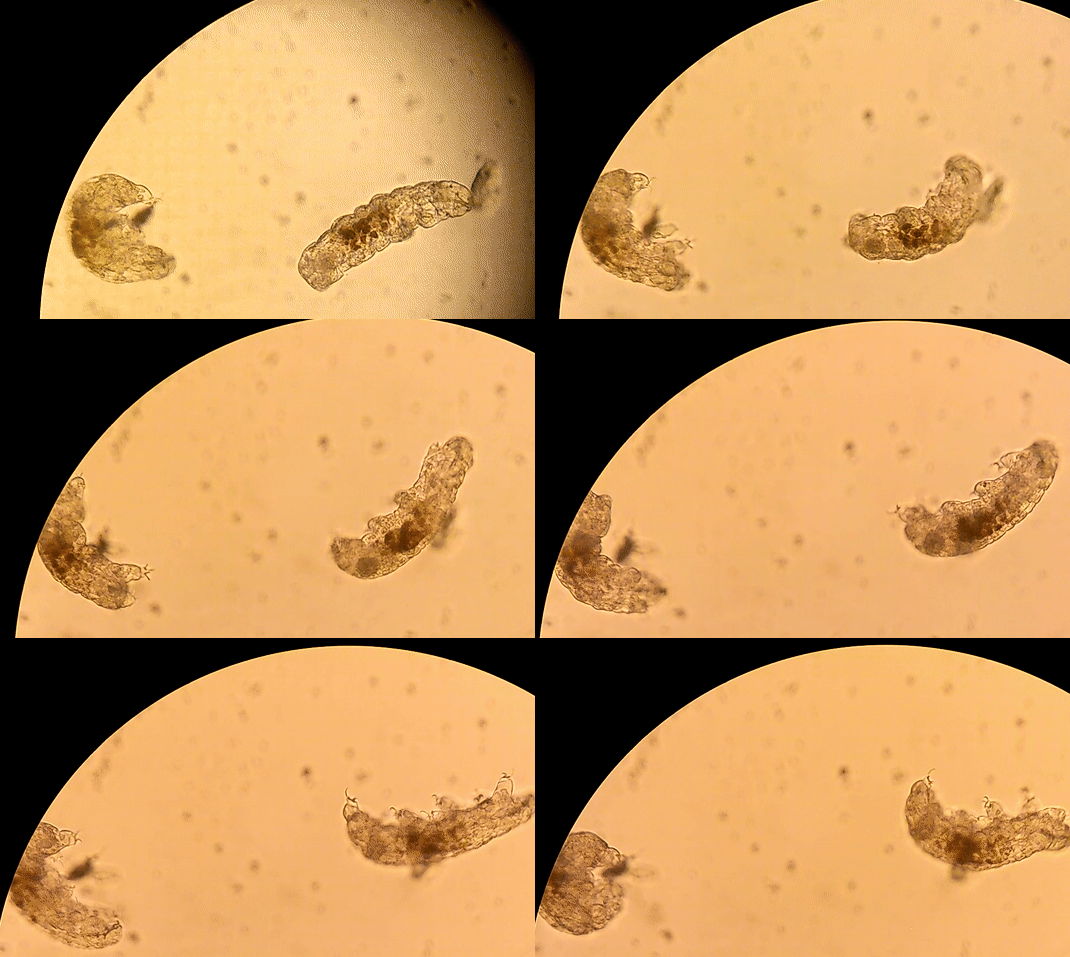
We named the tardigrade Louis after the Louisville Library. I didn’t take any video of Louis, but here is approximately what it looked like, from previous video I took of Antarctic tardigrades:
“Are you standing over a crevasse?” “No.” “Can we stop a moment? I need a picture of this mud puddle!”
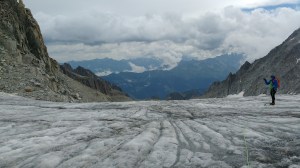
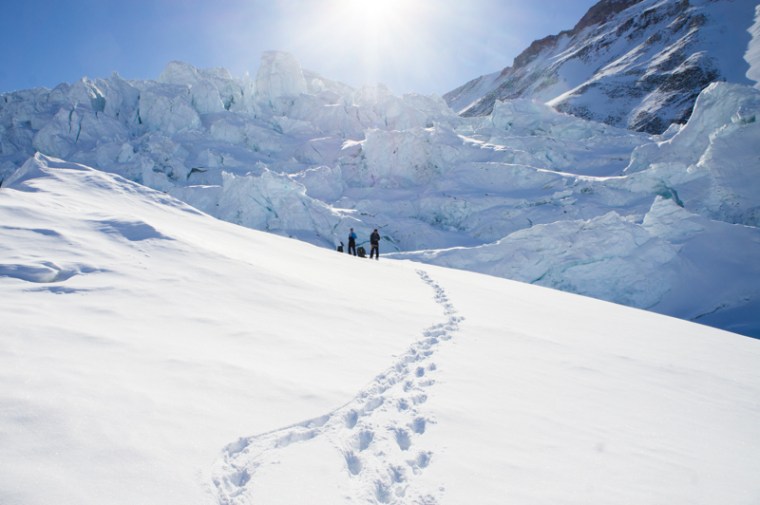
Cryoconite is a fancy word for dirt on a glacier. Which is why my friend, Martin, who I was roped to on a Swiss glacier, seemed amused at how often I wanted to stop between jumping crevasses to excitedly photograph the mud puddles.
At one point he pointed out it’s basically the same dirt we had been hiking over beside the glacier that was blowing down onto the ice.
But the difference to me is how the bacteria and other microscopic life in that dirt change in their growth patterns with the addition of water. I study the microscopic life in cryoconite holes on Antarctic glaciers (see more about that project here). I was very excited to see cryoconite in a different part of the world.
Other groups are studying cryoconite on alpine glaciers, like these guys and these guys and these guys. This glacier looked very different than our study glaciers in Antarctica, partly because it was more of an entire debris field rather than isolated little islands of sediment, more like the cryoconite at the Alaskan site that my friend, Jack, just published a neat paper on.
Below you can see the difference between small, shallow, muddy cryoconite holes on the alpine glacier (left) and the larger, ice-lidded Antarctic holes that appear as dark circles of clearer blue ice (right).
Conditions in Antarctica right now are dark, cold, and inaccessible. Most of the plants, animals, and other living things – at least the ones on land – have gone to sleep for the winter. Of course, when I say “to sleep” in Antarctica that typically means dried out, frozen, or both – and they can still wake up from that! Antarctic critters are cool like that.
Anyway, this is the season that biology is not very interesting in Antarctica, so it’s a good time to analyze and present data to other scientists somewhere warmer, like Belgium. I was at the American research base McMurdo last season, so I met mostly Americans, but Antarctica is a unique continent because it is governed by an international treaty for use of peaceful scientific purposes.
Anthony Bordain – yes, the celebrity chef author/TV host – did a recent episode of his show in Antarctica (he was there filming while I was there in January). Whatever you may think about his style and his show, I was surprised and impressed by the thoughtful conversations he had with scientists and support staff of many stripes about life there and the importance of science and empirical facts. If you missed it, you can stream it for about $3 on Amazon. I recommend it, if only for the view out the helicopter as they land at the camp in Lake Hoare, where I worked. I hear that sight never gets old, even after dozens of seasons.
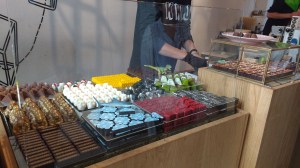
I also love the Belgian chocolate shops, like Bittersweet.
Although I met mostly Americans on the ice, I was aware there were many other national bases, which is why I was so thrilled to give a talk at SCAR Biology – a chance to meet Antarctic researchers from elsewhere! The conference welcome letter said there were about 400 attendees from about 30 countries. I love hearing all the different languages spoken around me. I have had fascinating conversations with people from at least a half dozen countries. I am still new to Antarctic biology, and am learning new things daily.
Here is a (very) incomplete list of things I have learned so far this week (note: this is not peer-reviewed or technical, and I might get some details wrong, so take these with a dash of skepticism):
Cryoconite holes can form not only on glaciers, but on ice shelves. That makes sense, but I had not really thought about it before.
Some algae in the McMurdo Dry Valley lakes produce antifreeze protein.
Rotifers are picky eaters who sort their food, not indiscriminate filter-feeders.
Overwintering crews at Antarctic stations show similar immune responses to astronauts, including fluctuating underperformance and overreaction of immune systems.
Diatoms are flying through the air in the McMurdo Dry Valleys.
Someone was once stabbed to death on a research cruise (not an American one) over a romantic interest.
Although cryoconite holes have been proposed as a likely feature to host life on other planets or even comets, there are some good reasons why they might not be likely to host life on Mars.
And then an iceberg the size of Delaware broke off the Larson C ice shelf, and Antarctica was in the New York Times (again – their reporters were down there this season while I was there, too). I’m a biologist, not an ice-shelf-ologist, but what I understand from reading expert opinions is that it’s the kind of event that happens, but is more likely to happen more often with climate change. And if it happens too much, and too much of the floating ice holding back the ice sheet from pouring off the rocky continent into the ocean goes, then we’re looking at more rapid sea level rise. So my understanding is that it’s hard to say whether this particular berg would have broken without climate change, but that this is certainly not a good sign. It’s neutral or ominous, not hopeful.
I have not heard much discussion of it today at the conference, even from marine biologists. Icebergs break off ice shelves, and this change is one more data point in the overall trend, is all. The media are not calling biologists for comment – I suspect the public is more interested in whether we will have to canoe to the grocery store tomorrow than whether the next generation will grow up without tuna fish sandwiches because the ocean ecosystems have collapsed.
But the iceberg break-off, along with a new analysis published in Science showing the relative magnitude of various actions to reduce a personal carbon footprint, has me thinking about the fact that hundreds of people took transatlantic flights or the equivalent to be here.
Several of the sessions at the conference are specifically for presenting research on human effects on Antarctic ecosystems, including the effect of climate change. Although atmospheric patterns result in my study site not changing at this time, the oceans have been absorbing perhaps more of the heat than some early expectations – and what does that mean for fish? I went to one talk on the adaptation of fish in the Southern Ocean to heat shock. The conclusion was that given millions of years, the fish could adapt to survive warming of the ocean by a few degrees – but that current projections don’t give them millions of years before we hit those temperatures.
So is it worth the carbon spewed into the atmosphere for us all to be here?
On a personal level, I am tempted to say yes. Yes, because while Skype is wonderful for connecting people in a low-carbon way, casual proximity yields the reshuffling of disciplines that create the combinations that wind up being advantageous, analogous to reshuffling DNA between multiple organisms in sexual reproduction (hey, we’re biologists here!). The unexpected interactions can lead to exponential growth in scientific discovery. You go to dinner in a strange city with a new friend, the distant colleague of someone you met on the train from the airport, and get stuck sitting next to a stranger entirely out of your field. By the end of the dinner, you have an idea for a collaborative project next season when you are both on the ice that would never have occurred to you otherwise.
On a scientific level, it may be tricky to measure the cost in the amount of carbon produced by the meeting and the degrees warming it will add to the climate, but it is almost impossible to quantify the value of the reshuffling of ideas and inspiration to young researchers in producing knowledge. Although studies try to put dollar amounts on basic research that underpins world changing technology, the exercise can feel as frustrating as trying to pin down a price for biodiversity or for friendship.
I’m still processing these thoughts, so I’ll end with a gratuitous Antarctica photo from last season. Onward we march?
My last two weekends involved my heart racing and my palms sweating.
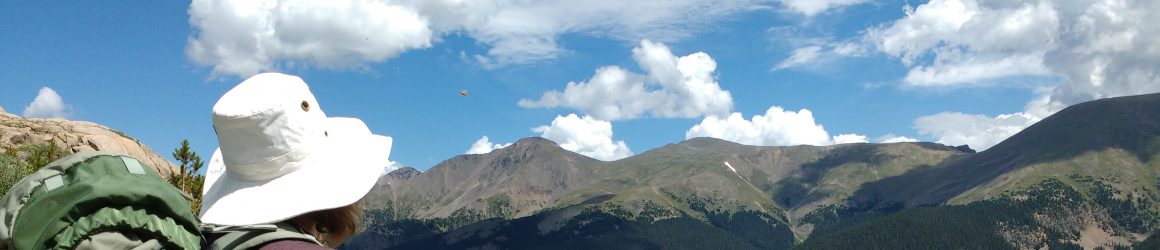
Last Saturday, I skied down my first backcountry couloir (a steep narrow gully that holds its snow until late spring) in Rocky Mountain National Park, hoping we had assessed conditions and the route correctly and none of us would be digging anyone out from under an avalanche. After decades of saying I would rather ski than snowboard because of the places I can access, I’ve finally started to explore those hard-to-reach places.
The weekend before, I rock climbed in Indian Creek for the first time. I had heard climbing friends talk about their trip to “the Creek” for years. Finally I swallowed my intimidation and tried it. Finally I saw what the big deal was all about.
The raw beauty of Indian Creek is hard to capture in a photo. Much like the exhilaration of being surrounded by blue sky and snow-covered peaks is hard to show in even a panorama, the 360-degree experience of the wide open space and the formations and the way the red sandstone overlaps itself is somehow exponentially greater than the sum of the photographed area.
Both of these places are on public property. Who does it belong to? All of us. Public land is a legacy of all Americans. We can all go to Rocky Mountain National Park. We can all visit Indian Creek. And it’s up to all of us to take care of these places, to not poop in the communal sandbox we all play in, so to speak.
Certainly we all need to metaphorically poop: we need some areas in which to mine for minerals we would like to continue use in smartphones, for example. That is why we have public lands designated for “multiple uses,” or as some people joke, “multiple abuses.” I may not know all the details of the Bears Ears National Monument, for example, and which sacred Native American sites it is meant to protect, but I know it includes Indian Creek, and I know that is a special place, not just for the world-class rock climbing, but for its dinosaur fossils.
The access and the space and the shared responsibility are why I am concerned about the movement in some western states to sell off federal public land. That land is a legacy of all of us. It would be tragic to sell it off and lock ourselves out of the many hidden places that make America great.
“Which one of us do you think is older?” I asked the sixty or so fifth graders seated on the floor of their school library, in an elementary just outside Denver, CO. “Raise your hand if you think she is older.”
About half the kids raised their hands. We probably both looked like generic grown-ups to them.
“Raise your hand if you think I’m older.”
About half the kids raised their hands again, including maybe some of the same kids, just covering all their bases.
“I’m two years older,” I confessed.
“But I’m taller,” added Aleah, my younger sister.
We were doing a joint presentation to the fifth graders on glaciers. Aleah is a PhD candidate at the University of Colorado at Boulder in Civil, Environmental, and Architectural Engineering, where she has been funded by NASA to use numerical modeling to understand how liquid water affects the melting of Greenland’s ice sheet. However, she has also used her background in engineering to find new ways to test the water storage capacity of upper layers in glaciers, which are partially compacted snow called firn. (You can see some of her published work here and a short video on her research here.)
Last year, at about this time, she traversed Greenland by snowmobile, measuring the firn with a prototype of a device she and her husband (also an engineer) had worked out. You can see some photos and stories about that traverse on her blog.
That was shortly after I had moved to Boulder to start studying microbes in glacial mud puddles called cryoconite holes. I recently returned from my first season studying microbes on Antarctic glaciers, which you can learn more about on our project blog.
Anyway, now that we both study glaciers after a fashion, when Aleah saw an email request from a fifth grade teacher seeking real live glacier scientists to talk to her class about glacier research, she forwarded it on to me, saying:
Hey – would you be interested in doing this together, if they’re still looking for someone to come talk about glaciers/ice sheets? We have great photos and stories from Greenland and Antarctica… It could be fun. And I never interact with 5th graders!
I of course have often interacted with fifth graders over the past several years of helping to launch Sky School, an outdoor science program at the University of Arizona. In my new position, I’m glad I have time to work on my research but I do miss teaching a teeny, tiny bit! A one hour presentation – with my sister – sounded like fun.
The silly putty glacier flowed down the slope and fanned out at the bottom, much like the glaciers I work on in Antarctica.
I learned some things about glaciers myself. For example, in order to be considered a glacier, the ice must be present year-round, and it must be flowing. That’s right, glaciers flow like a very, very slow liquid. This required a silly putty demonstration! (Fun fact: At least a few weeks ago, everyone in the Boulder-Denver area in the fifth-grade range was apparently making silly putty at home, and the hardware stores around town were having trouble keeping Elmer’s glue in stock.)
Besides giving some basic glacier facts, and talking about how they shape the surface of the earth (the curriculum standard we were hitting) and why glaciers matter to people, we showed pictures of each our field work on glaciers and answered questions.
One of the best parts of the presentation came later, when the teacher emailed us to say that one of the girls in her class told her she wants to study glaciers when she grows up! (Of course, I promptly sent her a link to this great program for high school girls… a few years early for this student to apply, but still.)
I had a blast getting to talk science and hang out with my sis for an afternoon. If you have classes in the Denver area (or within driving distance) and want your students to hear about life on The Ice, let me know – I’d be up for an encore. I might be able to convince my sister to do it again, too 🙂
Also, since I’m posting this on her birthday, happy birthday Aleah!
I say “weekend” because the official work week there is six days (only Sunday off), and if you’re in a field camp or doing science, that often means working seven days a week. Although we were in Antarctica to work – and we did work a lot – when you are on site for three months, it’s a marathon and not a sprint. You have to take breaks to care for your mental and physical health. I haven’t posted much about all the fun I had there, partly because I was focused on the work we were doing. But now I’m reflecting on my first season from back in Boulder, and I have some experiences too good not to share. (Also, the internet is fast enough here to upload all these photos in less than a day!) Some of the things we did for work were honestly the most fun (it’s hard to beat helicopters rides onto glaciers). But there was some good old goofing off, too.
Weather in Antarctica can be extreme. Therefore, one of the first (of many, many) trainings you have upon arrival to McMurdo Station includes safety regulations in high wind, extreme cold, or poor visibility. These weather conditions are classified as follows:
Condition 3: Normal. Most of the time – and pretty much all the time in the summer when most researchers are there – is considered Condition 3: no additional rules. (I never experienced anything other than Condition 3.)
Condition 2: Severe cold, wind, or poor visibility. Here’s a video someone posted of McMurdo in Condition 2.
Condition 1: The most extreme cold, wind, or low visibility. Someone else posted video of walking to work in Condition 1 – holding on to a rope to find their way!
Given this system, can you guess what Condition 4 might be? It’s too nice to work – go play outside! That’s the joke around McMurdo, anyway. So here are some of the outdoor adventures I had:
The Ob Tube
McMurdo Station is actually on an island just off the coast of Antarctica, and much of the research there is on the marine life – under the sea ice! Although there are pretty stiff requirements for diving, someone has built an observation tube of metal and glass for all of us who don’t get to dive. You walk out onto the ice shelf from the station until you reach what looks like a manhole, then you go down – one at a time (it’s a tight squeeze!). The second time I climbed down, I was lucky enough to be there when a couple divers dropped through the ice from a hole inside the nearby dive hut!
SONY DSC
SONY DSC
SONY DSC
SONY DSC
SONY DSC
SONY DSC
SONY DSC
SONY DSC
SONY DSC
SONY DSC
SONY DSC
SONY DSC
Ob Hill
Observation Hill is a high point looming above McMurdo, a cross at the top in memory of lives lost. A trail around its volcanic rocky sides was one of my favorite running routes. It felt so much like running in the Tucson Mountains or Pinacate that I half-expected to see a saguaro or a brittlebush sprouting beside the trail – except for the snow.
SONY DSC
SONY DSC
SONY DSC
SONY DSC
SONY DSC
Taking the Long Way Around
If we finished field sampling early and didn’t have to catch a lift home, we could hike through the more interesting features of the glacier on our way back to camp.
SONY DSC
SONY DSC
SONY DSC
SONY DSC
SONY DSC
SONY DSC
SONY DSC
SONY DSC
SONY DSC
SONY DSC
SONY DSC
SONY DSC
SONY DSC
DCIM100GOPROGOPR0264.JPG
DCIM100GOPROGOPR0265.JPG
DCIM100GOPROGOPR0273.JPG
Scenic Sampling
Sometimes you need samples that represent a bigger area…. and sometimes you just keep hiking along that ridge even after you collected your samples, just for fun. As we kept saying, hey – it’s not like we were going to run out of daylight!
SONY DSC
SONY DSC
SONY DSC
SONY DSC
SONY DSC
SONY DSC
SONY DSC
SONY DSC
SONY DSC
SONY DSC
Discovery Hut
Less than a mile from my dorm was one of the original landing points of several of the epic and storied British expeditions led by Sir Robert Falcon Scott and Ernest Shackleton in the early 20th century. It has been somewhat restored and preserved after years of use and abuse, and I was lucky to take a tour with a volunteer guide. I have read several accounts of early expeditions, including The Worst Journey in the World and Endurance. Seeing firsthand the conditions and the carcasses and the supplies I had read about gave me chills.
SONY DSC
SONY DSC
SONY DSC
SONY DSC
SONY DSC
SONY DSC
SONY DSC
SONY DSC
SONY DSC
SONY DSC
SONY DSC
SONY DSC
SONY DSC
SONY DSC
Castle Rock
The longest hike from McMurdo is to climb up to the high point of Ross Island and scramble up a rocky outcropping. You can make up to a ten mile loop by heading down the slope by the Kiwi ski hill (the Skiwi hill?) and back on the road. I didn’t make it up to Castle Rock’s summit until a few days before I left, when I headed up with my friend Jim – and it immediately became my favorite place on Ross Island. The photos don’t do it justice on a beautiful day.
SONY DSC
SONY DSC
SONY DSC
SONY DSC
SONY DSC
SONY DSC
SONY DSC
Marathon
One of the things I was really excited about when planning this trip was running a marathon. I had run three previously, but none since my first year in grad school, due to the time and energy required to train – and it was feeling like time for another race. I managed to get some long runs in before we left Boulder, but couldn’t run while at our field camp. Luckily, I had about a month to ramp my running back up in McMurdo as we started processing our samples in the lab.
I had some beautiful long training runs on the ice shelf road, Mount Erebus smoking in the distance against the deep blue sky. The actual race, though, was definitely Type II fun. The course was to run out 6.5 miles to a warming hut, then turn around and come back, and repeat. We battled 35 mph headwinds running out, with visibility so bad we could only see a few red flags marking the road ahead of us, no one in sight. The flat light made it impossible to tell the difference between ankle-deep drifts and patches of ice on the groomed road, and I saw a number of people wipe out hard. Fortunately Brendan ran slowly with me the first half of the first half, and let me draft off him! The second out-and-back I was on my own, though. I was proud to be one of only 14 finishers (3 of us women among that).
This post is about interesting tidbits unique to camp life in the Dry Valleys that I would never have thought to ask, and no one else has asked me either. I have now been back at the main research station, McMurdo, for a couple weeks, processing our samples and experiences. Here are a few thoughts.
I should mention that these are by no means universal to field camps even in Antarctica; I was at one particular camp that is supported throughout the season. Field camps can vary widely in their personnel and logistics.
A view of camp walking in from my tent.
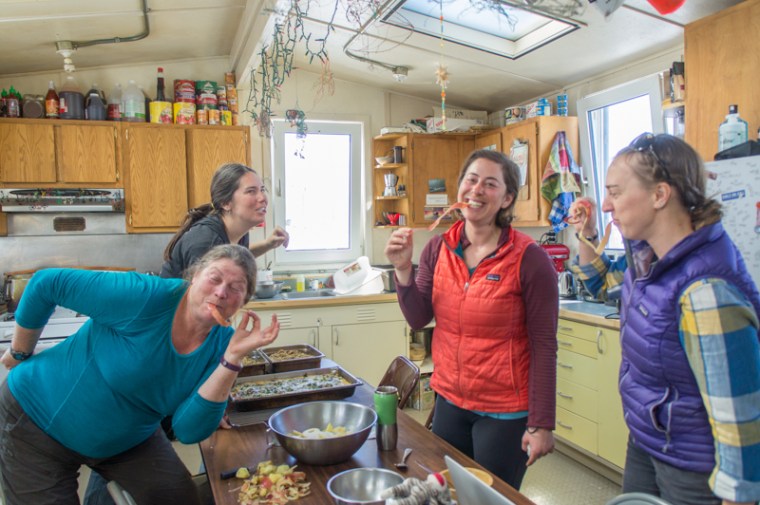
Also, as an update to an earlier post in which I said we had fresh vegetables (aka “freshies”): I started hearing rumors those would run out during December. Sure enough, the lettuce even back at the main station has gotten browner and browner for the last few days, to be replaced finally entirely by canned bean salads and steak strips coated in blue cheese. Even back at the camp, I had started discovering the expiration dates on some of the food was in ancient history – mostly for things that are still good, if a little stale, though, like energy bars. But freshies were already precious enough by Thanksgiving that when apples got peeled to make a pie, we raced to eat the peels.
Mmmmmmm apple peels! This is the cook hut at Lake Hoare camp.
How many mummies have you seen so far?
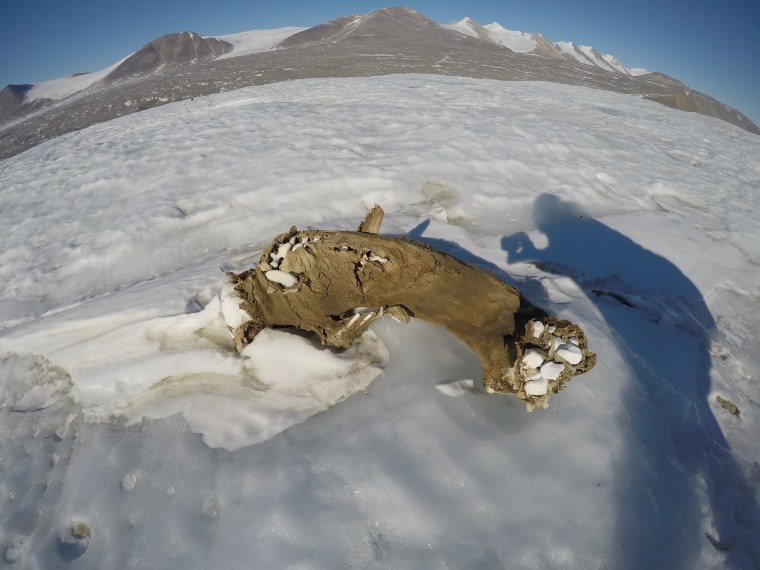
Sometimes during the summer, when the sea ice retreats closer to the land, Weddell seals and Adelie penguins wander up into the dry valleys. Why? No one knows. Are they exhausted and lost? Losers looking for love in a far-off land? Brave adventurers like Sir Robert Scott? Old and looking for a beautiful place to go quietly without being a burden? Obviously I’m personifying them egregiously here. Probably just hungry and disoriented. Skuas, which are aggressive, foraging sea birds, can clean up the penguin carcasses down to their skeletons, but seem only to be able to get the eyes of the tough-skinned seals, so the valley is littered with seal mummies. I say “littered” because I am surprised there is more than one, but they are not really that common. I have seen at least six different seal mummies so far, though, across two different glaciers and their approaches.
Terrible fisheye GoPro shot of one of the more beat-up seal mummies in the Taylor Valley.
Where do you go to the bathroom?
This is one of the weirdest for me: it feels all wrong to be camping and not allowed to pee on the ground, but this is a sensitive research area and them’s the rules. At camp, there are various forms of contained outhouses for human waste: from the low-tech urine barrels with a funnel at the top to the high-tech Rocket Toilets that burn off the contents. But on top of a glacier or if you don’t feel like hiking from your tent to the toilet, you have the Pee Bottle. For other women who have struggled with funnel systems, I recommend the cheapo version of cutting off the top of a drain cleaner bottle. It’s still a “pull down your pants and expose your rear end to the freezing Antarctic winds” sort of deal, but no spills.
Rocket toilets! In the snow! It may not seem like a big deal for it to snow in Antarctica, but it IS a big deal when it snows in one of the driest places on Earth: the McMurdo Dry Valleys in Antarctica, which is where we were camped.
Don’t you suffer from misophonia? Is living in a small camp in the cold hard in that respect?
Yep. My specific triggers are mostly chewing, slurping, dishes or wrappers that mean chewing is about to happen, knuckle cracking, sniffing, and coughing: in other words, everything that happens in the warm cook hut that we spend most of our time in when we’re not in our cold tents or out on the glacier. Last summer, I saw an audiologist and bought some low-end hearing aids to play white noise through to mask trigger noises. I am still getting used to using the hearing aids consistently, but I am always surprised at how much they help.
This is an icicle. INSIDE my tent, not outside. Approx. 3 inches long. It’s cold!
What’s the SNOW like? Is it dry? Are the layers well bonded? – Marielle
The short answer is that I haven’t seen much snow (until now!).
Most of the side of the island McMurdo Station is on was pretty snow-free by the time I arrived, whether from wind or sublimation or both, I don’t know. (Definitely in town there was some evidence of plowing, but even the slopes above were pretty bare.) I was pretty busy in town getting logistics set up, so I didn’t do any of the hikes to snowier parts of the islands yet.
Then I flew out to the Dry Valleys – so-called because they are not covered in ice sheets. They do get snow in the winter, but much had already melted and evaporated or just sublimated by the time I arrived. I did have to shovel out a site for my tent, but it was only a few inches deep and too crusty to see multiple layers in it. (So I guess they were well bonded?)
DCIM100GOPROGOPR0443.JPG
DCIM100GOPROGOPR0439.JPG
SONY DSC
But then on November 18, it started snowing in camp! It continued the next day, leaving a white dusting over the rocks in the valley! No real layers there to bond, though.
SONY DSC
SONY DSC
SONY DSC
DCIM100GOPROGOPR0454.JPG
The snow pretty much all sublimated within a couple days, as this is one of the driest places on earth. But as I write this, it’s snowing again! It feels cozy in the cook hut, and magical out by the helicopter pad and tents.
How do the showers work? Can you do laundry? -My mom, after I mentioned showering
Not at the field camp, we can’t do laundry. Our only source of water is melting chunks of ice from the glacier (glacier berries!), which will get harder to collect once the lake ice starts to melt, so we try to conserve water. Here we are stacking glacier berries in a sled to pull back across the frozen lake to camp:
DCIM100GOPROGOPR0244.JPG
DCIM100GOPROGOPR0252.JPG
We do get to shower once a week, which is more than I was expecting. I thought I’d go up to four weeks without a single shower or washing my clothes. For showers, we boil water and pour it into a sun shower bag.
How do you survive -22 degrees in a tent? –Kristine
A warm sleeping bag, a liner inside that, hot water bottles, and lots of clothing in my case. Some folks here say they are already sleeping with their bags open and stripping down to t-shirts to sleep. Not me! Maybe because my tent is more in the shade of the glacier (worth it for the view in my opinion) and is colder, or because I spent six years doing field work in hot Tucson, I bundle up at night. I am typically wearing 2-3 times as much clothing as everyone else at any given time, though, so it’s probably the Tucson thing.
Are you making friends? -Hilary
When I first started talking about doing research in Antarctica years ago now, my mom told me I had better watch Werner Herzog’s Encounters at the End of the World. She warned me it looked like this place was full of weird, old bearded men. After watching that documentary and agreeing with her assessment, I still only wanted to do Antarctic research even more.
Not that I have anything against weird old bearded men, but the the US Antarctic Program is somewhat more diverse than that. It is true that there is a majority of men overall, and white men at that. (And a lot of them do indeed have beards.) There are plenty of younger adults working all kinds of jobs, and all ages and genders I have met have been adventurous and outdoorsy, fun kinds of people.
The people are one of the best parts of working down here. There are funny characters. Most people working here are very kind, competent, and fun. One things we noticed at McMurdo was that although there was a bit of bureaucracy about who we had to see about what, the competence and helpfulness of the people in the jobs made it seem easy.
In the field camp at the moment, we actually are majority women. Although we work a lot, both in the field and on data analysis and other computer-based tasks, we are also living out here, and have to unwind occasionally. Some evenings we can go on fun hikes, or take silly pictures, or watch TV shows on the hard drives together.
Want to know more about what I’m doing down here?
Check out our team’s blog: cryoholes.wordpress.com.
I had about a billion questions about what Antarctica would be like before I arrived, and many others once I got here. Folks back home have been asking me questions by email since I’ve been here, too.
Here are answers to some things I always wondered, and some others I never thought to ask – send me your questions! What do you want to know?
The view from our lab window.
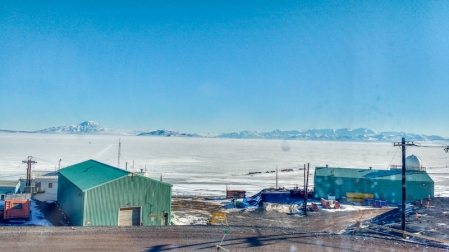
What does it look like? Just how cold is it? You can see a webcam image (and current temperature!) of McMurdo Station here. The webcam doesn’t do the view across the ice shelf justice, though.
Does the light ever change? It’s summer here, which means the sun never sets. It does move around in the sky, though, and shadows get long after dinner. I stayed up past midnight once, and the sun dipped near enough to the horizon to get that “alpine glow” on the far-off glaciers and the “golden hour” lighting like an hour before sunset.
Am I camping or what? Right now I’m stationed at McMurdo, which has indoor laboratory, dining, and dorm buildings. If you’re picturing small college dorm rooms with multiple people per room and a bathroom down the hall, you’re right on. Thursday I will fly about 45 minutes by helicopter to a field camp, where I will be living in a tent for the rest of November.
How is the food? Am I doing okay? (Yeah, that was my mom who asked.) The food is good. It’s a dining hall (“galley”). There are indeed vegetables and fruit. That said, everyone being inside a lot and eating out of the same galley, viruses go around like wildfire. I’ve been here less than a week and am already sick, despite using the handwashing stations outside the galley and the hand sanitizer on the tables religiously.
What the heck do I do all day here? So far, I have had days of briefings and meetings on safety and field logistics, things like how to safely approach a helicopter on a glacier and which directions storms come from at McMurdo. I have also been chasing down and checking over all the equipment for the field work and the lab work that we will need to use over the next three months, then organizing and repacking it. Every day has been different and new and exciting. And it will only get more different and new and exciting once we get to the field.
What am I doing here anyway? Studying microbial communities in cryoconite holes (which I liken to natural test-tube experiments)! You can see my previous post and also follow our research team’s blog for more details.
The last thing on my to-do list last week: fly to Antarctica. It wasn’t a metaphor or a joke.
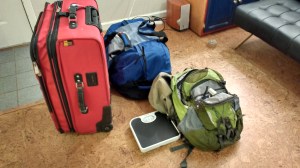
I was slightly concerned the evening before that not all my gear would fit in my bags, but it did!
Actually, I was only going to leave for Antarctica Friday. It will take me three to four days to get there (via New Zealand), so I won’t arrive “on the ice,” as they say, until Monday night Colorado time. I’m posting this from Christchurch, NZ, where I’m spending the day being issued cold weather gear from the US Antarctic Program (that classic red parka in all the pictures).
It’s still a little surreal that I’m really going. As a kid, I dreamed of running the Iditerod. I read all the books about the great race that I could find. But with climate change melting the course more and more every year, that started to look unlikely. About ten years ago, fresh out of college, I started applying to research technician jobs I saw advertised in Antarctica. I figured it was a long shot, though: if they didn’t already have someone in mind, there were probably hundreds (at least) of applications and even if I were qualified, it would be practically a lottery.
I fell in love with a hot desert instead for a time. I was thrilled that Peter Chesson agreed to advise my doctoral work, and I learned a tremendous amount in his lab and appreciated his support (and still do!). But at some point while counting seedlings in full sun at 115 degrees Fahrenheit, with the dark rocks burning through the soles of my shoes, I started to daydream about Antarctica again.
It was around then that Diana Nemergut first told me about cryoconite holes, ice-bound natural microcosm experiments in the glaciers of Antarctica. Her excitement was contagious, and I was interested in her research. When she offered me a position as a postdoc, I was was both honored and humbled, wondering if I could really contribute what she thought I would bring to the project.
Diana passed away at the end of last year. There’s not an easy way to say that. I barely knew her, especially compared to her long-time colleagues and her family, yet she was such an inspiring example of a scientist and a person and made such an impression on me in the short time I had to interact with her that even I miss her. She is certainly in my thoughts as I head to Antarctica, as she is often in the thoughts of her many friends.
I am also grateful to her collaborator Steve Schmidt for taking on the responsibility for the project and for adopting me and welcoming me into his lab. Some of you reading this may remember me talking last year about moving to North Carolina to work with Diana, and been confused when I instead wound up in Boulder. 2016 has so far been full of highs and lows, but above all it has been a year of many unexpected transitions and growth personally, geographically, and research-wise.
Despite the massive amounts of planning that have already gone into this upcoming field season (seriously, this is the best-planned field study I have EVER embarked on – and it could still change anyway due to field conditions), I am sure the rest of 2016 has the potential to set new high bars for unexpectedness and growth even in this year of transitions.
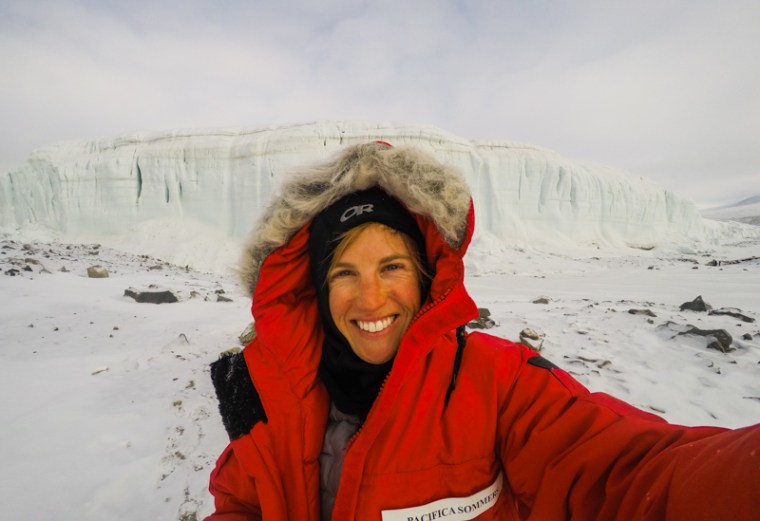
Can you see the simultaneous excitement and exhaustion in my face? Behind me are the iconic tree ferns of New Zealand in Christchurch’s botanic gardens. Listening to birdsong and being bathed in green light and bright blooming flowers helped me reset after about 30 hours of travel in buses and airplanes.
I’ll try to update this site regularly despite the limited bandwidth at McMurdo, and you can also follow progress from our team blog (cryoholes.wordpress.com), YouTube channel, and follow us on Twitter (@cryoholes).


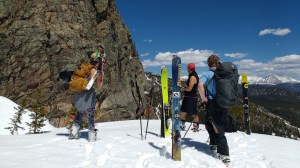 Last Saturday, I skied down my first backcountry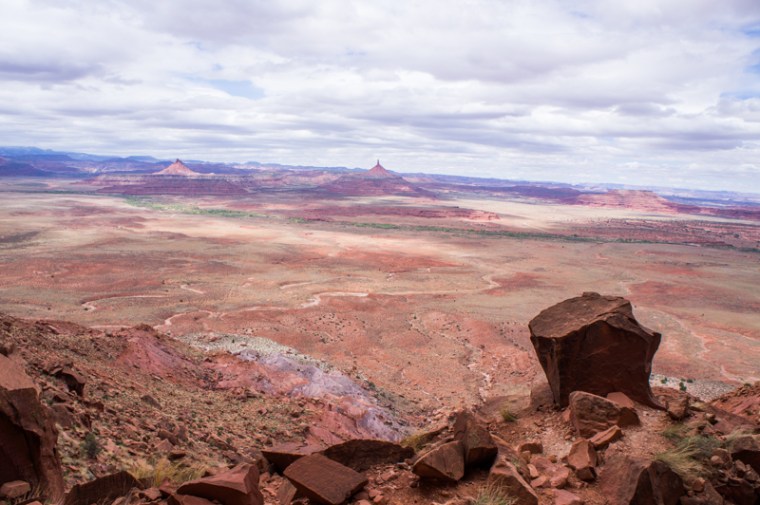


 “Which one of us do you think is older?” I asked the sixty or so fifth graders seated on the floor of their school library, in an elementary just outside Denver, CO. “Raise your hand if you think she is older.”






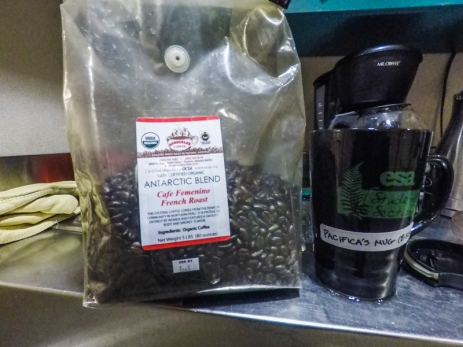 How is the food? Am I doing okay? (Yeah, that was my mom who asked.) The food is good. It’s a dining hall (“galley”). There are indeed vegetables and fruit. That said, everyone being inside a lot and eating out of the same galley, viruses go around like wildfire. I’ve been here less than a week and am already sick, despite using the handwashing stations outside the galley and the hand sanitizer on the tables religiously.

 Biologist. Explorer. Storyteller.