Biodiversity: the Blog

Quiz: What does The Green Rim refer to?

Answer: it depends. I had the great fortune to encounter two different, but spectacular, green rims in the last week.

If you are an astronomer, you might look for the green rim on the trailing (upper) side of the sun as it sets. It helps to be at high altitude on a clear day with a good set of binoculars. This green rim, which can be seen as a green flash reflected across the ocean as the sun sets over water, is a result of the way our atmosphere scatters light of different wavelengths. Scattering of light is also why the sky appears blue on earth. Shadows on Mars are red because their atmosphere scatters light differently.

Blue shadows in pink at sunset from the way our atmosphere scatters different wavelengths

After at least three tries at observing sunset with binoculars from the top of Mount Lemmon, last night I finally saw the green crescent that lasted for the final seconds as the sun sank below the horizon! I was at the Mount Lemmon Sky Center with a number of Tucson area science teachers and MLSC Director Alan Strauss. It was a fantastic night to observe the sky, animals’ tracks in the snow, and to explore future collaborations to bring more K-12 students up the mountain to observe these same things.

SONY DSC

Tucson area teachers get a look at Vega during the day on the Jamieson telescope. I hope their students soon can, too!

Speaking of snow, I believe that was the attraction that packed the highway to the top of Mount Lemmon yesterday. Mount Lemmon, one of an archipelago of Sky Islands, provides a taste of weather rarely experienced in the Sonoran Desert. Sky Islands are mountain peaks sporting environments, plants, and animals more expected in the Rocky Mountains or Canada than Mexico. The Madrean Archipelago of Sky Islands, a collection of mountain ranges whose diverse landscape provide a network of interconnected habitats for montane species, stretches from the Sierra Madres in the south to the Mogollon Rim in the north.

Everyone in Tucson seems to want to play in the snow! Tracking animals is much easier in snow, especially at certain times of day.

The Mogollon Rim creates a very different kind of Green Rim. This line across eastern central Arizona is the edge where the Colorado Plateau falls off into the Sonoran Desert. One week ago, I drove east and north on Highway 77 through the towns Show Low and Pinetop to ski in a foot of new powder at Sunrise Ski Resort. As we climbed in elevation, bare ground shrank as shrubs and grass cover increased. Saguaro cactus and agave were replaced with pinion pine and juniper trees, and, ascending into the mountains, taller, more majestic conifer forests.

As we ascended the Mogollon Rim toward the Colorado Plateau, the landscape became greener and whiter and colder!

The variable environments provided  by the Mogollon Rim, the Colorado Plateau and Sonoran Desert, and the archipelago of Sky Islands, increases the biodiversity of this spectacular region.

Cool perspective of the people benefiting from Starizona's generous donation of eyepieces for use on the Jamieson telescope at  the Mount Lemmon Sky Center.
Cool perspective of the people benefiting from Starizona’s generous donation of eyepieces for use on the Jamieson telescope at the Mount Lemmon Sky Center.

Entering the whispers of trees

The title comes from a poem written by a 13 year old hiker.

One of the most important investments I can in biodiversity being around in the future make is to share the fun, the memories, the games I played outdoors in the Salt Lake City foothills with kids growing up in a world dominated by video games and urban surroundings. So I volunteer with Sierra Club’s Tucson Inner City Outings, a nonprofit that takes kids hiking who might not otherwise have the chance.

One of our favorite things to do on any hike is five minutes (or even ten, or more!) of silence, spread out and listening and looking around like a wild animal. During a recent hike’s quiet time with ICO leader Deborah Vath, participants had the opportunity to record their experiences as poetry, which was published in the local Sierra Club chapter’s winter newsletter:

Poems by participants on an Inner City Outings hike with the Trekking Rattlers club.

We’ll have a far more diverse and beautiful world if every thirteen year old can let their mind enter the whispers of trees, like Julia.

Mammals among the Joshua Trees

I have always been fascinated by the Dr. Seuss-like Joshua Trees (actually a type of yucca!) of the Mojave Desert. Their twisting and contorting magnifies after they die and burn, curling up like enormous spiders writhing on the desert floor. The Mormon pioneers who named them must have been in dire straits emotionally to see something uplifting in their haunting forms.

After a burn in a Joshua tree forest in southern Nevada (2007)

Last week I spent four days camping in Joshua Tree National Park. I didn’t bring a tent, despite the bright full moon. I often get questions about whether I worry about the wildlife around me without a tent, so I brought my infrared game cameras (Bushnell Trophy Cams) along to see who visited our campsite while I lay blissfully unaware nearby. One was set up facing a sandy patch baited with oats in hopes of finding kangaroo rats, and the other above our picnic table to see who shared our dinner tastes!

Here’s who showed up to the party:


Sky Islands and Students

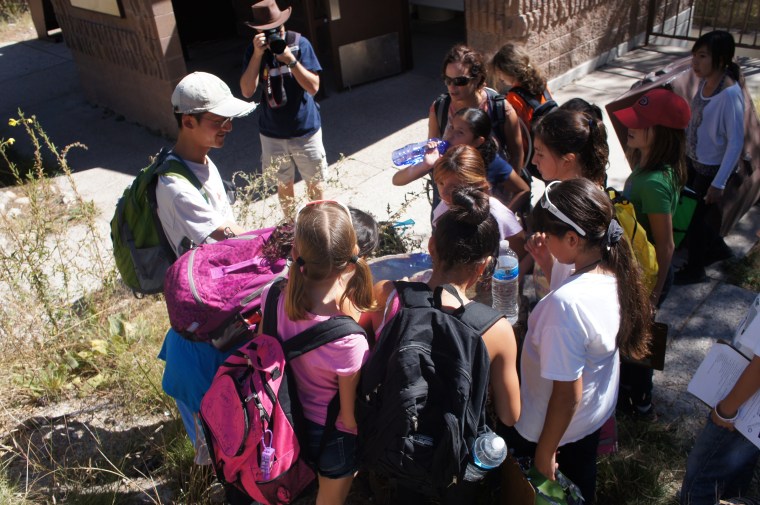
UA News covered some of the trips inspired by fellow grad student and blogger Ben Blonder, Mount Lemmon Sky Center Director Alan Strauss, and teachers at Inner City Outings that I have been helping to organize. You can read the story here. (One correction: the tree students are ringed around is a Douglas fir, not a pine!)

A few more photos from the interdisciplinary geology-ecology-astronomy trips we have taken 10-13 year olds on:

Peering through the Jamieson telescope, though eyepieces donated by Starizona

Contemplating rock formations at Windy Point with fellow grad student Yue “Max” Li

Counting tree rings at Middle Bear with Max