The title comes from a poem written by a 13 year old hiker.
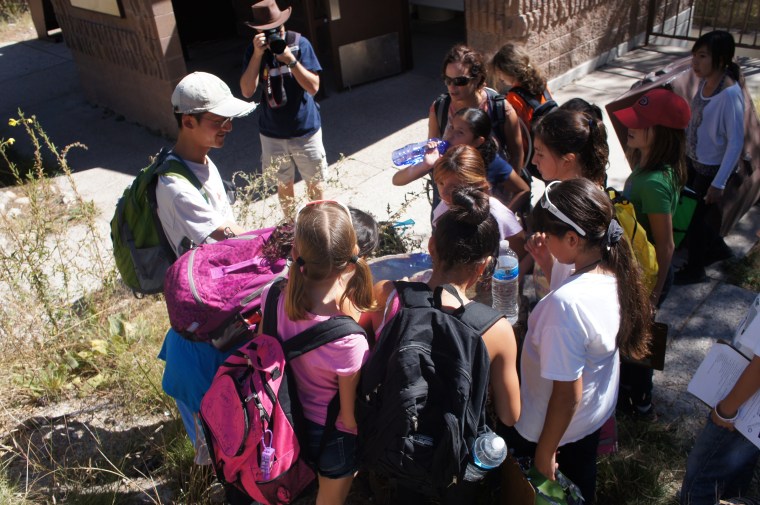
One of the most important investments I can in biodiversity being around in the future make is to share the fun, the memories, the games I played outdoors in the Salt Lake City foothills with kids growing up in a world dominated by video games and urban surroundings. So I volunteer with Sierra Club’s Tucson Inner City Outings, a nonprofit that takes kids hiking who might not otherwise have the chance.
One of our favorite things to do on any hike is five minutes (or even ten, or more!) of silence, spread out and listening and looking around like a wild animal. During a recent hike’s quiet time with ICO leader Deborah Vath, participants had the opportunity to record their experiences as poetry, which was published in the local Sierra Club chapter’s winter newsletter:
Poems by participants on an Inner City Outings hike with the Trekking Rattlers club.
We’ll have a far more diverse and beautiful world if every thirteen year old can let their mind enter the whispers of trees, like Julia.
I have always been fascinated by the Dr. Seuss-like Joshua Trees (actually a type of yucca!) of the Mojave Desert. Their twisting and contorting magnifies after they die and burn, curling up like enormous spiders writhing on the desert floor. The Mormon pioneers who named them must have been in dire straits emotionally to see something uplifting in their haunting forms.
After a burn in a Joshua tree forest in southern Nevada (2007)
Last week I spent four days camping in Joshua Tree National Park. I didn’t bring a tent, despite the bright full moon. I often get questions about whether I worry about the wildlife around me without a tent, so I brought my infrared game cameras (Bushnell Trophy Cams) along to see who visited our campsite while I lay blissfully unaware nearby. One was set up facing a sandy patch baited with oats in hopes of finding kangaroo rats, and the other above our picnic table to see who shared our dinner tastes!
Ever seen a newborn saguaro cactus, just days old? They are very picky about germinating, but I finally convinced some to come up in my growth chambers. I understand they are a preferred food of small rodents, so of course my fellow underground burrowing grad students wanted to try them as well. Cute, huh?
1-3 day old saguaro seedlings, germinated from fruit collected in June around my study plots on Tumamoc Hill
… and can you believe they grow into these monsters?
Researchers walk through a forest of saguaro cactus (Carnegea gigantea), with patches of bunch grass at their feet. Difficult to tell from the resolution of this photo whether the grass is native or an introduced invasive species.
I have been trying to catch rodents in the act of foraging for seeds or seedlings. Usually, I manage to position my trail cameras behind branches and get hundreds of videos of wind waving them. Or the batteries shift out of place and I get no videos at all (so much for being “rugged”). Or water gets through the weatherproof casing and the screen stops working (see comment on ruggedness…).
But my latest efforts to study seed removal by granivores (failed due to cloudbursts, but) yielded an infrared video of a big old packrat appearing to try getting into my experimental exclosures at the seeds inside – and seeming to fail! Score one for my methods?
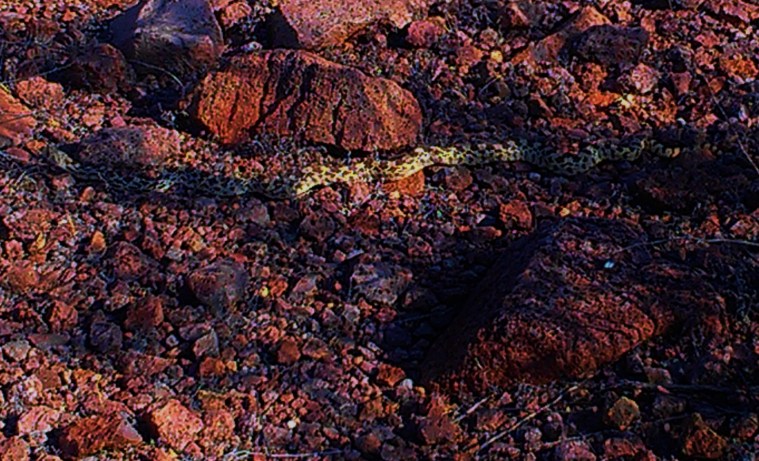
Once again, I saw two snakes on my way to check plots for seedlings at Saguaro National Park! This time, they were not venomous (at least, the first wasn’t, the second I’m not so sure), so I stopped to snap some photos with my cell phone (my good camera being too bulky for the trail run to the far plots).
Pretty sure this is a coachwhip (Coluber flagellum)
Dangerous or not, they seemed just to be cold and sunning themselves (snakes from other climates would laugh; it was “only” 80 degrees at that point, positively chilly here!), but still gave me a good shot of adrenaline when I came upon them suddenly.
A really terrible photo of a snake hanging out. Can you tell what it is? I’m still trying to ID it.
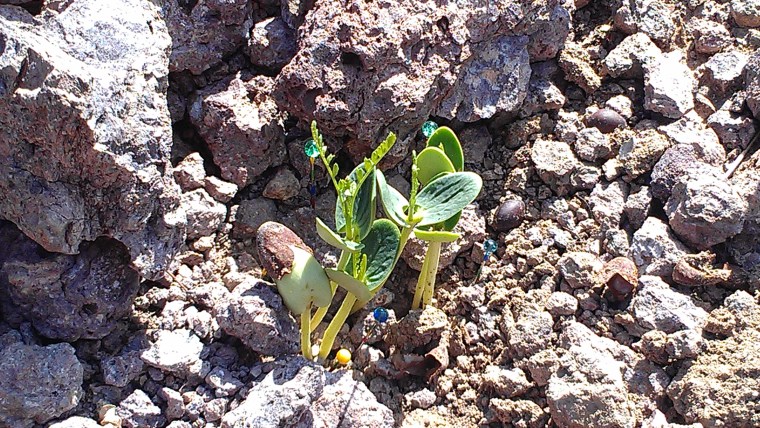
A wide diversity of seedlings has been germinating in the Tucson Mountains, where my research study sites are located, since the monsoon season got seriously under way 10 days ago. Watching the cryptic cotyledons flush out into cagey leaves has me playing plant detective. See how you do – which seedlings can you identify?
Are these two the same? One is just older than the other?These two lobed cotyledons might be a distinctive clue?
These you should recognize from a previous post, if not otherwise.
I posted in April about the sunbursts of palo verde trees (foothills PV: Cercidium microphyllum, syn. Parkinsonia microphylla, and blue PV: Cercidium floridum, syn. Parkinsonia florida) in full flower. These unique trees have green bark that photosynthesizes like leaves! Well, maybe not quite like leaves – I need to find out more about how they exchange carbon dioxide with the surrounding air. I bet the cells have a slightly different structure. Anyone reading this know?
These palo verde seedlings appear almost to glow in low light conditions like a rainstorm. I need to take my waterproof camera out with me soon to capture that!
Anyway, their seedlings germinated in force throughout the Tucson mountains last week, after a 4th of July celebratory rainstorm. These trees produce seed pods much like snow peas you grow in your garden, which is hardly surprising, given that they are in the pea family, and which are edible and taste like peas, but nuttier. Tiny beetles lay their eggs in many seed pods, then hatch out and eat the seeds. They may claim a quarter to a half of the seed crop, according to the seeds I collected and observed beetles hatching from (several thousand seeds from three sites).
The seeds that survive the beetle onslaught are often in pods with siblings, so groups of up to five of these enormous, luminous, hilarious looking seedlings have been germinating in hollows throughout the volcanic slopes of the Tucson foothills. Consider five small seedlings in a space smaller than one tree. Only one can survive long enough to reproduce, clearly. So does this hedge the tree’s bets, or reduce the vitality of all the seedlings? Do trees that produce seeds in pods of 1-2 seeds do better than those dropping pods of four seeds at a time? These would be some interesting questions to investigate.
I have noticed a number of them disappearing, but not as many as I might imagine if the plentiful desert cottontails or ground squirrels were eating the juicy-looking cotyledons. I have game cameras deployed in the foothills, and I am wondering: where do these seedlings go?
It’s like something out of The Amazing Spiderman: as if scorpions weren’t cool (or scary) enough, if you shine a black light on them at night, they glow bright green.
I photographed this scorpion at Organ Pipe National Monument’s group campsite in late May, during the Ecology and Natural History field course. It’s too large to be an Arizona bark scorpion (the most dangerous one in North America), but we did not identify what it was. Regardless, several people slept in cars that night. (I slept on the ground in my sleeping bag as usual… seeing one didn’t change the fact I knew they were around.) Turns out that green glowing, caused the the black light we’re shining on it, means it’s detecting that light with its whole body!
Why? Douglas Gaffin and his fellow scientists in Oklahoma did some experiments with blindfolding scorpions (yikes), then shining lights on them, and watching their responses. They showed that the scorpions reacted to UV light as though the whole rest of their body (the cuticle or outer shell) were detecting the light! You can check out a colorful poster of their findings, or if that’s too dense, read a news article summarizing it.
You ever wonder what animals are doing when you’re not around? I did. Especially what they thought of some little structures I’m using for my field experiments this summer. So I set up some Bushnell TrohpyCams by a few structures to see who came by and what they wanted. There are some peanut butter coated oats near the cages as bait. There were also track pads, which some folks at Saguaro National Park were awesome enough to lend me….. but monsoon season is unpredictable, and a cloudburst wiped all the chalk off my tracking plates before I could get to them. Here are a couple of fun ones.
I love that at the end of the second one, the desert cottontail rolls in the dirt, much like my roommate’s cat.








 Biologist. Explorer. Storyteller.